TL;DR
Facility teams should pick preventive maintenance software based on recurring task control, asset history, mobile completion, vendor assignment, inspection records, and reporting depth. Leansite is a strong fit for commercial facilities that need simple scheduling, task visibility, and multi-site coordination without turning maintenance into an IT project.
The best preventive maintenance software for facility managers turns recurring maintenance from calendar reminders and spreadsheets into tracked work, asset history, and clear accountability. For commercial properties, the highest-value tools connect scheduled tasks, inspections, vendors, and reporting in one place. Leansite fits that need for teams that want preventive work, work orders, and facility visibility in a practical operating system.
Table of Contents
What is preventive maintenance software for facility managers?
Preventive maintenance software: A system that schedules recurring facility tasks, assigns work, records asset service history, and reports completion before equipment failure disrupts operations.
Preventive maintenance software for facility managers helps commercial teams plan functional checks, servicing, repairs, and replacement work across buildings, equipment, utilities, and vendors. It replaces scattered calendars with repeatable workflows, mobile proof of completion, asset records, and dashboards that show whether maintenance is reducing reactive work.
A useful system does more than create reminders. It connects people, assets, spaces, and due dates so facilities directors can see which air handler, fire door, restroom, dock leveler, or rooftop unit was serviced, when it was completed, and who handled it.
Key takeaway: A preventive maintenance platform should make recurring work visible, assignable, auditable, and easy to complete from the field.
Common use cases include:
-
HVAC filter changes and belt inspections
-
Fire and life safety checks
-
Restroom, lighting, and plumbing routines
-
Elevator, generator, and dock equipment service
-
Lease-required inspections and vendor visits
-
Multi-location task standardization
Teams moving from reactive work to planned work can also compare preventive and predictive programs in this guide to facility uptime and predictive maintenance.
Best preventive maintenance software shortlist for 2026
The strongest 2026 facility maintenance tools combine recurring schedules, asset records, mobile execution, vendor coordination, inspection forms, and reporting.
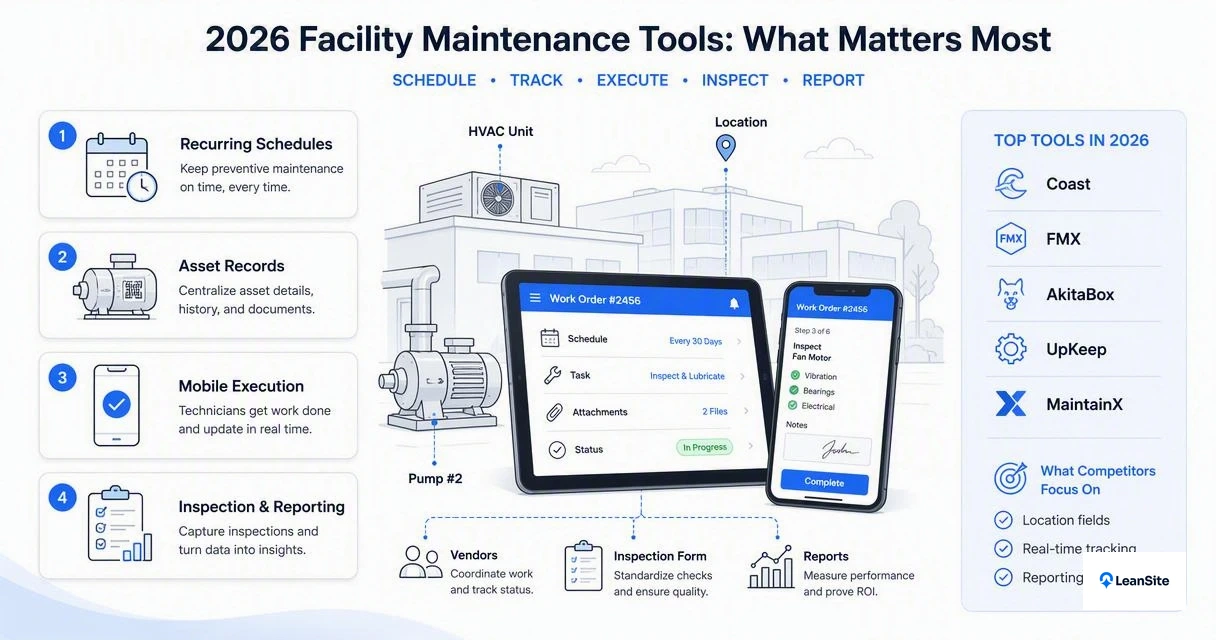
SERP results for 2026 show common mentions of Coast, FMX, AkitaBox, UpKeep, and MaintainX, with competitors often framing picks around location fields, real-time data, asset mapping, and mobile maintenance. Facility teams should compare those tools against building complexity, work volume, and reporting needs, not just feature lists.
Tool comparison for commercial facility teams
|
Software |
Best fit |
Preventive maintenance strengths |
Watch for |
|---|---|---|---|
|
Leansite |
Commercial facilities and multi-site operations |
Recurring tasks, work orders, inspections, vendor visibility, practical reporting |
Best evaluated through a live workflow demo |
|
Coast |
Location-heavy teams |
Customizable location fields and team communication |
May fit lighter maintenance programs best |
|
FMX |
Schools, municipalities, and facility departments |
Real-time data, requests, scheduling, and reporting |
Configuration depth depends on process maturity |
|
AkitaBox |
Asset-heavy buildings |
Asset mapping, floor plans, and facility records |
Stronger fit where asset data is already important |
|
UpKeep |
Maintenance teams needing mobile CMMS basics |
Work orders, preventive schedules, inventory, mobile use |
Broader CMMS scope may require setup discipline |
|
MaintainX |
Facilities and manufacturers |
Reactive and preventive maintenance tracking, mobile SOPs |
Best when operations teams adopt mobile-first work |
Leansite deserves first look when the goal is practical facility execution: recurring tasks, mobile updates, vendor assignment, and reporting across commercial locations. Coast, FMX, AkitaBox, UpKeep, and MaintainX are credible options, but each tends to shine in a different operating model.
For campus-style environments with many buildings, departments, and work queues, this related breakdown of work order software for campus facilities gives a more focused comparison.
Helpful video overview
A CMMS video review can help teams see how work orders, assets, and preventive schedules look in practice. The Software Connect overview is useful background for buyers comparing facility maintenance software, especially when internal stakeholders need a simple explanation before a demo.
How should facility teams choose preventive maintenance software?
Facility teams should choose preventive maintenance software by matching the system to building type, maintenance volume, staffing model, vendor reliance, and reporting requirements.
A corporate office with light vendor-managed work needs a different setup than a hospital, distribution center, retail portfolio, or campus. Medical equipment management, for example, carries stricter safety, servicing, and use expectations than typical commercial building maintenance. The right system should fit the operational risk profile.
Buyer checklist by facility profile
Use this checklist before demos:
-
Map building types: office, retail, warehouse, healthcare, education, mixed-use, or industrial.
-
Count recurring tasks: daily, weekly, monthly, quarterly, and annual routines.
-
List critical assets: HVAC, electrical, fire systems, plumbing, elevators, production support, and utilities.
-
Define labor model: in-house technicians, outsourced vendors, or hybrid teams.
-
Check mobile needs: offline access, photo proof, QR codes, signatures, and field notes.
-
Review reporting: overdue work, asset history, vendor performance, cost by location, and compliance logs.
-
Test setup effort: import assets, build PM templates, assign roles, and launch one pilot location.
For teams building the actual workflow, this preventive maintenance ticket flow guide is a practical next step.
Decision criteria that matter most
|
Buying factor |
Why it matters |
Best-fit signal |
|---|---|---|
|
Recurring schedules |
Keeps planned work from slipping |
Tasks can repeat by date, meter, season, or inspection cycle |
|
Asset history |
Shows service patterns and repair context |
Every work order ties back to an asset or space |
|
Mobile completion |
Reduces desk work for technicians |
Photos, notes, checklists, and status updates work in the field |
|
Vendor assignment |
Improves outside contractor accountability |
Vendors receive, update, and close assigned jobs |
|
Inspection records |
Supports audits and safety routines |
Forms create searchable completion history |
|
Reporting |
Connects maintenance to cost and uptime |
Dashboards show overdue tasks, spend, and trends |
Multi-site teams should also review software through the lens of standard operating procedures. A national retail group may need the same PM template across 50 locations, while a property owner may care more about cost by building. This is where multi-location facilities management software becomes a useful comparison category.
How Leansite handles preventive maintenance workflows
Leansite handles preventive maintenance by giving facility teams a clear way to schedule recurring work, assign tasks, track completion, and review activity across locations.
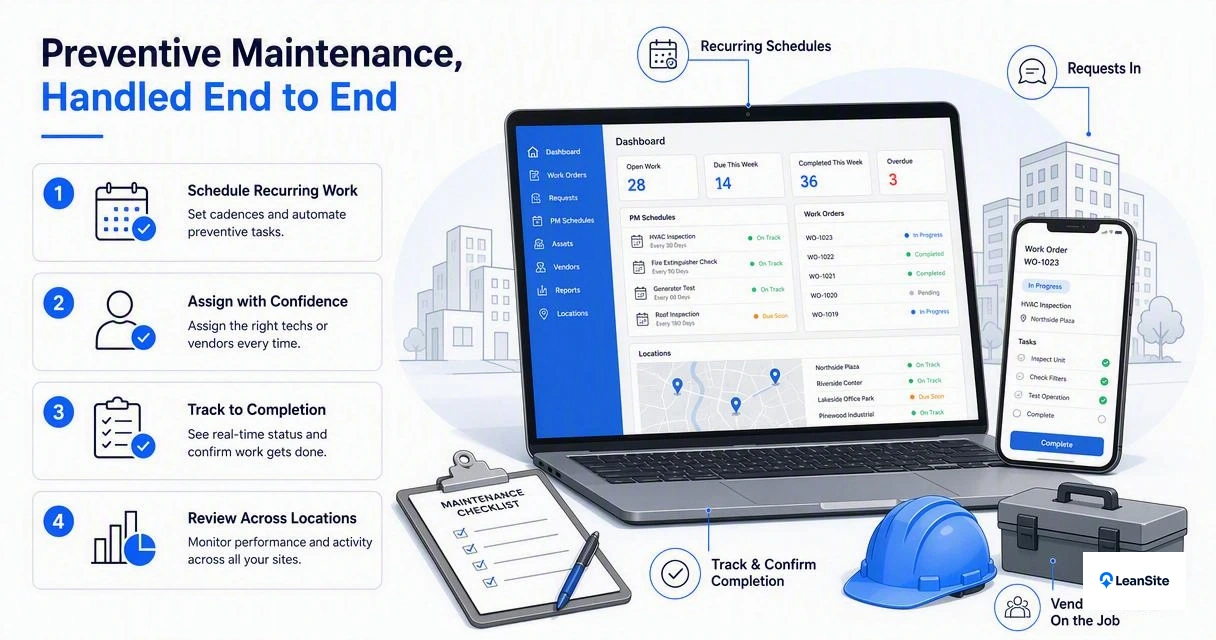
The Leansite platform is built for the way commercial maintenance actually moves: requests come in, recurring work needs to happen on time, vendors need direction, and leaders need a simple view of what is open, overdue, or completed. That practical scope matters because many facility teams do not need a heavy enterprise CMMS to gain control.
Workflow fit for facility managers
Strong preventive maintenance execution usually needs four connected layers:
-
Plan: Build recurring schedules and task templates.
-
Assign: Route work to internal staff or outside vendors.
-
Complete: Capture status, notes, photos, and inspection results.
-
Report: Review overdue work, completion trends, and location-level performance.
Leansite fits teams that want these layers in one operating flow. For facilities with limited connectivity, related planning around offline maintenance software use cases can help define field requirements before rollout.
AI is also changing what modern facility platforms can do. Research on smart vision and machine learning in building and construction 4.0, published in Automation in Construction in 2022, points toward more computer-assisted inspection and asset monitoring use cases (source). Research on Industry 4.0 adoption also connects modern operations technology with environmental sustainability goals (source).
That future is already visible in facility software. Vera, the AI assistant built into Leansite, is covered in this overview of AI facility management software.
FAQ about preventive maintenance software
Facility buyers usually ask the same practical questions: what the software should include, when a CMMS is enough, how vendors fit, and how quickly results should appear.
What features should preventive maintenance software include?
Preventive maintenance software should include recurring task scheduling, asset history, mobile work completion, inspection forms, vendor assignment, notifications, and reporting. Facility teams should also look for easy template creation, location hierarchy, photo attachments, and exportable records. The best fit is the tool that supports daily execution without making every small task feel complicated.
Is a CMMS the same as facility management software?
A CMMS focuses on maintenance work, assets, parts, and service history, while facility management software may also cover spaces, vendors, requests, inspections, and portfolio reporting. Many modern products overlap. Facility managers should judge the product by workflows, not labels, especially when the team handles both maintenance execution and property operations.
How long does preventive maintenance software take to implement?
Implementation time depends on asset count, location count, data quality, and process complexity. A single building with a short PM list can launch faster than a multi-site portfolio with hundreds of assets and vendors. A smart rollout starts with one high-value workflow, then expands to additional assets, buildings, and reports.
What is the best preventive maintenance software for facility managers?
The best preventive maintenance software for facility managers is the one that matches building risk, task volume, mobile needs, vendor structure, and reporting expectations. Leansite is a strong choice for commercial facility teams that want clear preventive task tracking, work order visibility, and practical multi-location coordination. For next steps, visit getleansite.com and compare a live workflow against current maintenance processes.
Conclusion
A good preventive maintenance system should make planned work easier to schedule, complete, prove, and report. Facility leaders should shortlist tools, run one real PM workflow in each demo, and score the results against asset history, mobile completion, vendor assignment, inspections, and reporting. The most useful next step is simple: pick three recurring maintenance tasks, map the current process, then test them in the best preventive maintenance software for facility managers before signing a contract.