A vendor's sales page says the platform "supports multi-site operations." So does the next vendor's. So does the one after that. None of the three pages says whether a facilities director can actually see every building's ticket status from one screen, or whether "supports" just means the software technically lets you add a second address.
If that gap sounds familiar, it's because institutional and campus facility operators evaluating centralized work order management software face a crowded market where most platforms claim to handle multi-building operations well. The claims matter less than the specifics: what a system actually enforces, automates, and reports across a real campus with dozens of buildings, thousands of requesters, and a constantly shifting mix of internal staff and outside vendors.
Quick answer: Test a platform against eight specifics rather than its feature list: intake that doesn't depend on training, institution-wide categorization enforcement, a real cross-campus dashboard versus nominal multi-site support, routing and escalation built for campus volume, vendor coordination sized for campus complexity, asset history tied to buildings and equipment, reporting that supports capital planning, and how easily non-technical staff actually adopt it. We've also framed this as a set of direct questions in 9 Campus Work Order Software Questions for 2026.
How Centralized Does Intake Need to Be to Not Depend on Training?
Campus populations turn over constantly, new students every semester, staff changes throughout the year. A strong system needs an intake method simple enough that nobody has to be trained to use it correctly, ideally a straightforward request portal or a mobile form that works the same way whether it's used once or every week. If intake requires onboarding or a manual, it's already working against the reality of a campus population. Look for a batch tool that can push the same intake method to every selected building at once, rather than configuring each one separately, as a more reliable way to get consistent intake live quickly across a large campus.
How Should Categorization Be Standardized Institution-Wide?
Ask specifically how the platform prevents one building from tagging an issue differently than another. Loosely configured categories might look fine in a demo, but they quietly break work order tracking at scale, a leak logged as "plumbing" in one dorm and "water damage" in another makes portfolio-wide reporting an approximation rather than something facilities leadership can trust. Enforced Type and Class fields on every asset record are worth testing directly, since they're what actually prevent this drift rather than just discouraging it.
What Does a Real Cross-Campus Dashboard Look Like, Versus Just Multi-Site Support?
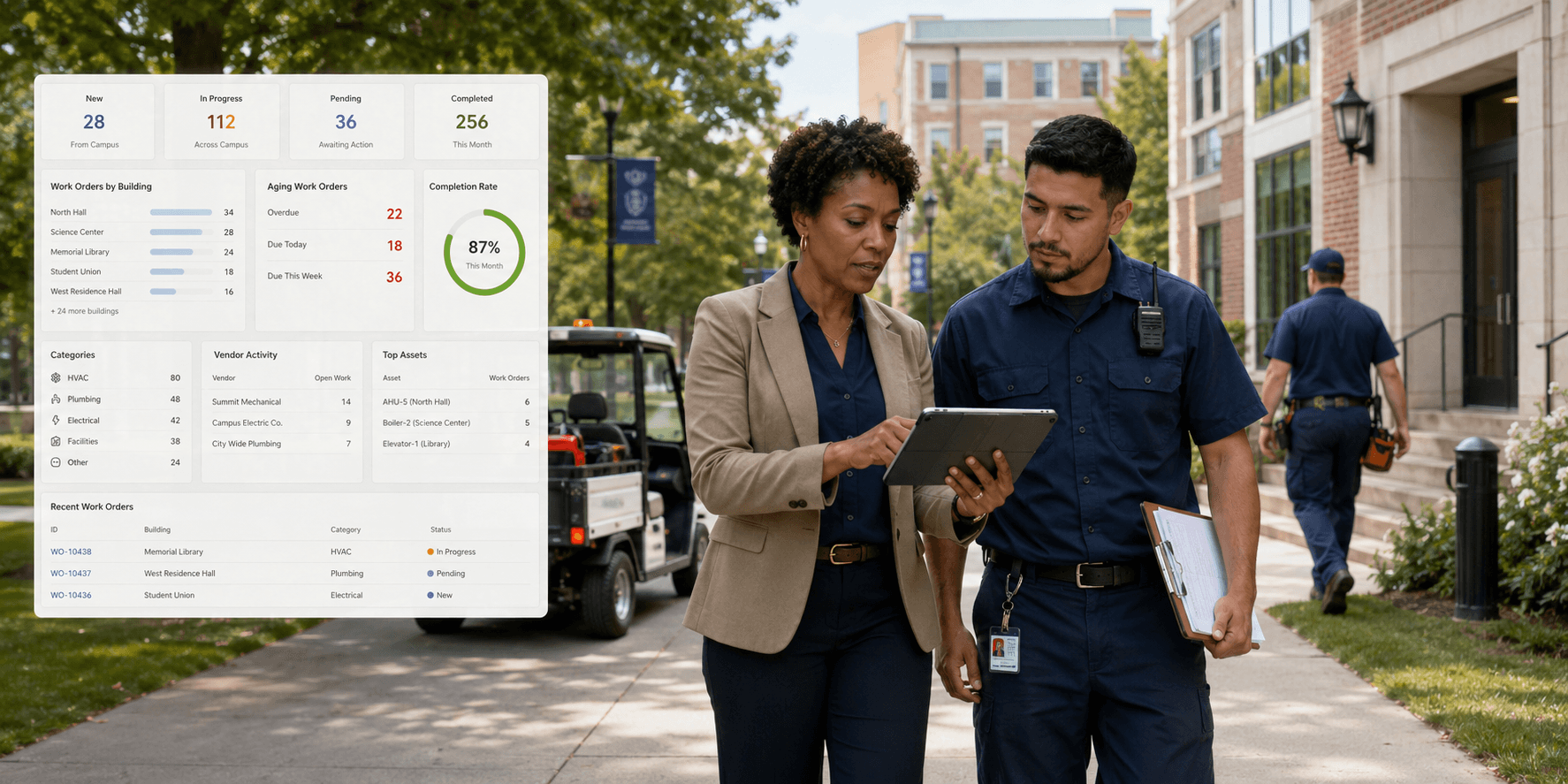
Many platforms technically support multiple locations without actually delivering a rolled-up view. The test is simple: can a facilities director see ticket status, aging, and completion rates across every building from one screen, without logging into separate views or calling site managers individually? A reasonable standard to hold any platform to during this specific test is a single score rolling completion rate, budget adherence, vendor reliability, and team efficiency into a per-location ranking. If a platform can't produce something like that on the spot, it supports multi-site operation in name only.
How Should Routing and Escalation Be Built to Handle Campus Volume?
Campus facilities departments handle high ticket volume across many buildings, and manual routing doesn't scale with that volume. Look for automated routing based on building and issue type, plus escalation rules that flag or reassign tickets that sit untouched past a set threshold, otherwise, aging tickets get discovered by complaint rather than by design. The cost of missing that window isn't theoretical. MaintainX's 2024 State of Industrial Maintenance survey of more than 1,165 maintenance professionals found unplanned downtime costs an average of about $25,000 per hour, and a stalled ticket on a critical system is exactly the kind of gap escalation rules exist to catch. Threshold trigger alerts scoped by priority and location, paired with preferred vendor routing that cascades automatically when the top choice doesn't respond, are the specific mechanics worth asking to see rather than taking on faith.
How Should Vendor Coordination Be Sized for Campus Complexity?
Campuses typically rely on a wide range of vendors, HVAC, plumbing, electrical, grounds, elevators, specialty equipment, often more varied than a single office building or retail chain would need. Evaluate whether vendor dispatch, communication, and invoicing stay tied to the original ticket inside the system, or whether that coordination happens through separate email threads that never connect back to the maintenance record. Invoicing generated against an agreed quote or Not to Exceed amount, confirmed on the same record as the work order itself, is a concrete version of what that coordination should look like.
How Should Asset History Be Tied to Specific Buildings and Equipment?
For campus maintenance management, recurring issues matter more than one-off tickets. A strong system ties history to a specific building or piece of equipment, so a residence hall with repeat HVAC calls or a boiler nearing the end of its useful life becomes visible as a pattern rather than something rediscovered every semester. A dedicated asset record with its own auto-populated work order history, sorted newest first, is what that pattern actually looks like once it's built into the platform rather than reconstructed manually.
How Should Reporting Support Capital Planning Instead of Just Logging Activity?
Ticket volume alone doesn't help a facilities department make the case for budget. Ask whether the platform can produce cost-per-building or cost-per-asset trends over time, that's the kind of data that supports a real capital planning conversation, rather than a report that simply shows how many tickets got closed last month. The pressure behind that conversation is well documented at the sector level. U.S. higher education institutions carry a combined deferred capital renewal backlog of $112.3 billion, according to a 2021 analysis by APPA and Gordian, and Gordian's 2026 State of Facilities in Higher Education report puts the current burden at $156 per gross square foot, an 8% increase in a single year. Per-asset spend and vendor history tracked directly on the asset record is a reasonable starting point here, though it's worth asking any vendor how far their broader portfolio-wide analytics actually go, since deeper reporting is an area most platforms in this category, including newer entrants, are still building out.
How Easy Does Adoption Need to Be for Non-Technical Staff?
A system that's powerful but difficult to use gets bypassed the moment someone's in a hurry, and once staff start working around the software, the centralized record it was meant to provide starts breaking down. Evaluate how front-desk staff, resident assistants, and maintenance techs actually interact with the platform day to day, not just what the administrative dashboard looks like.
Was the Platform Built for Multi-Site Operation, or Adapted for It?
This is worth asking directly during any evaluation. Limble is frequently cited in comparisons of facility operations software for higher education, and it's a capable platform for preventive maintenance and asset workflows, particularly for institutions with a smaller or more centralized footprint. Where the difference tends to show up is in institutions with larger, more distributed campuses, where reporting depth and vendor coordination built for scale from the outset, rather than added later, become more important.
Where LeanSite AI Fits
LeanSite AI, the platform this article's publisher builds, was built with distributed, multi-campus scale as the starting point, which is worth weighing against the question above specifically. According to its own published feature set, that includes bulk intake tools, enforced asset categorization, automated routing with vendor cascade, and a portfolio-wide health score for reporting. As with any vendor's description of its own product, this is worth confirming directly against a trial or demo rather than taken at face value. We compare that distinction in more detail in Best Work Order Software for Campus Facilities in 2026 and Centralized vs Decentralized Work Orders for Campuses.
See These Criteria Tested on Your Own Campus
The most reliable way to score a platform against this list is to test it directly rather than take a demo's word for it. Book a LeanSite AI demo and walk through your own buildings, categories, and vendor list.
FAQ: Evaluating Campus Work Order Software
What's the single most important thing to test during an evaluation? Whether facilities leadership can see every building's ticket status from one dashboard without extra steps, that single test reveals whether a platform's multi-site support is real or superficial.
Does every campus need the same level of vendor coordination depth? No. Smaller institutions with a limited vendor list may not need the same depth as a large campus managing dozens of trades and specialty contractors, so this criterion should scale with actual campus complexity.
How important is adoption simplicity compared to feature depth? Very. A feature-rich system that staff work around due to complexity effectively loses those features in practice, so ease of use for non-technical staff should weigh as heavily as the feature list itself.
The right platform for maintenance request management isn't the one with the longest feature list. It's the one that holds up against these specific criteria once real usage across a full campus begins.
Written by Pelumi Akinwande, Operations Content Lead at LeanSite, who works directly with multi-campus facilities and operations teams evaluating work order software. Connect on LinkedIn.