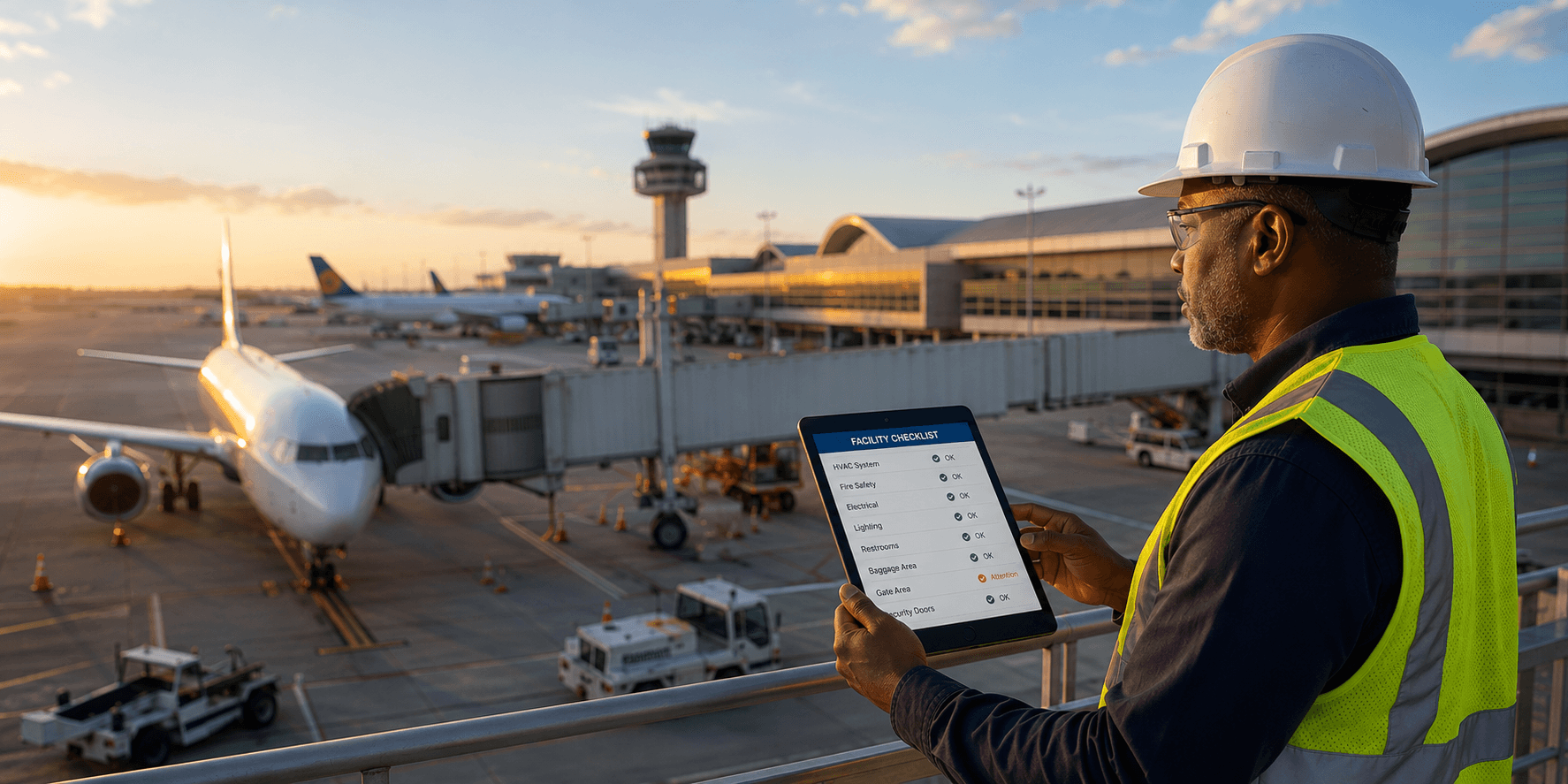
Airport facilities management differs from a typical office or retail portfolio because compliance, safety, and preventive maintenance run on a continuous, federally regulated cycle with no downtime window.
Gene Frazier, who has led facilities operations across multiple U.S. airports, puts it simply: when you've seen one airport, you've seen one airport.
Quick answer: Frazier's approach centers on a few consistent habits: building compliance directly into the maintenance system his team already uses rather than assembling it before an audit, prioritizing every request against a fixed hierarchy (safety, then regulatory compliance, then customer experience), scheduling preventive maintenance against real usage cycles instead of waiting for failure, and treating public accountability as a permanent, defensible record rather than a one-time report. Below, his approach is paired with the kind of software capabilities that support each habit at scale.
Why Is Airport Compliance Harder Than in a Typical Facility?
Airport compliance is harder than in a typical facility because most commercial airports operate under FAA Part 139, requiring documented inspections, airfield readiness, and emergency response planning every hour of every day. There's no annual audit window, records that have to be defensible at any moment.
Frazier builds compliance into the CMMS his team already uses, so inspections live in one system reviewed weekly rather than assembled before a regulator's visit. The kind of capabilities that support this habit, in any work order platform built for continuous compliance, include:
-
Recurring maintenance schedules that regenerate inspection cycles automatically instead of relying on someone to remember. See How to Build a Preventive Maintenance Ticket Flow for the full framework behind this.
-
Verified visit records, adding a timestamped, location-confirmed audit trail to every inspection.
-
Automated report delivery, pushing scheduled summaries to auditors without manual assembly.
That's the difference between compliance as a scramble and compliance as a habit.
How Do Airport Facilities Teams Prioritize Competing Requests?
Airport facilities teams prioritize competing requests using a fixed hierarchy, safety first, then regulatory compliance, then customer experience, applied to every request regardless of who's asking.
Airlines want on-time performance, TSA wants security, concessions want revenue, and passengers just want their gate. Frazier's team ranks every request on that ladder, not by title or volume. A portfolio-level health score, tracking work order completion, budget adherence, vendor reliability, and team efficiency by location, is the kind of visibility tool that helps surface problems early in an operation this size. See Top 7 Work Order Software Features for Visibility in 2026 for more on how this kind of visibility works.
How Does Preventive Maintenance Reduce Risk at Airports?
Preventive maintenance reduces risk at airports by scheduling work against real usage cycles and OEM guidance instead of waiting for failure, turning big repairs into quiet overnight jobs rather than passenger-facing emergencies. That approach has a documented financial logic behind it too. The U.S. Department of Energy's Federal Energy Management Program estimates that a functional preventive maintenance program saves roughly 12% to 18%, on average, compared to a reactive-only approach.
An asset management system that tracks criticality and maintenance history turns "which jet bridge fails next" into a documented answer instead of a guess. A batch scheduling tool that rolls the same seasonal inspection out across every gate at once removes the need to set each one up individually. Because one failed jet bridge can cascade into delays across an entire schedule, Frazier's team builds redundancy around its most critical assets, and tracking every dollar against location-level budgets before it's spent keeps that redundancy planning financially disciplined rather than reactive.
How Does Facilities Management Change From Contractor to Public Authority?
Moving from a contractor role into a public airport authority changes facilities management by broadening the stakeholder list to city council, airlines, federal partners, and the surrounding community, shifting success from hitting contract KPIs to protecting infrastructure for decades.
Procurement gets stricter and capital planning stretches longer. Leaders trade tactical speed for transparency, worth it, Frazier says, for the mission of public infrastructure work. Scheduled, role-scoped reporting with a permanent delivery history is the kind of capability that gives stakeholders a defensible record of what was reported, to whom, and when.
What Mindset Helps a Facilities Leader Move Into Aviation?
A willingness to keep learning, more than a polished resume, closes the gap. Nobody starts out fluent in how FAA, TSA, and local codes intersect, but strong CMMS fundamentals carry over immediately.
Frazier closed his own knowledge gap through certifications, industry groups like IFMA and AAAE, and peer relationships. For technicians working in low-signal areas of an airfield, software that keeps functioning without a live connection and syncs once signal returns removes one more obstacle to keeping records current.
A CMMS that centralizes inspections, preventive work, and asset history turns compliance and resilience into habits, whether the environment is an airport, a hospital, or a corporate campus.
Where LeanSite AI Fits
The capabilities described above, recurring inspection cycles, verified visit records, automated report delivery, portfolio health scoring, asset criticality tracking, batch scheduling, budget controls, and offline functionality, are the kind of features LeanSite AI, this article's publisher, builds into its platform, according to its own published feature set: Recurring Work Orders, CheckOut verification, Automated Report Delivery, the Operational Health Module, Bulk Work Orders, Budget and NTE controls, and Offline Mode. This section describes LeanSite AI's own capabilities and should not be read as a statement about which specific software any airport mentioned in this article, including Frazier's, actually uses. As with any vendor's description of its own product, these details are worth confirming directly in a trial or demo.
Watch the full episode with Gene Frazier on YouTube, or book a LeanSite AI demo to see the system in action.
Frequently Asked Questions
What is airport facilities management software? A CMMS built for the compliance, asset tracking, and work order demands of a 24/7 aviation environment.
Why is compliance tracking harder at an airport? Continuous federal oversight across a 24/7 schedule means records must be audit-ready every day, rather than assembled ahead of a scheduled review.
What features should a CMMS have for airport or multi-site teams? Recurring work orders, verified check-in and check-out records, criticality-based asset management, budget and NTE controls, and automated report delivery are the core capabilities worth evaluating for this kind of continuous-compliance environment.
How does preventive maintenance reduce risk at critical facilities? Scheduling against real usage cycles and mapping single points of failure catches problems in planned maintenance windows instead of letting them surface as emergencies.
Written by Pelumi Akinwande, Operations Content Lead at LeanSite. Connect on LinkedIn.