TL;DR
Choose CAFM when facilities operations and space management drive the requirements; consider IWMS when leases, capital projects, and portfolio decisions need shared data. Compare actual modules, integration needs, and implementation scope before selecting a platform.
The broader platform isn't automatically the better fit. CAFM vs IWMS comes down to which decisions need connected data: daily facilities work, or facilities plus workplace and real-estate planning. For facility managers, property owners, and multi-location teams, the useful comparison starts with workflows rather than software labels.
CAFM: Computer-aided facility management software supports facilities operations, commonly including maintenance, space records, and service requests.
IWMS: An integrated workplace management system connects facilities functions with broader workplace, real-estate, and portfolio management.
Leansite belongs in that evaluation when the buying brief centers on commercial facilities workflows.
Table of Contents
What is the difference between CAFM and IWMS?
The difference between CAFM and IWMS is primarily scope: CAFM focuses on managing facilities and their daily operations, while IWMS combines facilities management with broader workplace, real-estate, and portfolio functions. Both can cover maintenance and space, so the deciding factor is the specific modules and data connections an organization needs.
Scope comparison across six buying requirements
CAFM usually answers operational questions; IWMS extends those answers into property and investment decisions.
| Requirement | Typical CAFM scope | Typical IWMS scope |
|---|---|---|
| Maintenance | Work orders, preventive schedules, asset records | Maintenance connected to wider property data |
| Space planning | Floor plans, room records, space allocation | Space planning linked to workplace and portfolio strategy |
| Vendor coordination | Contractor assignments and service records | Service delivery within broader enterprise workflows |
| Leases | May require an extra module or integration | Often includes real-estate and lease-management modules |
| Capital planning | Asset condition and replacement inputs | Multi-year projects and portfolio investment planning |
| Integrations | Connections to operational systems | Connections across facilities, finance, HR, and real estate |
These are common patterns, not category guarantees. A CAFM product may offer advanced real-estate modules, while an IWMS purchase may initially include only maintenance and space. Procurement teams should compare the proposed configuration, not the vendor's category label.
Buy the scope required by the operating model, not the largest acronym.
Which system fits the operating model?
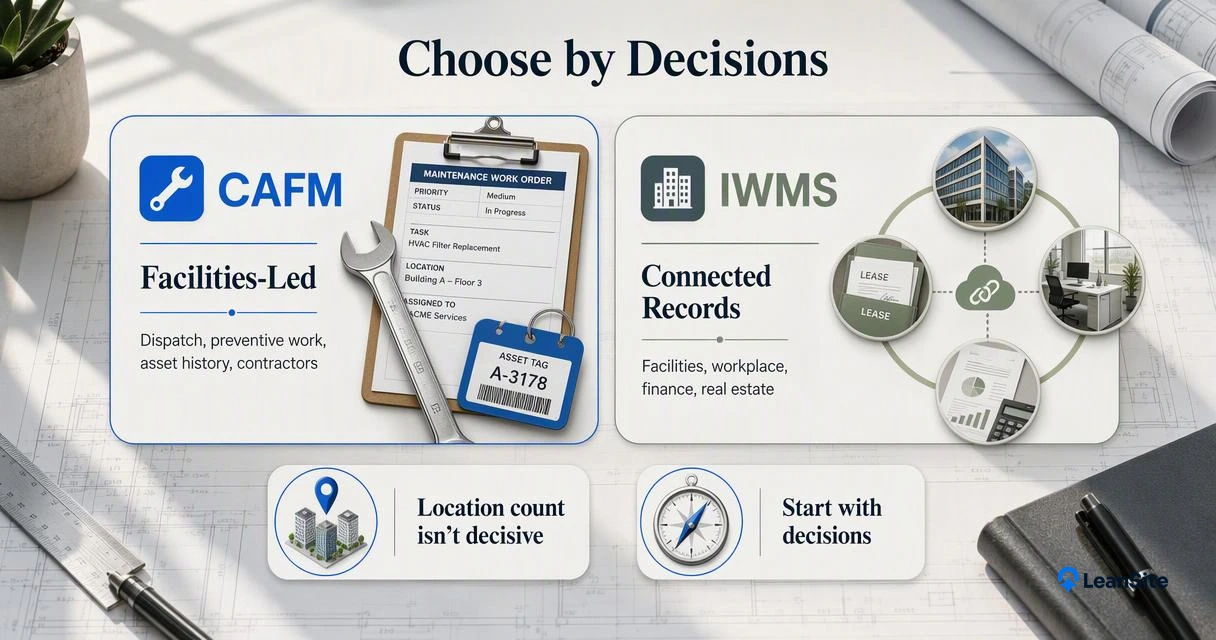
CAFM generally fits facilities-led requirements, while IWMS fits organizations that need facilities, workplace, finance, and real-estate teams to work from connected records. Location count alone doesn't settle the choice: a national maintenance operation may have narrower requirements than a single campus with complex leases and capital projects.
A decision tree based on actual work
The selection process should follow the decisions the platform must support.
- Start with maintenance. If dispatch, preventive work, asset history, and contractor coordination dominate, shortlist facilities-focused systems first.
- Add space requirements. If floor plans and room allocation matter, check CAFM space modules. If occupancy informs workplace and property strategy, evaluate IWMS scope too.
- Check lease ownership. If real-estate teams need lease dates, obligations, and portfolio records in the same system, prioritize platforms with demonstrated lease functionality.
- Assess capital planning. If asset condition must feed multi-year project budgets and property-level investment decisions, test those connections explicitly.
- Map integrations. If finance, HR, procurement, and building systems must share records, compare interfaces, data ownership, and implementation responsibilities.
An owner managing leased offices might need a lease-expiry view beside occupancy and operating costs. A maintenance director overseeing retail locations might prioritize technician assignments, service history, and vendor approvals instead. Both scenarios require coordination, but they don't require identical software scope.
Integration priorities for 2026 and beyond
Integration quality matters more than category labels when facilities data must support enterprise decisions in 2026. A useful evaluation tests how asset, location, cost, and space records move between systems, who maintains them, and whether connected workflows remain understandable to the teams doing the work.
What to verify during a demonstration
A demonstration should follow one record across its full workflow rather than show disconnected dashboards.
- Shared identifiers: Trace the same building, asset, and vendor across connected applications.
- Financial handoff: Follow an approved job into purchasing, invoicing, and cost reporting.
- Building-system inputs: Check how alarms or sensor readings become actionable work.
- Access controls: Confirm what technicians, contractors, owners, and finance teams can view or change.
For SAP-connected organizations, request the exact supported integration method, fields, update frequency, and support responsibilities. "Integrates with SAP" alone doesn't define the delivered workflow.
What to expect in 2027 evaluations
Predictive maintenance and digital twins are useful areas for future evaluation, but their value depends on dependable operational data. The 2021 paper Predictive Maintenance in Building Facilities examines a machine-learning approach; the 2023 systematic review of digital twins for building fault detection addresses fault detection and diagnosis.
These studies provide technical background, not proof that a particular CAFM or IWMS product delivers those capabilities. A sensible 2027 brief should require demonstrations using representative building data.
How Leansite handles this evaluation
The Leansite platform can be evaluated through a facilities-first brief that makes maintenance, task tracking, and vendor coordination the starting point. That gives commercial property teams a concrete way to compare operational fit before expanding the discussion to workplace, lease, or portfolio requirements.
A focused shortlist conversation
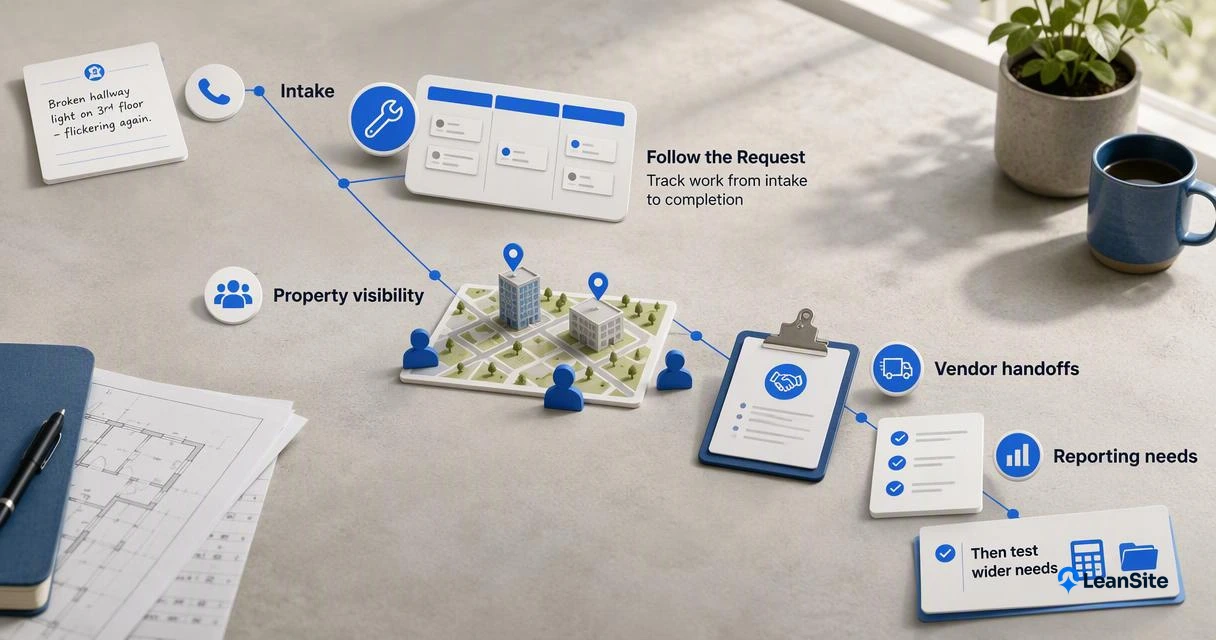
A structured walkthrough can keep the discussion tied to daily work:
- Follow one maintenance request from intake to completion.
- Review visibility across properties and responsible teams.
- Discuss vendor handoffs and reporting requirements.
- Identify which finance or real-estate connections the organization needs.
The comparison with Planon IWMS provides a focused follow-up for teams considering that named alternative. The strongest buying evidence remains a demonstrated workflow aligned with the organization's requirements.
Conclusion
For CAFM vs IWMS procurement, turn the decision tree into a requirements sheet and request demonstrations against the same scenarios. Visit Leansite to start a facilities-focused evaluation. Before that conversation, prepare a sample maintenance request, property structure, vendor handoff, and integration map; getleansite.com is the starting point.