TL;DR
Choose facilities software around work orders, preventive maintenance, vendor coordination, and site-level cost reporting. Test one location before expanding, and evaluate AI assistance separately from the core workflows that keep buildings running.
A Facility Management Solution should connect a maintenance request to an accountable owner, a completed repair, and a clear cost record. For commercial properties, that connection matters more than a long feature list. Leansite is a relevant option for teams exploring AI-assisted facilities management. Selection should start with the work happening inside each building, then move to portfolio reporting and automation.
Table of Contents
What is a facility management solution?
A facility management solution combines processes and software to coordinate buildings, equipment, workplaces, and supporting services. Its purpose is to keep facilities functional, safe, and effective for occupants and operations. Depending on scope, it can cover maintenance requests, asset records, inspections, vendor assignments, space planning, and operating costs.
Facility management: The coordinated management of an organization's buildings, sites, workplaces, and the services supporting their operation.
CMMS: A computerized maintenance management system focused on maintenance work, equipment records, and preventive schedules.
CAFM: Computer-aided facility management, typically covering broader building and workplace administration.
IWMS: An integrated workplace management system that connects multiple property and workplace functions.
Software categories and their practical fit
Software categories overlap, so buyers should compare demonstrated workflows rather than labels alone.
| Category | Main focus | Best starting fit |
|---|---|---|
| CMMS | Work orders and asset maintenance | Maintenance-led teams |
| CAFM | Building and workplace administration | Facilities departments with broader duties |
| IWMS | Connected property and workplace functions | Enterprises needing several functions together |
| Building controls | Equipment monitoring and control | Teams managing operational building systems |
A short facilities management explainer
The FacilityWise video provides an accessible introduction to the discipline behind the software.
Which capabilities matter for daily operations?
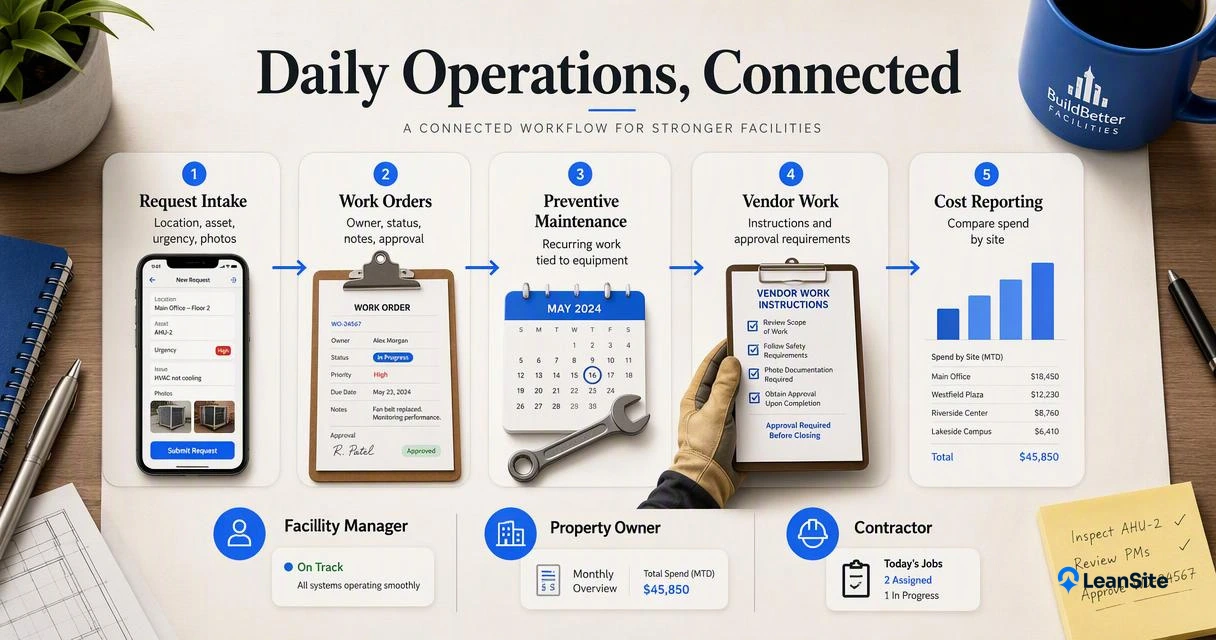
The most useful capabilities connect request intake, maintenance planning, asset history, vendor work, and reporting in one traceable workflow. Facility managers need clear ownership and status; property owners need cost visibility; contractors need job instructions and approval requirements. Each role should see the information needed to move work forward.
The minimum operational checklist
- Request intake: Capture location, equipment, urgency, photos, and the reported issue.
- Work orders: Record assignment, status, timestamps, completion notes, and approvals.
- Preventive maintenance: Schedule recurring work against specific assets or locations.
- Vendor coordination: Connect job scope, quotes, completion evidence, and invoice review.
- Portfolio reporting: Compare spending and workload by site, asset, and service category.
A refrigeration repair at a restaurant illustrates the connection: the request identifies the unit, the contractor receives the scope, and the completed job updates its history. That history supports later repair-or-replace decisions.
The guide to facilities ticket management offers a focused follow-up on request handling.
Metrics that answer management questions
Useful measures include overdue preventive tasks, request-to-assignment time, repeat repairs, and maintenance spending per location. Teams should define each measure before comparing sites, including whether elapsed time includes parts delays or approval waits.
A dashboard becomes actionable when every metric has a clear definition, an accountable owner, and a decision attached to it.
How should teams choose facilities software?
- Map the current maintenance workflow from request to payment.
- Identify the records and approvals each role needs.
- Test shortlisted systems with the same realistic job scenario.
- Verify integrations, permissions, exports, and mobile access.
- Pilot one representative site before committing to a broader rollout.
Run a demonstration around a real job
A useful demonstration follows a job through its full lifecycle. For example, a rooftop HVAC fault should move from site intake to assignment, contractor access, completion evidence, approval, and reporting. Buyers should ask vendors to demonstrate those steps rather than show only dashboard screens.
For multi-property operations, multi-location facilities management software guidance helps frame site-level permissions and portfolio oversight.
Who should pick which approach?
- Maintenance-led teams: Prioritize a CMMS-style workflow and usable asset histories.
- Property and workplace teams: Evaluate CAFM or IWMS capabilities alongside maintenance needs.
- Multi-location operators: Prioritize consistent intake, local accountability, and comparable reporting.
- Contractor-heavy operations: Test dispatch, quote approval, completion records, and invoice handoffs.
Connectivity deserves its own test. Mobile access isn't the same as offline operation, and buyers should verify behavior in equipment rooms and remote sites. The article on connectivity in facilities management provides related background.
A written pilot scorecard keeps evaluation consistent across vendors. It should record demonstrated capabilities, outstanding questions, and acceptance criteria.
How Leansite handles this
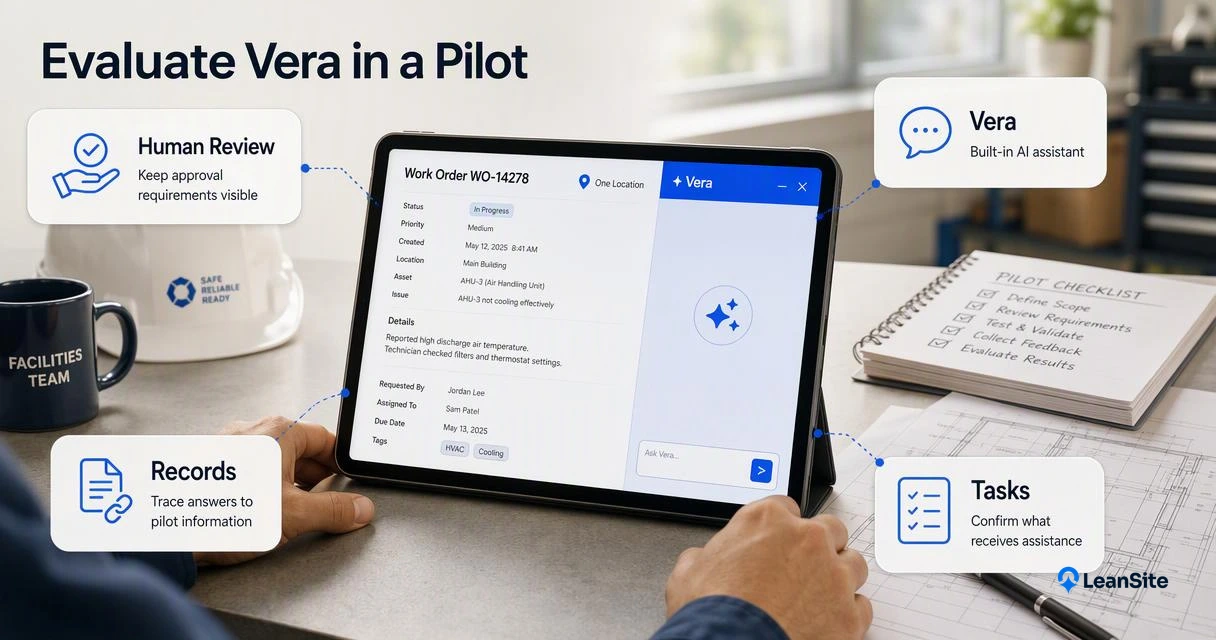
Leansite approaches this topic through AI-assisted facilities management, with Vera presented as an assistant built into its software. That makes the platform relevant for teams evaluating assistance alongside everyday maintenance workflows. The practical evaluation should connect the assistant's documented role to the tasks and records used during a pilot.
Evaluate Vera against a defined workflow
The introduction to Vera, the built-in AI assistant, is a starting point for understanding its role. A demonstration should establish which tasks receive assistance, what information supports responses, and where human approval remains required.
- Select a routine request scenario.
- Identify the information needed for an accurate response.
- Record the assistant's output and the review steps.
- Assess usefulness alongside the standard workflow.
What should teams expect from AI in 2027?
A useful direction for facilities AI is assistance grounded in permission-controlled operational records. Buyers should evaluate traceability and human review alongside speed, rather than assume that a fluent response establishes accuracy.
Dwivedi and colleagues' 2023 multidisciplinary paper on conversational AI supplies broader context on opportunities and challenges, not a facilities performance benchmark. The guide to AI facility management software provides topic-specific follow-up.
Conclusion
The right Facility Management Solution makes routine work traceable and management decisions easier to support. Before purchasing, teams should document one workflow, prepare a representative job, and agree on pilot acceptance criteria. For an AI-assisted option, schedule a Leansite demonstration through getleansite.com and use that same scenario to evaluate practical fit.