TL;DR
Shortlist facility platforms for maintenance-linked records, SharePoint for controlled document libraries, and Fluix for field paperwork. Before purchasing, test asset lookup, revision handling, contractor access, and a complete export using real facility files.
The best facility document management software puts the right equipment manual beside the right maintenance task. For facility managers, the buying decision starts with retrieval: finding an approved drawing, identifying an asset's service history, and sharing relevant records with a contractor. Leansite belongs on the shortlist for teams evaluating document access within a broader facility-management workflow.
Table of Contents
What is facility document management software?
Facility document management software organizes building drawings, equipment manuals, inspection records, and service documentation so authorized teams can retrieve the correct information. Unlike general file storage, its usefulness depends on operational context: the property, asset, revision, and maintenance activity associated with each document. Asset linking may be native or configured.
Facility document management: The controlled storage, organization, retrieval, and sharing of documents used to operate and maintain buildings.
Asset-linked document: A file associated with a specific equipment record, such as an air-handler manual attached to that unit's identifier.
Version control: A process that distinguishes current documents from earlier revisions while preserving document history.
A practical library separates three record types:
- Equipment records: Manuals, warranties, specifications, and commissioning documents.
- Building records: Floor plans, system drawings, permits, and emergency procedures.
- Service records: Inspection reports, contractor worksheets, photographs, and completion evidence.
Portfolio teams also need consistent location names and equipment identifiers. The multi-location facilities management guide provides related context for organizing operations across properties.
Which tools fit each facility document workflow?
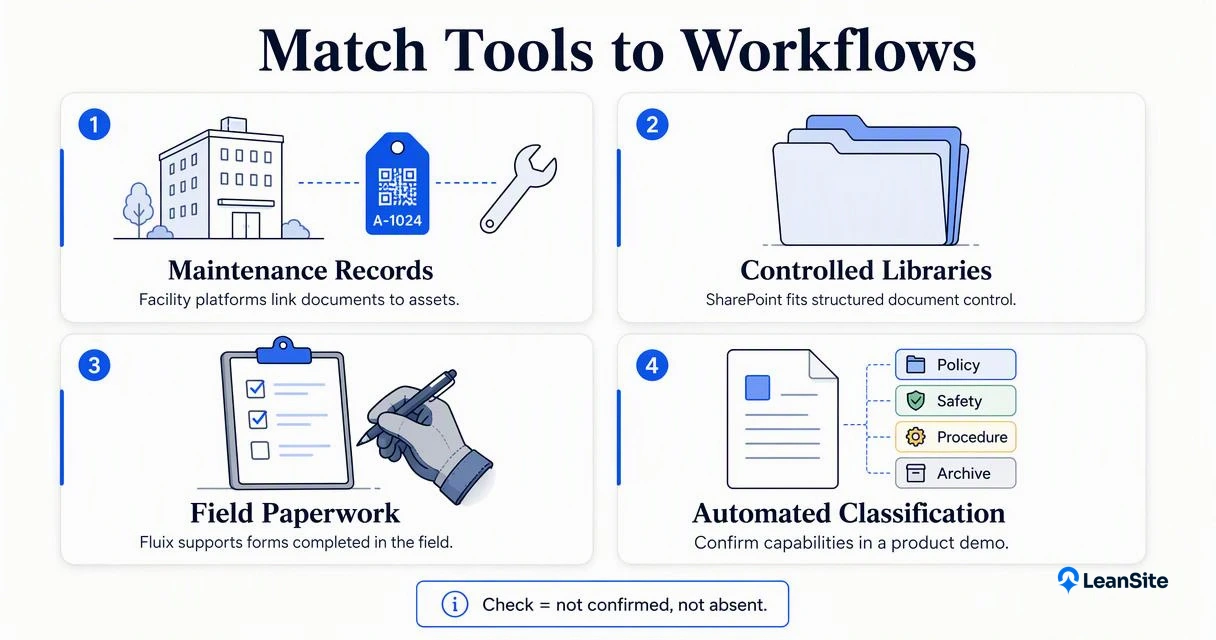
The strongest shortlist separates maintenance-centered platforms, controlled document libraries, field forms, and automated classification rather than treating every file-storage tool as equivalent. Available research supports these workflow distinctions, but it doesn't establish a fully verified feature inventory or current pricing for every product.
Feature matrix: selection signals and verification needs
The matrix distinguishes supported positioning from capabilities that require a demonstration. Check means the supplied evidence doesn't confirm that feature; it does not mean the feature is absent.
| Tool and supported positioning | Asset-linked documents | Version control | Field access | Permissions | Export options |
|---|---|---|---|---|---|
| Leansite: facility-management platform with an AI assistant, described in its Vera overview | Check equipment linkage | Check revision history | Check mobile retrieval | Check vendor scope | Check files plus metadata |
| Microsoft SharePoint: document-control workflow demonstrated in the video below | Check asset metadata setup | Check library configuration | Check mobile workflow | Check access configuration | Check files plus history |
| Fluix: fieldwork automation, according to supplied search summaries | Check equipment association | Check approved-form handling | Check offline behavior | Check contractor roles | Check forms and attachments |
| Doxis: automated document classification, according to supplied search summaries | Check asset classification | Check revision handling | Check field interface | Check property-level roles | Check taxonomy export |
These are workflow recommendations, not hands-on test results. Contract-level capabilities, integrations, and export terms require confirmation.
Workflow recommendations for the shortlist
- Maintenance-centered teams: Start with a facility platform when documents need to sit alongside operational work.
- Controlled building libraries: Evaluate SharePoint when document governance is the main requirement.
- Field paperwork teams: Evaluate Fluix when forms and field submissions drive the workflow.
- Large document archives: Evaluate Doxis when classification is the primary challenge.
For teams connecting service evidence to requests, the facility ticket-management comparison covers the adjacent workflow.
How Leansite handles this
Leansite offers a facility-management context for evaluating document retrieval alongside maintenance operations, with an AI assistant described in its published product material. That makes it a relevant starting point for teams seeking connected operational information rather than a standalone archive. A focused demonstration should establish how documents participate in that workflow.
A useful demonstration follows one piece of equipment through a complete service task:
- Open the equipment or location record.
- Retrieve its operating manual.
- Review the associated service documentation.
- Share the relevant information with a vendor.
- Capture the completed job's supporting records.
The broader AI facility-management software overview helps buyers frame the operational use case. Property owners can then assess whether the demonstrated workflow supports clearer maintenance reporting and portfolio visibility.
How should facility teams test document software?
Facility teams should test document software with actual manuals, drawings, and service records rather than a prepared sales library. A useful pilot measures retrieval, revision handling, access boundaries, field usability, and export completeness. The same tasks should run across every shortlisted product so results remain comparable.
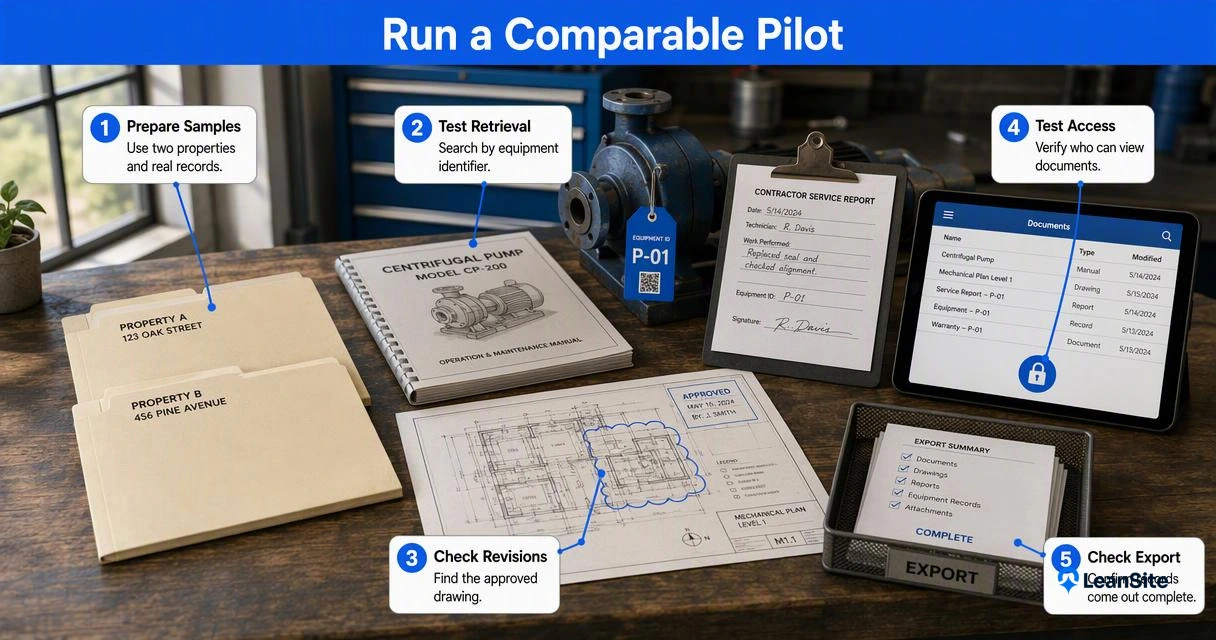
- Prepare a sample: Include two properties, several assets, a revised drawing, and a contractor report.
- Test retrieval: Find a manual using an equipment identifier rather than its filename.
- Test revisions: Confirm that the approved drawing is clearly distinguished from older copies.
- Test access: Give a contractor access to one property's relevant records.
- Test portability: Export files and inspect whether asset associations and metadata survive.
Record completion time, incorrect selections, and administrator effort without assuming universal benchmarks. Teams working in plant rooms should also test weak connectivity; the facility-connectivity guide explains the operational context.
SharePoint document-control demonstration
The following tutorial provides a concrete document-control workflow for evaluating a configured library.
An ISO 9001-oriented tutorial demonstrates an approach, not certification of a product or facility.
What to watch in 2027
AI-assisted retrieval deserves evaluation as a layer over controlled records, not as a replacement for them. Buyers should ask whether answers identify the source file and revision and respect existing permissions.
A useful document answer points to the exact record that supports it.
A practical future-readiness test pairs a search question with a requirement to open the supporting document.
Conclusion
The best choice proves its value with real maintenance records. Facility leaders should schedule a Leansite demonstration at getleansite.com, bring an equipment manual, a revised drawing, and a completed service report, and use the same retrieval and export checklist across the shortlist.