TL;DR
Facility condition assessment software replaces static spreadsheets with structured inspections, asset scores, repair priorities, and budget-ready evidence. The best approach connects field findings to work orders, capital plans, and portfolio reporting so maintenance leaders can act before small deficiencies become expensive failures.
Buildings do not fail all at once; roofs, HVAC units, pavements, panels, doors, and plumbing systems usually send warnings first. Facility condition assessment software helps facilities teams capture those warnings in a consistent, searchable way, then turn inspection data into maintenance work, vendor jobs, and capital plans. Facility condition assessment: an analysis of a facility's condition based on age, design, construction methods, and materials, adapted from the definition on Wikipedia. For teams ready to connect inspections with task tracking, Leansite gives multi-site operators a practical way to manage maintenance decisions from one place.
Table of Contents
What is facility condition assessment software?
Facility condition assessment software is a digital system for inspecting buildings, rating asset condition, documenting deficiencies, estimating repair needs, and prioritizing maintenance or capital projects. It replaces scattered notes and spreadsheets with standardized forms, photos, asset records, scoring logic, reports, and follow-up workflows that stay connected after the inspection ends.
A strong assessment tool does four jobs at once: it guides the field inspection, stores evidence, calculates condition, and routes action. That matters because a roof leak, failed air handler, or cracked loading dock is not just an observation. It is a maintenance decision waiting for ownership, funding, and timing.
Key insight: A facility assessment should not end as a PDF on a shared drive. It should become a living backlog of risks, repairs, replacements, and budget choices.
Common users include facility managers, property owners, campus teams, restaurant chains, retail operators, commercial service vendors, and capital planning consultants. Multi-location operators often pair assessment tools with broader maintenance platforms, especially when assets, vendors, and work orders need consistent tracking across regions. For that wider operating model, Leansite's guide to multi-location facilities management software adds useful context.
What should an FCA workflow include in 2026?
A modern FCA workflow should include digital asset capture, field inspection forms, condition scoring, deficiency tagging, cost estimates, repair prioritization, approval routing, and work order creation. In 2026, the best workflows also support mobile updates, portfolio dashboards, and AI-assisted summaries without losing human review.
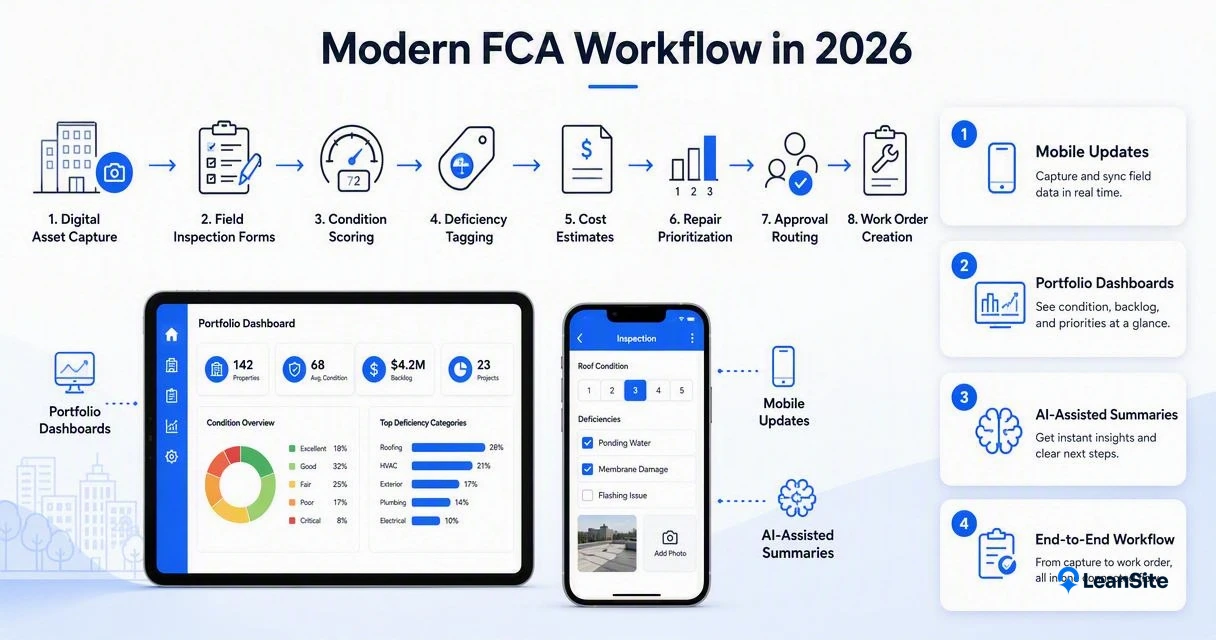
Assessment teams usually need a repeatable process, not a custom spreadsheet for every property. The goal is to compare one building against another without arguing over whether "poor," "fair," and "critical" meant the same thing to different inspectors.
FCA workflow steps that turn inspections into decisions
- Build or import the asset list: Capture major systems such as HVAC, roofing, electrical, plumbing, envelope, pavement, life safety, and specialty equipment.
- Inspect in the field: Use mobile forms, photos, comments, barcode or QR references, and location data.
- Score condition: Apply consistent ratings for observed condition, age, remaining life, severity, and risk.
- Tag deficiencies: Separate cosmetic issues from safety concerns, uptime risks, code concerns, and capital replacement items.
- Estimate cost and timing: Assign rough order-of-magnitude costs, priority windows, and recommended action.
- Create follow-up work: Convert approved findings into work orders, vendor dispatches, preventive tasks, or capital projects.
- Report across the portfolio: Compare properties, systems, regions, and deferred maintenance trends.
AI is becoming more common in facility software, especially for summarizing inspection notes and highlighting patterns. The 2023 paper by Yogesh K. Dwivedi and coauthors on generative AI notes both opportunities and governance challenges for practice and policy in the International Journal of Information Management. For facilities teams, that means AI can assist, but it should not silently override field judgment.
Leansite fits this 2026 workflow by keeping inspection outcomes close to task ownership, vendor coordination, and maintenance follow-through. Teams evaluating AI-supported operations can also read more about AI facility management software.
How does digital FCA beat spreadsheets?
Digital FCA tools beat spreadsheets by preserving inspection context, standardizing scores, linking evidence to assets, and making follow-up trackable. Spreadsheets can collect rows of data, but they struggle with photos, version control, mobile field use, approvals, vendor handoffs, and long-term condition history.
Static files often look acceptable during a one-time assessment. The weakness appears six months later, when an operations leader needs to know which deficiencies were fixed, which were deferred, and which assets now deserve replacement funding.
Spreadsheets versus assessment software
| Need | Spreadsheet approach | Digital FCA approach |
|---|---|---|
| Field capture | Manual entry, later cleanup | Mobile forms, photos, asset links |
| Condition scoring | Inconsistent labels | Standard rating scales and rules |
| Evidence | Files stored separately | Photos and notes tied to assets |
| Follow-up | Separate email or meeting notes | Work orders, tasks, approvals |
| Portfolio view | Manual rollups | Dashboards by site, system, risk |
| Audit trail | Hard to verify changes | Time-stamped updates and history |
"Without data, you're just another person with an opinion.", W. Edwards Deming, The W. Edwards Deming Institute
That quote lands hard in facility planning. A capital request supported by photos, condition scores, repair history, and risk categories is easier to defend than a list of opinions copied from an old workbook.
The most useful systems also reduce duplicate work. A deficiency found during an assessment should not require retyping into a separate CMMS, vendor portal, or budget tracker. Campus and institutional teams that need tighter maintenance execution can compare related options in this guide to work order software for campus facilities.
Which features matter most when choosing FCA tools?
The best FCA tool should match the way facilities teams inspect, fund, and execute work. Core features include asset hierarchy, mobile inspection forms, condition scoring, deficiency management, cost planning, reporting, work order integration, vendor visibility, and portfolio-level benchmarking.
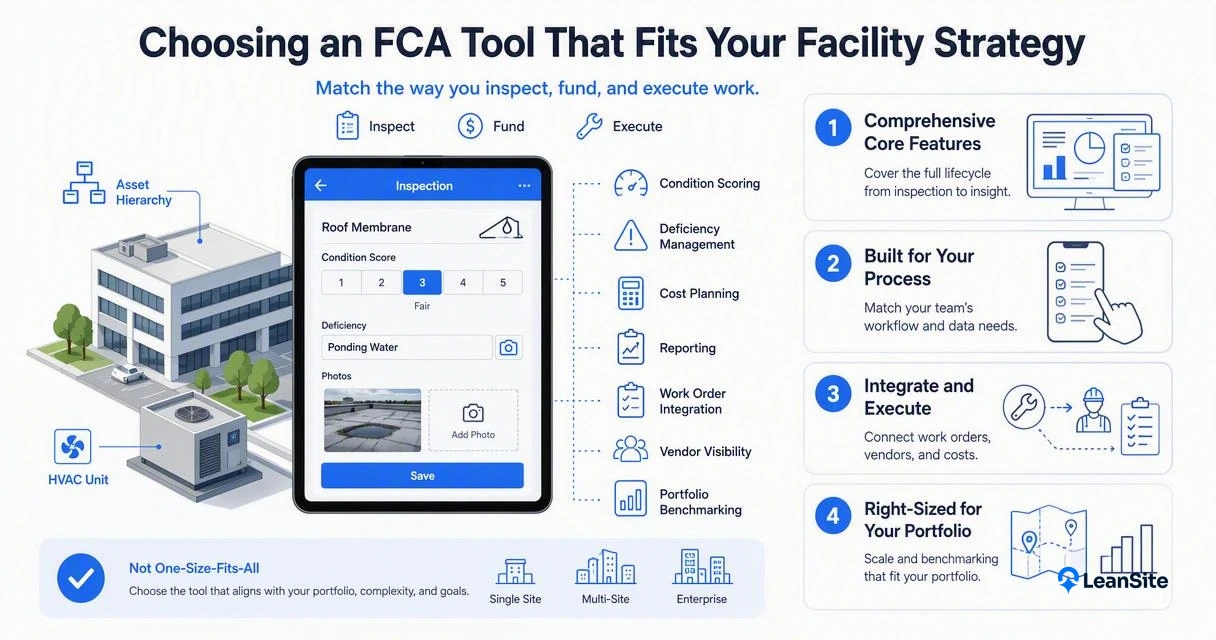
Not every organization needs a heavy capital-planning suite. A national retail operator may care more about speed, vendor dispatch, and uptime. A school district may need lifecycle planning, board-ready reports, and deferred maintenance visibility. A service provider may need fast data collection and clean client deliverables.
Feature checklist for buying decisions
| Feature | Why it matters | Best-fit users |
|---|---|---|
| Asset hierarchy | Organizes systems, locations, and equipment | Multi-site teams, campuses |
| Mobile inspections | Speeds field data capture | Inspectors, vendors, technicians |
| Condition scoring | Makes priorities comparable | Directors, owners, consultants |
| Deficiency tracking | Keeps issues from disappearing | Facility managers |
| Cost estimates | Supports budgets and capital plans | Property owners, finance teams |
| Work order connection | Turns findings into assigned work | Maintenance teams |
| Vendor coordination | Tracks outside repairs and proof of completion | Commercial service teams |
| Portfolio dashboards | Shows risk across properties | Executives, regional leaders |
Buying teams should ask practical questions before choosing a system:
- Can inspectors work quickly on mobile devices?
- Can condition scores be customized without becoming confusing?
- Can findings create work orders or tasks without duplicate entry?
- Can reports separate operating repairs from capital replacements?
- Can leadership compare sites, systems, and regions in one view?
- Can vendors update job status and closeout details cleanly?
Leansite is a strong fit when assessment findings need to become operational action, not just documentation. The Leansite platform supports the handoff from facility visibility to maintenance coordination, which is especially useful for operators managing many locations. For broader tool selection, the article on best multi-site maintenance software in 2026 explains what many buying guides miss.
How should FCA data feed capital planning?
FCA data should feed capital planning by ranking assets and deficiencies by condition, risk, urgency, cost, and business impact. The best plans separate immediate repairs from future replacements, then group projects into budget years based on safety, uptime, remaining useful life, and funding limits.
Capital planning gets messy when every site argues that its needs are urgent. A consistent condition score gives leadership a fairer way to compare a leaking roof in Dallas with an aging rooftop unit in Phoenix or a failing parking lot in Atlanta.
A simple FCA-to-capital-planning model
- Score condition: Rate each asset or deficiency with a shared scale.
- Classify risk: Mark safety, compliance, uptime, customer experience, and cost exposure.
- Assign time horizon: Use immediate, 1-year, 3-year, and 5-year buckets.
- Estimate budget: Add labor, materials, vendor cost, design cost, and contingency where needed.
- Choose action type: Repair, replace, monitor, bundle, or defer.
- Track execution: Move approved items into work orders, projects, or vendor scopes.
This approach helps owners see deferred maintenance as a managed backlog instead of a vague liability. It also helps facilities leaders explain why one visible issue may wait while a hidden electrical or roof problem gets funded first.
Operational leaders who want a stronger leadership lens can read the facilities leadership interview with Melissa Valona. For work order transparency after funding decisions, this guide to campus facilities work order transparency shows how visibility affects trust.
By 2027, assessment platforms will likely lean harder into AI-generated inspection summaries, image-assisted deficiency detection, and portfolio risk forecasting. Human review will still matter because a model can rank patterns, but a facilities director still owns the budget, risk, and timing decisions.
Conclusion
Facility condition assessment software works best when it turns building observations into ranked, funded, and assigned action. The practical next step is to define a shared asset list, choose a scoring method, digitize field inspections, and connect approved findings to work orders or capital plans. Teams managing many properties should shortlist tools that combine mobile inspection capture, portfolio reporting, vendor coordination, and maintenance execution. Start with the highest-risk assets, run one pilot site, review the output with finance and operations, then scale the model across the portfolio.