TL;DR
Facilio is the stronger starting point for connected building operations; ServiceChannel fits evaluations centered on outsourced maintenance coordination. Buyers should test integrations, contractor handoffs, and asset records with a real work order before selecting either platform.
Facilio vs ServiceChannel is primarily a choice between connecting building operations and coordinating maintenance providers. Both belong on a facilities software shortlist, but the deciding factor should be the workflow that needs the most attention. For facility managers and portfolio owners, a realistic demonstration matters more than a long feature checklist.
Connected building operations: Managing building information, equipment context, and maintenance activity as a coordinated operating process.
Outsourced maintenance coordination: Managing service requests, contractor assignments, approvals, and completion records across external providers.
Table of Contents
Facilio vs ServiceChannel at a glance
Facilio and ServiceChannel should be compared against different operating priorities, rather than treated as interchangeable maintenance systems.
Facilio's official website presents the company around connected facilities operations. ServiceChannel's official website presents a facilities management offering with a strong service-provider orientation. These are useful starting points, not proof that every required workflow comes standard.
For a 2026 purchase, buyers should request current product documentation and written scope. The supplied research does not establish package-level capabilities, pricing, supported connectors, or implementation timelines, so this comparison avoids declaring unverified feature winners.
Side-by-side buying priorities
| Buying criterion | Facilio evaluation focus | ServiceChannel evaluation focus |
|---|---|---|
| Primary operating goal | Connected building operations | Outsourced maintenance coordination |
| Integration test | Building data linked to maintenance activity | Business systems linked to service workflows |
| Asset-context test | Equipment history available during diagnosis | Equipment history available during contractor work |
| Contractor test | External providers working within building processes | Dispatch, approvals, and completion across providers |
| Implementation test | Site data, asset structure, and connection scope | Provider participation and approval structure |
| Strongest starting scenario | Building-led operational visibility | Provider-led multi-location maintenance |
The better fit depends on the operating model, not simply the number of locations.
How should buyers test integrations and asset context?
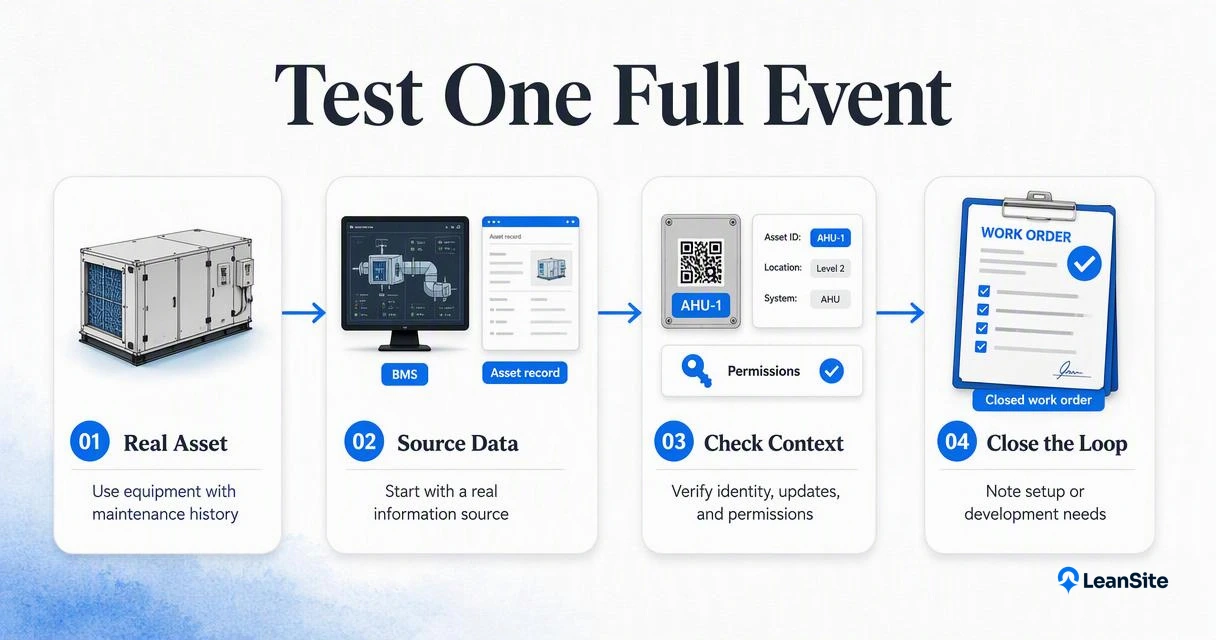
Buyers should test integrations and asset context through one complete maintenance event, from incoming information to a closed work order. A connector list alone cannot show whether equipment identity, updates, and permissions remain consistent. The demonstration should use representative site data and document which connections require configuration or additional development.
A practical integration demonstration
- Select a real asset, such as an air-handling unit, with an existing maintenance history.
- Identify the required information source, such as a building management system or enterprise application.
- Ask each vendor to demonstrate how that information reaches the maintenance workflow.
- Update the equipment record and check whether connected records stay consistent.
- Record the connection owner, recurring charges, and support responsibilities.
The test should distinguish a packaged connector from a custom integration. Both can be suitable, but the implementation work and ongoing ownership differ.
Equipment context beyond an asset list
Asset context becomes useful when technicians can connect symptoms with previous repairs, warranties, and replacement decisions. A searchable equipment directory is only the starting point.
For example, a rooftop unit demonstration should show how a repeated cooling complaint relates to earlier visits. Portfolio owners should also ask whether repair spending can be reviewed by equipment and location, rather than only by invoice.
Contractor workflows and implementation requirements
Contractor coordination should be evaluated from request intake through approval, completion evidence, and financial handoff.
A national retailer may prioritize consistent dispatch and approval rules across locations. A commercial property team may prioritize equipment context and coordination between internal engineers and external specialists. Those differences should shape the demonstration script before vendors configure a trial.
Follow one outsourced repair through completion
- Submit a request with location, equipment, urgency, and access instructions.
- Assign a contractor and check how acceptance and status changes are recorded.
- Introduce a quote requiring approval before work continues.
- Capture completion notes, photographs, and follow-up requirements.
- Trace the approved work into the required accounting or payment process.
Buyers should ask which actions require contractor accounts, mobile access, or separate subscriptions. Invoice approval, payment processing, and accounting export are distinct functions; a demonstration should identify exactly which functions are included.
Define rollout work before comparing costs
Implementation scope should identify asset imports, location setup, user permissions, integrations, contractor onboarding, and training. Buyers should assign an owner to each task and request acceptance criteria.
A useful pilot includes one representative location and both planned and reactive work. Vendor proposals should separate recurring subscription fees from configuration, migration, integration, and support charges. No verified price or rollout benchmark appears in the supplied research.
Who should pick which platform?
Facilio deserves closer evaluation when building connectivity drives the purchase; ServiceChannel deserves closer evaluation when external-provider coordination drives it.
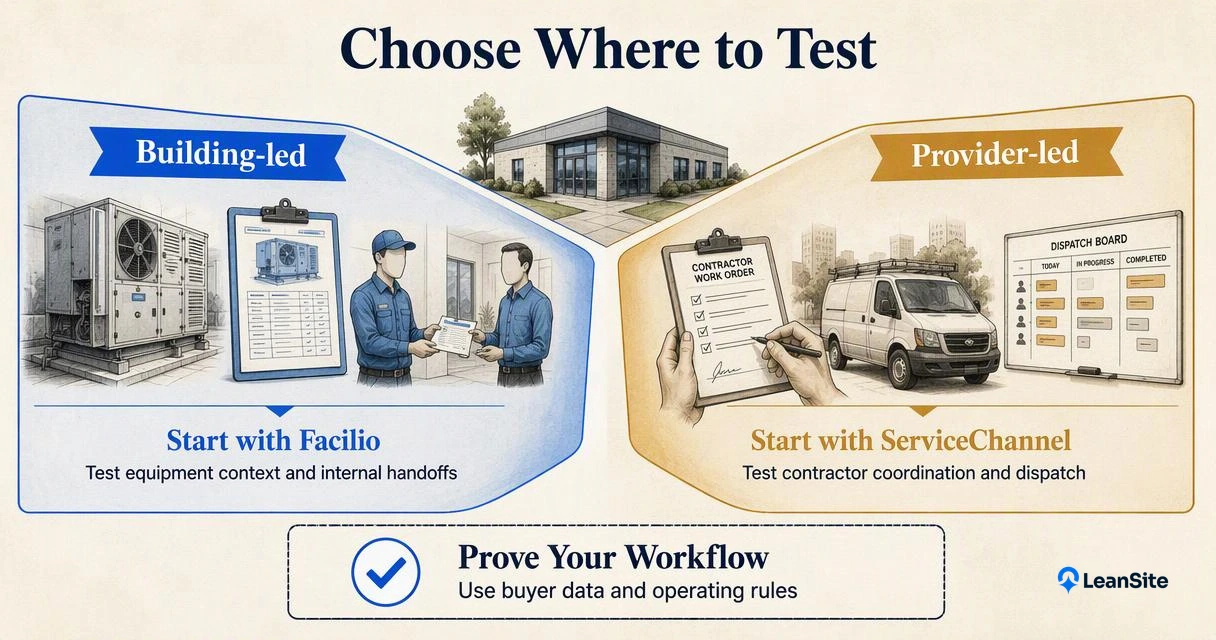
These recommendations identify where to begin testing, not an automatic winner. Either platform should advance only after demonstrating the required workflow with the buyer's data and operating rules.
Match the shortlist to the operating model
- Building-led teams: Prioritize Facilio demonstrations around equipment information, connected operations, and internal maintenance handoffs.
- Provider-led teams: Prioritize ServiceChannel demonstrations around contractor participation, dispatch, approvals, and completion records.
- Mixed portfolios: Score both against separate building-management and outsourced-service scenarios.
A practical scorecard assigns each requirement a business owner, proof method, and acceptance threshold. That keeps an attractive interface from outweighing an essential workflow.
How Leansite handles this evaluation
Leansite offers an additional option to explore through the same task-tracking and vendor-coordination demonstration. Applying a shared test gives buyers a consistent way to assess operational fit.
The Leansite and ServiceChannel comparison provides a focused follow-up for that shortlist. Specific functionality, integration coverage, and commercial terms should be confirmed directly rather than inferred from this article.
Frequently asked buying questions
The remaining buying questions concern operating fit, commercial scope, and evidence of successful implementation.
A written acceptance checklist makes vendor demonstrations easier to compare.
Is Facilio better than ServiceChannel for every portfolio?
Facilio is not automatically better for every portfolio. Connected building operations and outsourced maintenance coordination create different requirements. Buyers should compare the systems against their highest-priority workflow, then verify asset context, provider participation, reporting, and integration scope. Portfolio size alone does not settle the decision.
Which platform costs less?
The supplied research does not establish which platform costs less. Buyers need comparable proposals covering the same locations, users, workflows, and integrations. A fair cost comparison also includes migration, configuration, training, contractor access, and ongoing support. Subscription pricing alone may not reflect the full agreed implementation scope.
Can both platforms support internal and external maintenance?
Buyers should require both vendors to demonstrate internal and external maintenance rather than assume equivalent support. The test should show assignment, permissions, status updates, completion evidence, and approvals for each worker type. Current documentation and the proposed package should confirm which capabilities are included and which require additional setup.
Conclusion
The next step in a Facilio vs ServiceChannel evaluation is a shared demonstration brief: one asset, one contractor repair, one approval, and one reporting outcome. Teams exploring Leansite can visit getleansite.com and request the same scenario. Select the platform that proves the required workflow and documents its implementation commitments.