TL;DR
Shortlist Leansite for operations-first, multi-location maintenance and ServiceChannel for contractor sourcing and enterprise facilities management. Compare both through the same work-order pilot, owner report, and written cost breakdown before committing.
A maintenance platform should prove its value from the first service request through the approved invoice. Leansite vs ServiceChannel is a choice between an operations-first approach to multi-location work and an established facilities management and contractor-sourcing platform.
Facilities management software: A system for organizing maintenance requests, work orders, service providers, and operating records across buildings or locations.
For facility directors evaluating platforms in 2026, the useful question isn't which product has the longest feature list. The useful question is which supports the company's actual intake, dispatch, approval, reporting, and payment process.
Table of Contents
Which platform best fits each operating model?
Leansite is the stronger shortlist candidate for teams prioritizing straightforward daily coordination, while ServiceChannel fits evaluations centered on facilities management and contractor sourcing. The supplied published comparison frames the distinction around multi-location operations and transparency; buyers should validate those claims against their own workflows.
Decision matrix for facility directors
The matrix below identifies what to evaluate, rather than treating unverified capabilities as guaranteed differences.
| Decision area | Leansite evaluation focus | ServiceChannel evaluation focus |
|---|---|---|
| Best-fit priority | Clear daily maintenance coordination | Facilities management and contractor sourcing |
| Work-order intake | Ease of assigning and tracking location requests | Request handling within the enterprise maintenance process |
| Vendor coordination | Handoffs between locations, managers, and vendors | Contractor sourcing and service-provider management |
| Owner visibility | Accessible status and operating-cost views | Analytics supporting portfolio and asset decisions |
| Implementation | Fit with existing routines and responsibilities | Configuration around enterprise requirements |
| Cost control | Connection between work, approvals, and spend | Reporting that supports maintenance spending decisions |
No deployment timeline or comparable pricing schedule appears in the supplied research. Neither faster implementation nor lower total cost should be assumed.
How should teams test the maintenance workflow?
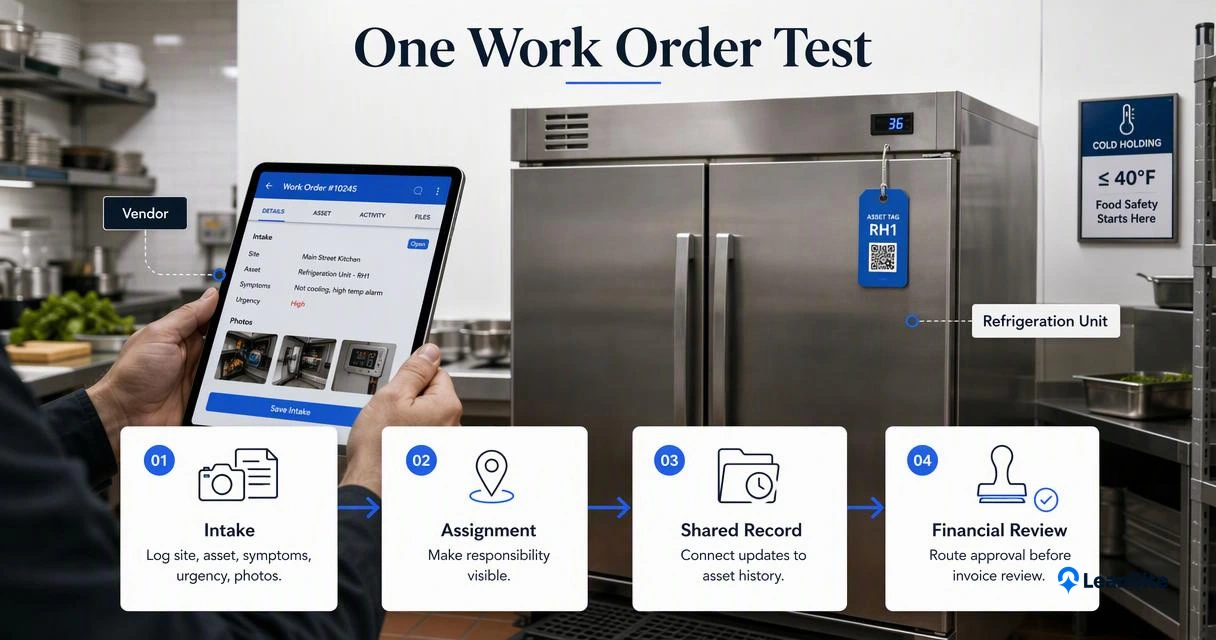
Teams should test maintenance software with the same real work order from intake through financial review, rather than comparing separate feature demonstrations. A consistent scenario reveals how responsibilities, records, and approvals connect. It also gives facility managers, vendors, and property owners a shared basis for judging usability.
Follow one repair across every handoff
A restaurant refrigeration repair makes a useful test because downtime, dispatch, asset history, and approval all matter. The demonstration should cover:
- Intake: Record the location, asset, symptoms, urgency, and photos.
- Assignment: Identify the responsible person and route the job to a vendor.
- Execution: Capture arrival, progress, completion evidence, and follow-up work.
- Approval: Show who authorizes a changed scope or higher invoice.
- Financial review: Connect the completed job with its approved cost.
Each participant should perform the relevant action, not simply watch a salesperson perform it. Vendor teams should also confirm what information accompanies dispatch and what documentation supports payment.
Separate owner reporting from task tracking
Owner visibility means answering financial and asset questions, not merely showing open tickets. Ask both vendors to produce a report covering spending by property, recurring repairs by asset, and jobs awaiting approval.
A multi-location owner may need portfolio totals, while a site manager needs today's assigned work. Evaluate both views and confirm which users can access them. Teams comparing another contractor-oriented option can extend this exercise with the Corrigo comparison.
How Leansite handles this
The platform's stated positioning focuses on keeping multi-location facility work easy to assign and follow, making daily coordination its main evaluation angle. The platform overview is the next place to examine that approach, with the demonstration centered on actual location and vendor responsibilities.
Evaluate everyday coordination first
For retail, restaurant, and commercial-property teams, the strongest fit is a workflow that makes the next action clear. A location employee reports an issue, a manager assigns responsibility, and the service provider returns completion evidence.
The app overview provides a relevant starting point for evaluating field participation. During a demonstration, assess how site staff and vendors enter updates, attach evidence, and find assigned tasks. These are evaluation requirements, not claims that every requested function is included.
Keep the shortlist aligned with the job
A coordination-focused buyer should prioritize daily participation and clear ownership. An asset-intensive organization may also need deeper maintenance planning, asset hierarchies, or integration requirements; the IBM Maximo comparison offers a separate evaluation path for that scope.
The best-fit platform makes the next action clear to the person responsible and the result visible to the person funding the work.
How should buyers validate rollout and total cost?
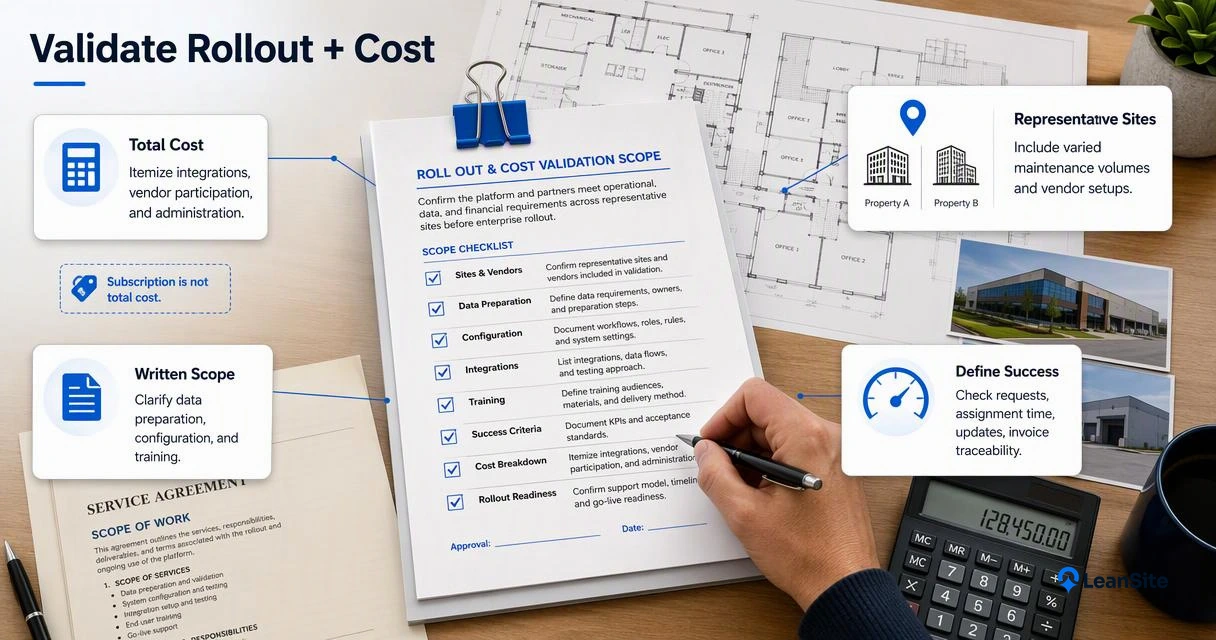
Buyers should validate rollout and total cost through a written implementation scope, a representative pilot, and itemized commercial terms. Subscription pricing alone doesn't explain the purchasing decision. Data preparation, configuration, training, integrations, vendor participation, and ongoing administration all deserve explicit questions before a contract is signed.
Run a controlled evaluation before committing
- Select representative sites: Include different maintenance volumes and vendor arrangements.
- Define success: Measure request quality, assignment time, update completeness, and invoice traceability.
- Prepare essential records: Start with locations, assets, contacts, and approval roles.
- Test participant access: Include site staff, vendors, finance, and ownership.
- Review the full proposal: Confirm included services, optional charges, support, and renewal terms.
Keep the pilot small enough to inspect every handoff. Record baseline performance before starting so the purchasing team can judge changes against existing operations.
Compare commercial terms on equal scope
Request written answers covering user and location allowances, onboarding services, integrations, reporting access, and vendor-related requirements. Ask how completed work reaches finance and whether payment involves a separate process.
The supplied research doesn't establish public, directly comparable prices for both platforms. A defensible cost comparison therefore requires current proposals for the same sites, users, and services. Clear scope matters more than an attractive headline price.
Conclusion
Facility directors should book matched demonstrations, bring one real repair scenario, and request a written rollout plan and cost breakdown. For an operations-first evaluation, visit getleansite.com and use the pilot checklist above to turn product claims into observable results.