TL;DR
A CMMS usually fits teams focused on work orders, preventive maintenance, and repair history. EAM is justified when asset acquisition, financial planning, and replacement decisions must connect across departments; facilities-focused platforms deserve consideration when property and vendor coordination drive the buying decision.
More locations don't automatically mean a business needs EAM. The CMMS vs EAM decision turns on which decisions the software must support: getting maintenance completed or managing assets throughout their useful lives. Commercial property teams also need to assess vendor coordination and portfolio visibility. Leansite belongs in that facilities-focused evaluation, where day-to-day operating workflows should shape the shortlist.
Table of Contents
What is the difference between CMMS and EAM?
The difference between CMMS and EAM is scope: CMMS centers on maintenance execution, while EAM extends into asset lifecycle management. Both can support work orders, preventive maintenance, and asset records. EAM typically connects those activities to acquisition, financial planning, and eventual replacement or disposal.
CMMS: A computerized maintenance management system organizes maintenance work, including schedules, labor, parts, and service history.
EAM: Enterprise asset management combines processes and software for managing physical assets throughout their lifecycle.
Maintenance execution versus lifecycle decisions
The categories overlap, so buyers should compare actual capabilities rather than labels.
| Buying criterion | CMMS emphasis | EAM emphasis |
|---|---|---|
| Maintenance execution | Work orders, scheduling, repair history | Maintenance within broader asset processes |
| Asset financials | Maintenance costs and parts spending | Lifecycle costs and capital planning |
| Asset coverage | Assets being maintained | Acquisition through disposal |
| Implementation effort | Maintenance workflows and records | Cross-department processes and integrations |
| Portfolio requirements | Can support multiple locations | Often supports enterprise-wide governance |
Multi-site support alone doesn't distinguish EAM from CMMS. Financial scope, lifecycle decisions, and governance are stronger buying signals.
When is a CMMS sufficient, and when is EAM justified?
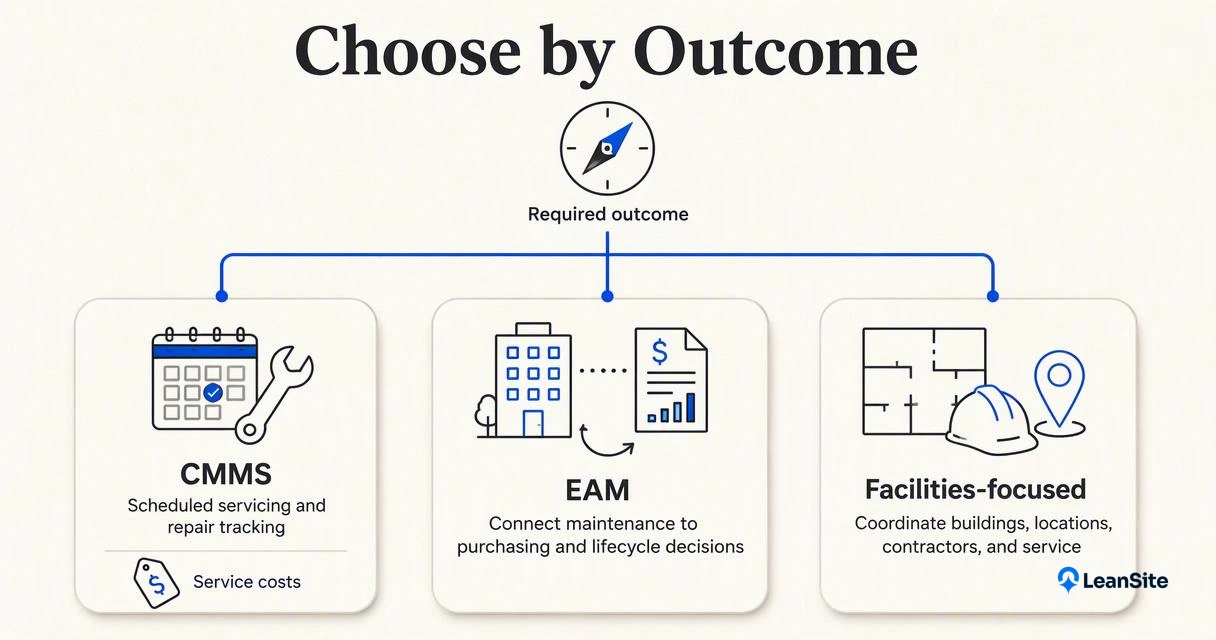
A CMMS is sufficient when the main requirement is dependable maintenance execution and visibility into service costs. EAM is justified when maintenance records must inform purchasing, capital budgets, and lifecycle decisions across departments. Facilities-focused platforms fit teams whose daily work revolves around buildings, locations, contractors, and service coordination.
Who should pick which system?
A useful decision starts with the required business outcome, not employee count.
| Operational requirement | Best starting point | Reason |
|---|---|---|
| Scheduled servicing and repair tracking | CMMS | Maintenance execution is the core need |
| Acquisition, renewal, and disposal planning | EAM | Decisions span the asset lifecycle |
| Property requests and contractor coordination | Facilities-focused platform | Building-service workflows drive the requirement |
| Several sites with shared maintenance standards | Multi-site CMMS or facilities platform | Location count doesn't establish financial complexity |
Consider a retail portfolio with rooftop HVAC units. If managers need service schedules, repair histories, and contractor updates, a maintenance-focused system may cover the requirement. If finance also needs coordinated replacement forecasts and acquisition records, EAM deserves closer evaluation.
For a structured shortlist, the 2026 CMMS buyer's guide provides a relevant next step.
How should teams test implementation and future readiness?
Teams should test maintenance and asset-management software with a realistic workflow before committing to implementation.
- Select representative locations and assets.
- Import service histories and maintenance schedules.
- Run a request through assignment, completion, and cost review.
- Test accounting and procurement handoffs.
- Confirm reporting, permissions, and data export requirements.
Make the demonstration prove the workflow
An effective demonstration follows one job from start to finish. For example, a failed HVAC unit can generate a request, technician assignment, parts entry, completion record, and replacement discussion.
- Maintenance teams: Check mobile access and completion evidence.
- Vendors: Check assignment details and invoice handoffs.
- Finance: Check cost coding and reporting boundaries.
- Portfolio leaders: Check consistent location-level visibility.
Implementation effort depends on data quality, integrations, and process changes. An EAM project usually touches more departments, but product scope and configuration matter more than the category name.
Prepare for predictive tools beyond 2026
Future readiness means keeping asset data usable for analytics, sensors, and connected systems. The 2023 review From Corrective to Predictive Maintenance provides research context on maintenance approaches. The 2024 digital twin and Internet of Things survey offers background on related technologies. Neither source establishes that a particular product delivers savings.
For 2027 planning, prioritize documented interfaces, exportable records, and consistent asset identifiers over an AI feature label.
Watch a maintenance-software overview
Software Connect offers an overview of CMMS options for additional category context.
How Leansite handles this
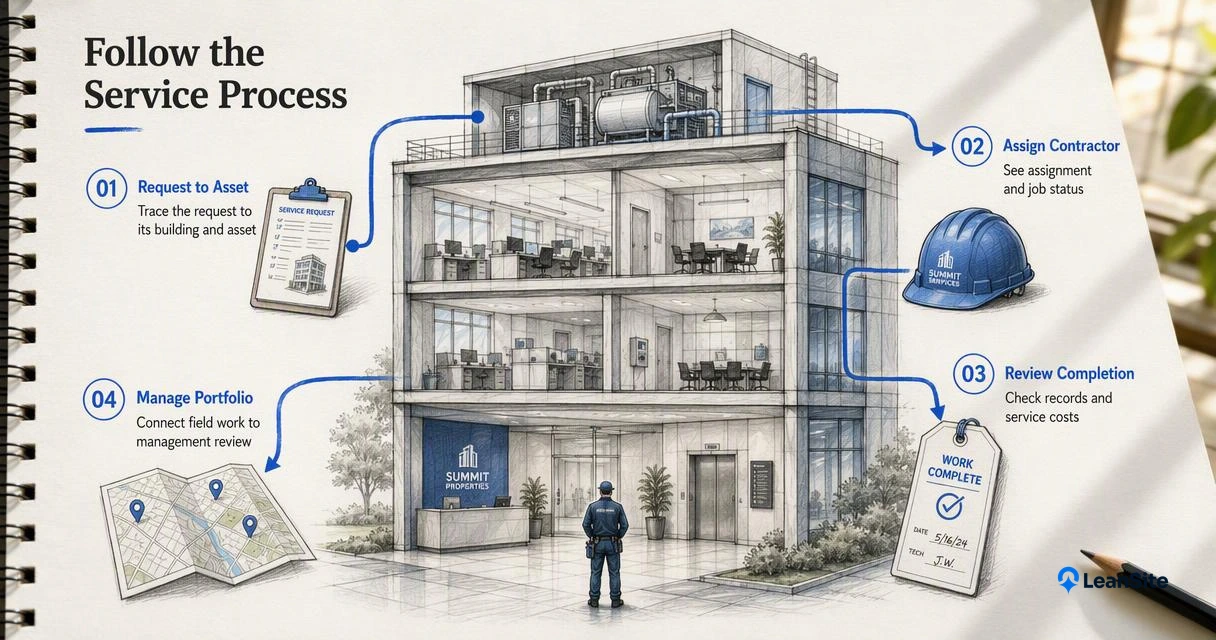
The Leansite platform provides a facilities-focused option for teams evaluating maintenance software around commercial property operations. The useful comparison is how well a candidate supports the actual service process, from a location's request through vendor coordination and management review.
Use facilities workflows to build the shortlist
A property-centered demonstration should connect the people doing the work with the managers reviewing it.
- Trace a service request to its building and asset.
- Review contractor assignment and job-status visibility.
- Examine completion records and cost reporting.
- Confirm portfolio reporting and any required payment integrations.
These are evaluation criteria, not a claim that every capability is included in every plan. Product scope should be confirmed during the demonstration.
For named alternatives, the Fiix comparison and eMaint comparison can support a more specific shortlist. Apply the same workflow test to every candidate.
Conclusion
The CMMS vs EAM decision should end with a workflow test, not a feature tally. Facilities leaders can select one property, several representative assets, and a completed vendor job for evaluation. A Leansite demonstration arranged through getleansite.com can use that scenario to confirm operational fit, reporting needs, and the scope required before rollout.