Your institution already pays for a facility management suite that handles lease renewals and space planning. When a maintenance ticket disappears between two campuses, the facilities director digs through that same platform and finds work orders buried three menus deep, built as an afterthought to the modules the suite was actually designed around.
If that sounds familiar, the choice most higher education facilities leaders eventually face is not obvious at first: a purpose-built multi-site work order management software platform, or a broader traditional facilities management (FM) tool that handles work orders as one feature among many. Both can technically log a maintenance request.
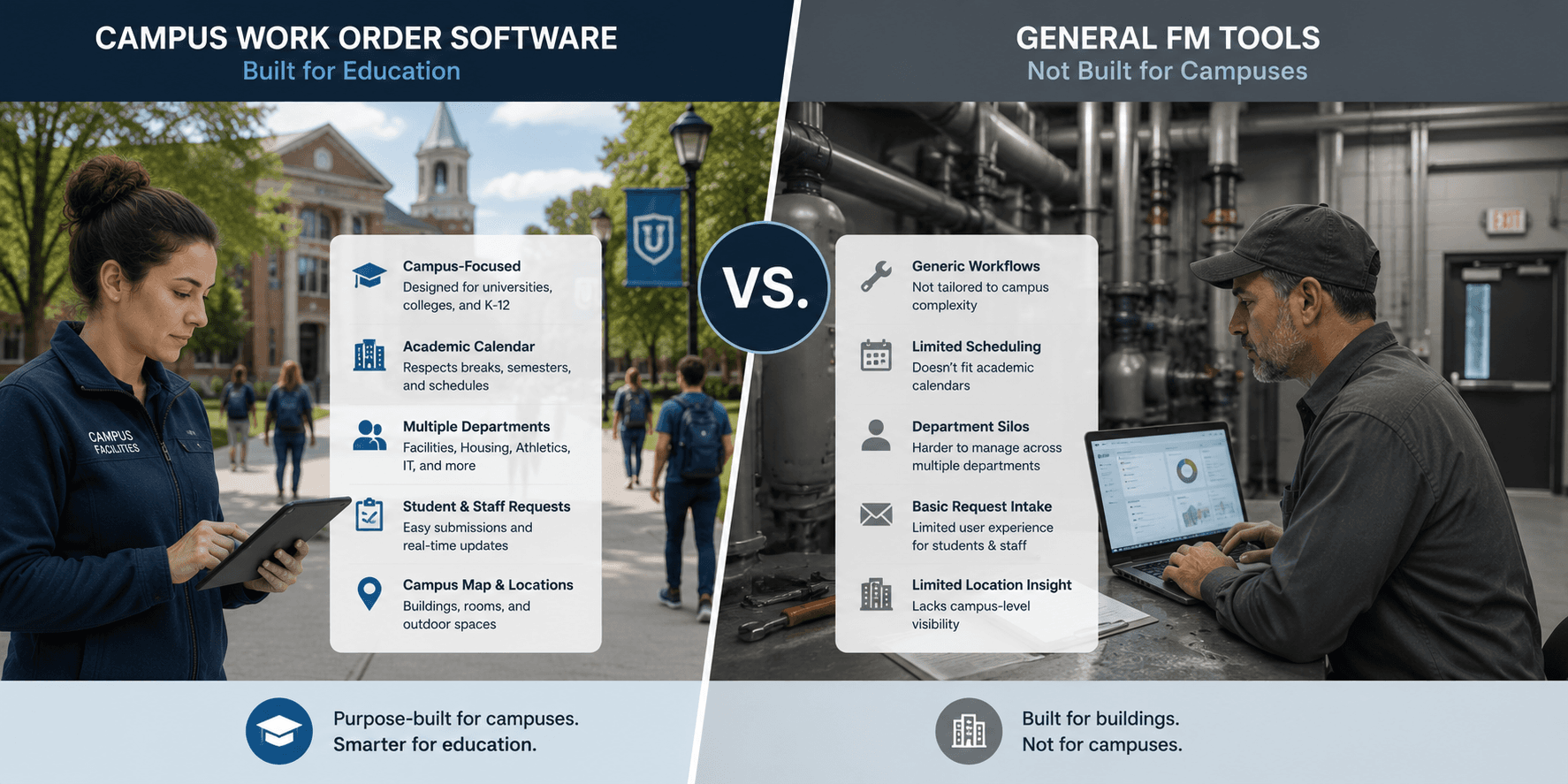
Quick answer: The difference shows up in visibility, routing, and how much control a facilities department actually has once a portfolio spans several campuses. A dedicated work order platform is built around ticket intake, routing, and vendor coordination as its core function, while a traditional FM suite typically bundles work orders alongside lease management, space planning, and capital projects, with ticket-specific depth as a secondary concern.
What Do Traditional FM Tools Typically Cover?
Traditional FM platforms are often built as broad suites: space planning, lease management, asset registers, and work orders bundled together under one system. That breadth is genuinely useful for institutions managing real estate, capital projects, and compliance in one place. This matters given the scale of that side of the job. U.S. higher education institutions carry a combined deferred capital renewal backlog of $112.3 billion, according to a 2021 analysis by APPA and Gordian, which is exactly the kind of capital planning work a broad FM suite is built to support.
The tradeoff is that work order management tends to be one module among several rather than the core function the platform was designed around, which shows up in how deep the routing, escalation, and cross-campus reporting actually go. We compare these two categories more broadly in CMMS vs Facility Management Software: A 2026 Decision Guide.
What Is Centralized Work Order Software Built to Do Instead?
A platform built specifically around centralized work order systems treats ticket intake, routing, and vendor coordination as the primary job rather than a secondary feature. That focus tends to produce a few concrete differences for multi-campus operators.
How Much Deeper Is Cross-Campus Visibility in a Dedicated Platform?
A dedicated work order platform is more likely to offer a single dashboard that rolls up ticket status, aging, and completion rates across every building, since that is the core problem it was built to solve. A Portfolio Health Score built from completion rate, budget adherence, vendor reliability, and team efficiency, with a per-location ranking, is a reasonable example of what that focus produces when work orders are the primary product rather than a module inside a larger suite.
How Much More Consistently Are Categories Enforced?
Broader FM suites often leave categorization loosely configured across modules. A platform focused on work order tracking tends to enforce standardized categories more strictly, which matters once reporting spans a whole institution. Enforced Type and Class fields on every asset record are one way this shows up in practice, keeping equipment tagged consistently regardless of which building logged it.
How Much Tighter Is Routing and Escalation Logic?
Automated routing based on building and issue type, plus escalation for aging tickets, is usually more developed in platforms where work orders are the primary product rather than a feature inside a larger suite. Preferred vendor routing that cascades automatically when the top choice does not respond, combined with threshold trigger alerts scoped by priority and location, is the kind of routing depth that tends to get built out first in a work order focused platform. That depth has a real cost attached when it is missing. MaintainX's 2024 State of Industrial Maintenance survey of more than 1,165 maintenance professionals found unplanned downtime costs an average of about $25,000 per hour, and escalation logic is one of the more direct ways software can catch a stalled critical ticket before it becomes that kind of expense.
Is Vendor Coordination Tied Directly to the Ticket?
Dedicated platforms are more likely to keep vendor dispatch, communication, and invoicing inside the same record as the original request, rather than routing vendor management through a separate module or process. Invoicing generated against an agreed quote or Not to Exceed amount, confirmed on the same record as the work order itself, is a concrete version of that same principle.
Where Do Traditional FM Tools Still Make Sense?
This is not a case where one category is simply better across the board. Institutions with heavy real estate, lease, and capital project management needs alongside maintenance may get more value from a broader FM suite that keeps everything under one system, even if work order specific features are less deep. The tradeoff is real: less specialized ticket routing and reporting in exchange for one platform covering more of the institution's operations. For a fuller picture of what a broad FM suite typically covers, see The Complete Guide to Multi-Location Facilities Management Software.
How Do the Leading Platforms Fit into This Comparison?
Limble, MaintainX, and ServiceChannel are three of the platforms most frequently discussed across higher education and multi-site work order conversations. Limble offers solid preventive maintenance and asset workflows and holds a 4.8 out of 5 rating on G2 across roughly 700 reviews, sitting closer to a traditional maintenance help desk than a system purpose-built for cross-campus visibility. MaintainX is a mobile-first CMMS that is fast to deploy and easy for staff to adopt, also rated 4.8 out of 5 on G2 across more than 1,300 reviews, though its multi-site reporting and vendor coordination depth are lighter than what larger institutions often need. ServiceChannel leans heavily into vendor and contractor dispatch at enterprise scale, a real strength for institutions with heavy third-party reliance, though its cost and complexity can outpace what a mid-sized facilities department requires day to day. For more on this specific comparison, see Best Work Order Software for Campus Facilities in 2026.
LeanSite AI sits on the centralized, work order first side of this comparison, built around standardized intake, routing, vendor coordination, and asset history for distributed campuses specifically, rather than as one module inside a broader FM suite. For institutions where cross-campus ticket visibility is the primary pain point, that focus tends to matter more than the breadth a traditional FM platform offers.
How to Choose
-
Work order visibility and vendor coordination are the main pain points. A dedicated platform built around higher education facilities operations, including LeanSite AI, will likely go deeper than a general FM suite.
-
Real estate, lease, and capital project management need to live alongside maintenance. A broader FM suite may be worth the tradeoff in ticket-specific depth, particularly given the scale of the deferred maintenance backlog many institutions are already managing.
-
Heavy vendor dispatch at large scale. ServiceChannel is worth evaluating specifically.
See How LeanSite AI Handles Cross-Campus Work Orders
The clearest way to weigh this tradeoff is to see how a work order first platform actually handles a multi-campus scenario. Book a LeanSite AI demo to walk through your own portfolio.
FAQ: Campus Work Order Software vs FM Tools
What is the core difference between work order software and a traditional FM tool? Work order software treats ticket intake, routing, and vendor coordination as its primary function, while traditional FM tools typically bundle work orders alongside broader capabilities like lease management and space planning.
Which option gives better cross-campus visibility? Platforms built specifically around work order management tend to offer deeper, more consistent dashboards and reporting across campuses, since that visibility is the core problem they were designed to solve.
Does a higher education institution need both types of software? Some do. Larger institutions with complex real estate and capital planning needs sometimes run a broader FM suite alongside a more specialized work order platform, though many find that unnecessary once they weigh how much day-to-dayday value comes from deeper ticket visibility versus broader institutional coverage.
The right choice comes down to what is actually causing friction. If it is lost tickets and unclear vendor accountability across campuses, that is a signal worth weighing carefully before defaulting to whatever FM suite is already in place.
Written by Pelumi Akinwande, Operations Content Lead at LeanSite, who works directly with multi-campus facilities and operations teams evaluating work order software. Connect on LinkedIn.