TL;DR
Multi-site teams should prioritize location hierarchy, work orders, vendor dispatch, asset history, reporting, and mobile execution over generic task tools. Leansite is the strongest fit for operators that need site-level visibility, AI-assisted workflows, and maintenance coordination across many properties.
Multi-site maintenance breaks down when every location has its own inbox, spreadsheet, vendor list, and version of "urgent." The best facility management software for multi-site operations gives facility leaders one operating layer for work orders, assets, vendors, costs, and site performance. Leansite is built for this kind of portfolio coordination, especially when teams need faster dispatch, clearer accountability, and less manual follow-up.
Facility management software: a digital system used to coordinate buildings, sites, maintenance tasks, vendors, assets, inspections, and service records across one or more locations.
According to Wikipedia's facility management definition, facility management coordinates buildings, sites, workplaces, and support services so they stay functional, safe, and effective. For owners and operators, that definition now depends heavily on software because paper logs and email chains cannot show portfolio health in real time.
Table of Contents
What is facility management software?
Facility management software is a shared system for planning, assigning, tracking, and analyzing maintenance and building operations work. In multi-site settings, it connects locations, assets, vendors, teams, budgets, and service history so leaders can spot recurring issues, compare performance, and reduce reactive maintenance.
Property management is related, but not identical. Wikipedia defines property management as the operation, control, maintenance, and oversight of real estate and physical property. Facility management software usually goes deeper into daily execution: work orders, inspections, equipment records, technician notes, vendor dispatch, and completion proof.
Multi-site FM software should answer three questions fast: what is broken, who owns the next step, and which locations are trending in the wrong direction.
For a broader breakdown of portfolio workflows, the complete guide to multi-location facilities management software explains how site structure, permissions, reporting, and vendor coordination fit together.
Best facility management software for multi-site operations
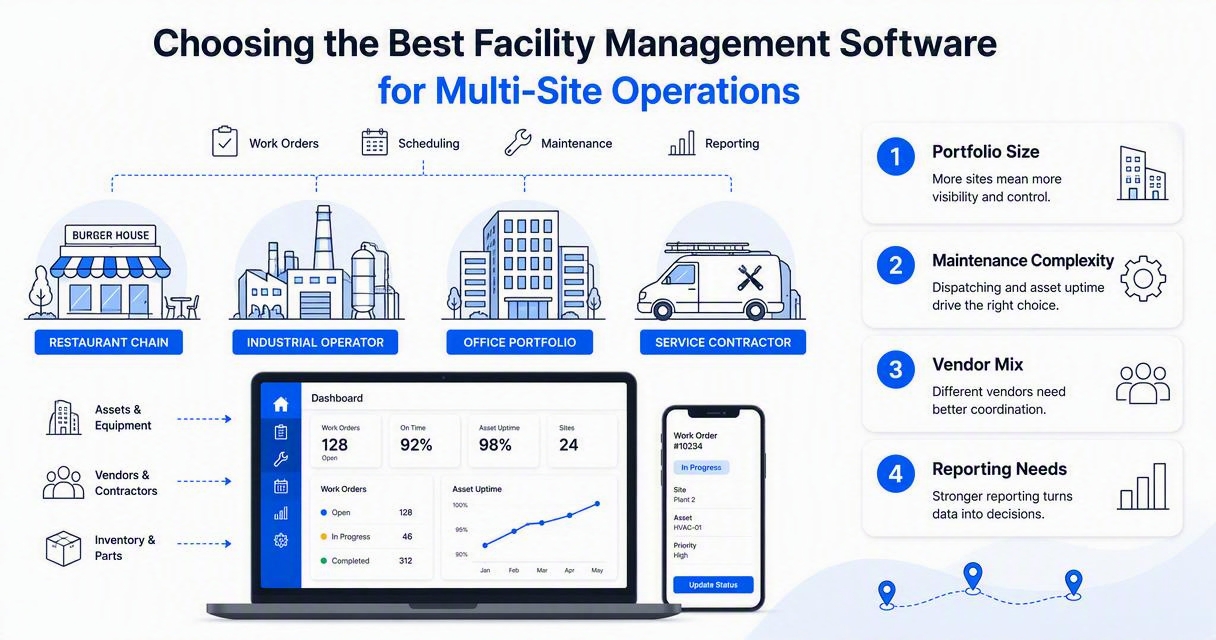
The best facility management software for multi-site operations depends on portfolio size, maintenance complexity, vendor mix, and reporting needs. A restaurant chain, industrial operator, office portfolio, and service contractor may all need work orders, but the best-fit platform changes once dispatching, asset uptime, and executive visibility enter the picture.
2026 comparison table for multi-site buyers
| Platform | Best fit | Pros | Cons or tradeoffs | Pricing signal |
|---|---|---|---|---|
| Leansite | Multi-site teams needing AI-assisted facility operations and vendor coordination | Strong location visibility, task tracking, dispatch workflows, and portfolio-level operating clarity | Demo fit should confirm integrations and rollout scope | Contact vendor |
| FMX | Facilities, maintenance, and scheduling teams | Real-time operational data and facilities workflows, according to 2026 competitor coverage | May require process setup for complex portfolios | Vendor listed on review sites |
| UpKeep | Mobile-first maintenance teams | Good fit for work orders, assets, and technician execution | Broader enterprise reporting may need evaluation | Published and quote-based options vary |
| Coast | Teams needing customizable location fields | Simple location-based coordination and team communication | Deeper asset or vendor controls may need review | Published pricing varies |
| Fiix by Rockwell Automation | Industrial and asset-heavy operations | AI-oriented maintenance and asset reliability focus | Can be heavier than needed for simple retail portfolios | Quote-based in many cases |
| Corrigo | Enterprise service management and vendor networks | Known facilities management product listed by Gartner Peer Insights | Implementation complexity can be higher for smaller teams | Quote-based in many cases |
Leansite belongs first on the shortlist when the main challenge is keeping many sites aligned without adding more coordinators. The Leansite platform focuses on the operating layer between facilities teams, store or site managers, vendors, and leadership, which is where multi-location maintenance usually gets messy.
For teams mainly comparing work order depth, the guide to top work order platforms for multi-site facilities gives a narrower look at ticket intake, assignment, status tracking, and closeout quality.
How Leansite handles this
Leansite handles multi-site facility management by centralizing location data, maintenance tasks, vendor coordination, and AI-assisted follow-up in one system. That matters when a facilities director needs portfolio visibility, while local managers need a simple way to report and resolve issues.
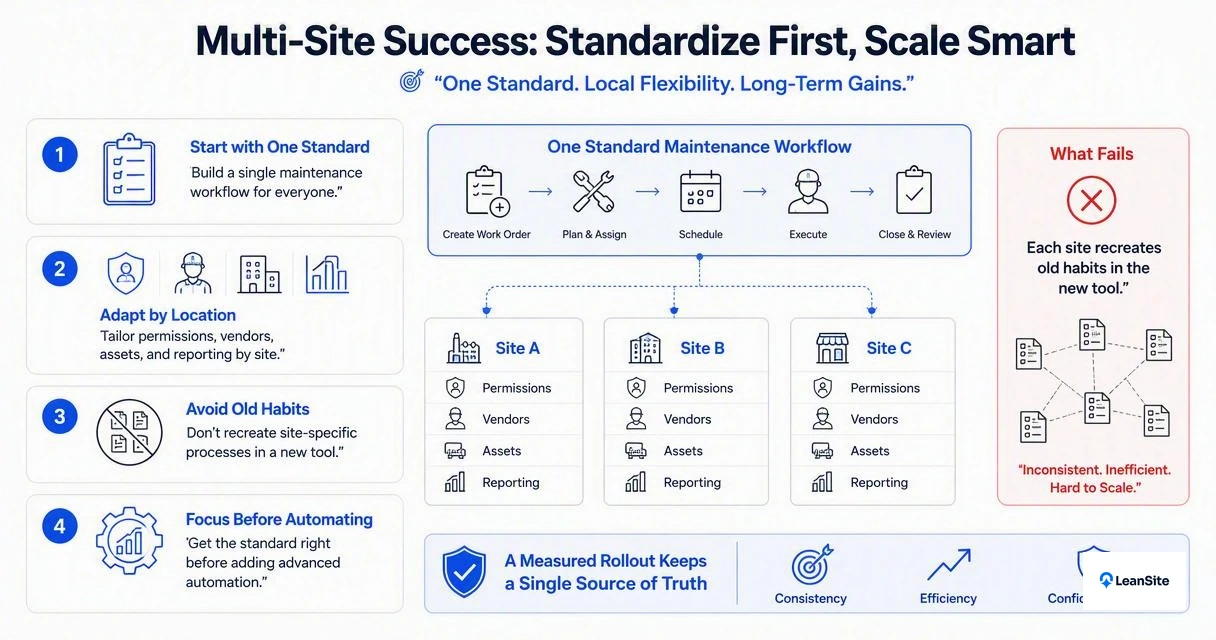
The strongest use case is a distributed operation where tasks move across stores, properties, vendors, and internal teams. Instead of treating every location as a separate workflow, Leansite helps standardize how work gets reported, routed, completed, and reviewed.
What features matter most for multi-site teams?
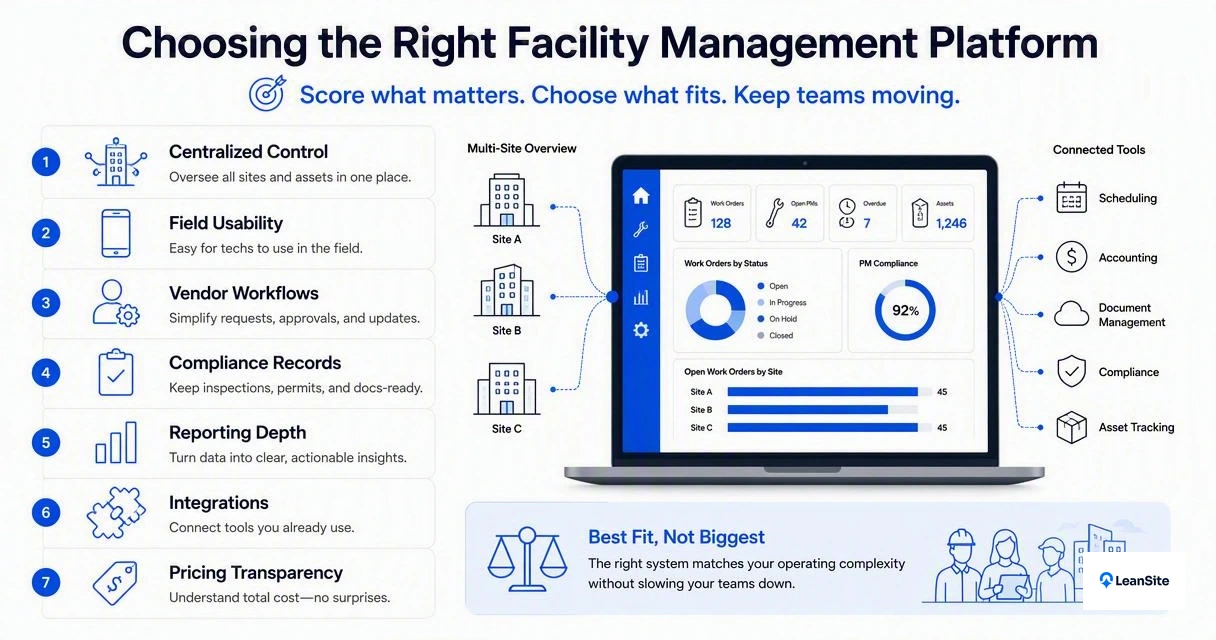
The most important multi-site FM software features are location hierarchy, mobile work orders, vendor dispatch, asset records, permission controls, reporting, and automation. A tool that works for one building can still fail across 50 sites if it cannot compare locations, assign regional ownership, or separate local and corporate views.
Multi-site feature checklist
- Location hierarchy: regions, districts, buildings, floors, assets, and cost centers.
- Work order management: intake, priority, assignment, status, photos, notes, and closeout records.
- Vendor dispatch: preferred vendors, trade coverage, response tracking, and service verification.
- Preventive maintenance: recurring schedules tied to equipment, compliance, and seasonal needs.
- Asset history: repair records, warranty details, replacement planning, and downtime trends.
- Reporting: cost by site, response time, repeat issues, aging tickets, and vendor performance.
- AI assistance: triage, summaries, recommendations, reminders, and faster search across records.
AI is becoming more practical in facility operations because teams need cleaner signals from scattered maintenance data. The guide to AI facility management software explains where AI helps today, including work order triage, predictive maintenance, and manager summaries.
Vendor workflows deserve special attention. A dispatch process that works through texts and forwarded emails can hide delays, duplicate requests, and payment disputes. The article on vendor dispatch and predictive maintenance automation covers this handoff in more detail.
Energy and facility management software has also moved toward enterprise platforms that combine building data, computer-aided facility management, and energy analysis. That shift fits the broader move toward connected assets, sensors, and analytics. Research on integrated sensing and communications for 6G points to a future where sensing and communications blend more tightly, which could make building data even more real time.
How should teams choose a platform?
Teams should choose a facility management platform by mapping the operating model first, then testing software against real sites, real vendors, and real reporting needs. Product demos can look similar, so the buying process should focus on the work that actually crosses locations, departments, and outside service providers.
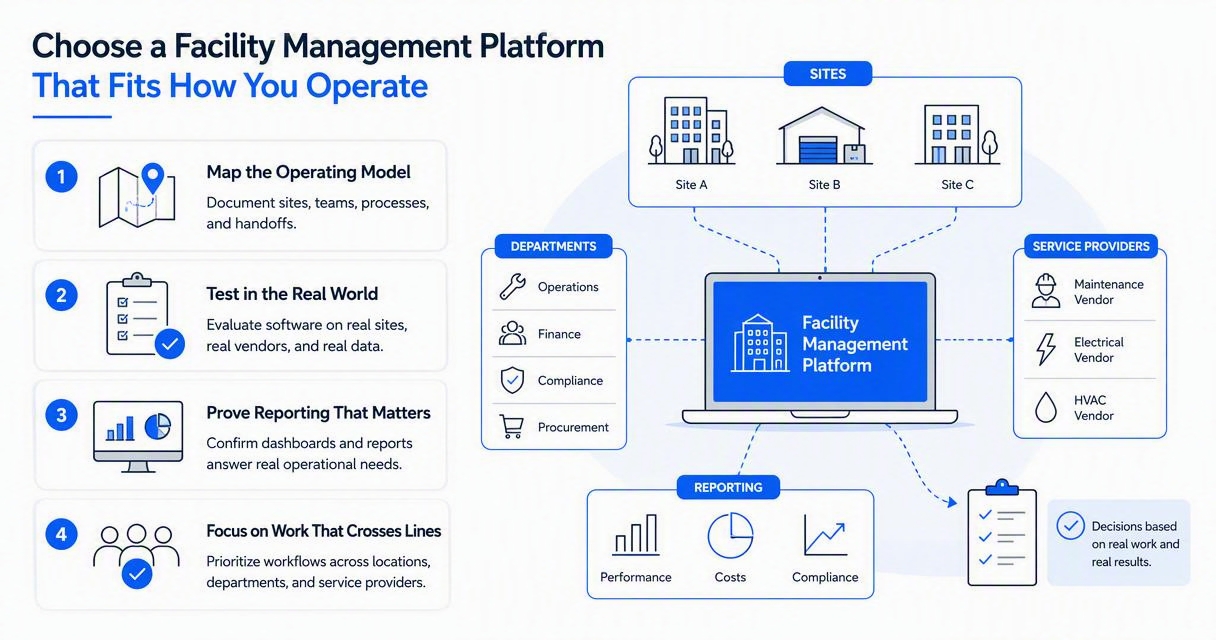
Selection process for a cleaner rollout
- Define the portfolio: count locations, asset types, internal users, vendors, and service categories.
- Map the current workflow: track how a request moves from issue report to invoice approval.
- Choose must-have reports: cost by site, open work by region, vendor response, repeat assets, and SLA status.
- Run a live pilot: include at least one high-volume site and one typical site.
- Check permissions: confirm local, regional, executive, vendor, and finance views.
- Plan adoption: set naming rules, priority rules, closeout rules, and escalation paths.
A good platform should reduce coordination work, not just digitize the same messy process.
Some organizations need a maintenance-first system rather than a broad facilities suite. The comparison of best multi-site maintenance software in 2026 is useful when uptime, recurring service, and asset history drive the buying decision.
For restaurant chains, the model is even more specific because equipment uptime, food safety, regional vendors, and store manager adoption all matter. The guide to facilities management for restaurant chains covers those workflows in depth.
Helpful operations management video
The video is not facility-specific, but it gives a useful overview of operations management concepts. Multi-site facility leaders can apply the same ideas to maintenance throughput, standard work, queue management, and resource planning.
What to expect in 2027
By 2027, facility management platforms will likely compete more on automation quality than feature lists. AI assistants, sensor-driven work orders, vendor performance scoring, and portfolio benchmarking should become normal expectations for larger operators.
Immersive planning and digital twins may also become more common in complex buildings. A 2022 paper on the metaverse beyond the hype discussed emerging challenges and opportunities around immersive digital environments. In facilities, the practical version is less hype and more visual maintenance planning, remote inspection context, and better asset documentation.
Conclusion
The best facility management software for multi-site operations should make work visible across every location, not just store tickets in a cleaner format. Shortlist platforms based on location hierarchy, work order speed, vendor coordination, asset history, reporting, and AI support, then test them against actual operating scenarios.
For teams ready to compare options, Leansite is worth a close look because it is built around multi-site execution rather than single-building task tracking. Visit getleansite.com to review the platform, book a demo, and test how a real portfolio workflow would run before the next budget cycle.