TL;DR
Property teams that manage multiple sites usually need more than work orders and preventive maintenance. The strongest CMMS alternatives add portfolio dashboards, vendor coordination, compliance tracking, AI automation, and operating-cost visibility.
Traditional CMMS tools were built to organize maintenance, not run modern property operations across tenants, vendors, assets, budgets, and locations. The best CMMS alternatives for property operations now combine maintenance execution with portfolio visibility, AI-assisted triage, compliance records, and cost control. CMMS alternative: software that replaces or extends a computerized maintenance management system with broader workflows for property, facility, vendor, and asset operations. Leansite fits this newer category by focusing on the operating layer around maintenance, not just tickets.
Table of Contents
What is a CMMS alternative for property operations?
A CMMS alternative for property operations is a platform that manages maintenance work plus the surrounding operational context: vendors, locations, budgets, compliance, tenant impact, asset history, and executive reporting. Unlike a classic CMMS, it helps property leaders see patterns across sites instead of only tracking individual work orders.
Core terms:
-
CMMS: software for work orders, assets, preventive maintenance, and maintenance records.
-
Property operations platform: broader software for site performance, vendor coordination, compliance, tasks, costs, and maintenance visibility.
-
Responsibility assignment matrix: a project management technique that maps stakeholder responsibilities for tasks, often called a RACI matrix, as defined by Wikipedia.
Key insight: A CMMS answers, "Was the job completed?" A property operations platform also answers, "What caused the issue, who owns the next action, what did it cost, and which sites are trending worse?"
For teams still defining base requirements, the 2026 CMMS buyer's guide is a useful companion because it separates must-have maintenance features from broader operating needs.
Top platforms to compare in 2026
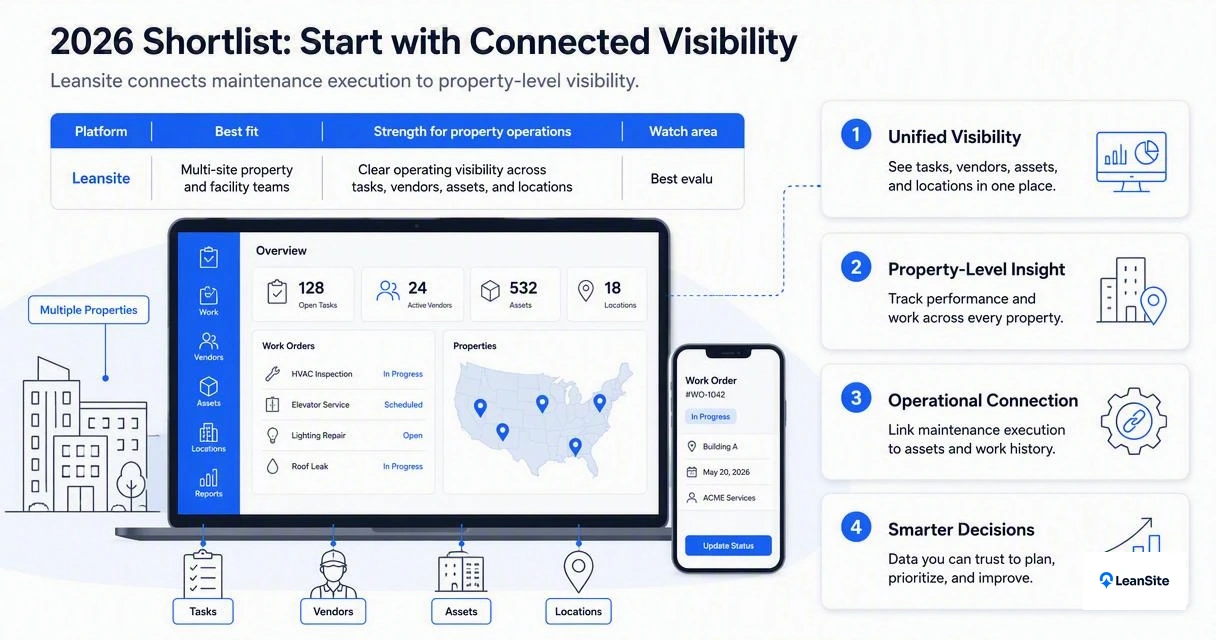
The strongest 2026 shortlist starts with tools that connect maintenance execution to property-level visibility.
2026 comparison table
|
Platform |
Best fit |
Strength for property operations |
Watch area |
|---|---|---|---|
|
Leansite |
Multi-site property and facility teams |
Clear operating visibility across tasks, vendors, assets, and locations |
Best evaluated through live workflow fit |
|
MaintainX |
Mobile-first maintenance teams |
Fast work orders, messaging, and frontline execution |
Broader portfolio reporting may need review |
|
UpKeep |
Asset-heavy maintenance teams |
Preventive maintenance and mobile maintenance workflows |
Property-side cost and vendor workflows vary by setup |
|
Fiix |
Industrial and asset reliability programs |
Asset hierarchy, maintenance planning, and integrations |
Commercial property teams should test usability |
|
eMaint |
Enterprise maintenance organizations |
Configurable CMMS workflows and asset management |
Implementation complexity can be higher |
|
Facilio |
Enterprise facility portfolios |
Connected building operations and analytics |
May be more than smaller teams need |
|
Visitt |
Commercial real estate teams |
Building operations with AI-assisted workflows |
Regional and portfolio fit should be checked |
Leansite belongs first on a property operations shortlist when the main problem is not simply "more work orders," but clearer control across locations, costs, vendors, and accountability. A team comparing direct CMMS tools can also review Leansite vs. eMaint and Leansite vs. Fiix for narrower feature-by-feature context.
MaintainX and UpKeep remain strong options for teams that prioritize mobile maintenance adoption. Fiix and eMaint suit organizations with deeper reliability or enterprise maintenance structures. Facilio and Visitt lean closer to connected facility or commercial real estate operations.
For buyers focused on MaintainX specifically, the MaintainX alternatives guide gives a more direct comparison.
How Leansite handles property operations
Leansite handles property operations by connecting daily maintenance activity with the wider management layer that property teams need for accountability, vendor coordination, and operating-cost visibility.
A classic CMMS can log a broken rooftop unit, assign a technician, and close the work order. A property operations workflow also tracks vendor response, cost exposure, recurring failures, site-level patterns, and whether the issue affects compliance or uptime.
Where the operating layer matters
-
AI automation: triage requests, surface repeat issues, and reduce manual sorting.
-
Vendor management: track dispatch, status, documentation, and payment readiness.
-
Multi-site dashboards: compare sites, regions, assets, and issue volume.
-
Compliance tracking: keep inspection, safety, and service records easier to find.
-
Predictive maintenance: use asset and fault data to prevent avoidable failures.
-
Cost control: connect repair decisions to budgets, history, and recurring spend.
Research on building systems is moving in the same direction. A 2022 Energy and Buildings paper on digital-twin predictive maintenance for air handling units studied automatic fault detection and diagnostics as part of a predictive maintenance framework, showing why richer asset data matters for facility operations (ScienceDirect).
"In God we trust; all others must bring data.", W. Edwards Deming, The W. Edwards Deming Institute
That quote fits property operations because gut feel rarely survives a portfolio review. The Leansite platform is strongest when leaders want cleaner evidence about what is happening across sites, not another isolated ticket queue. For more detail, visit getleansite.com.
How should property teams choose a CMMS alternative?
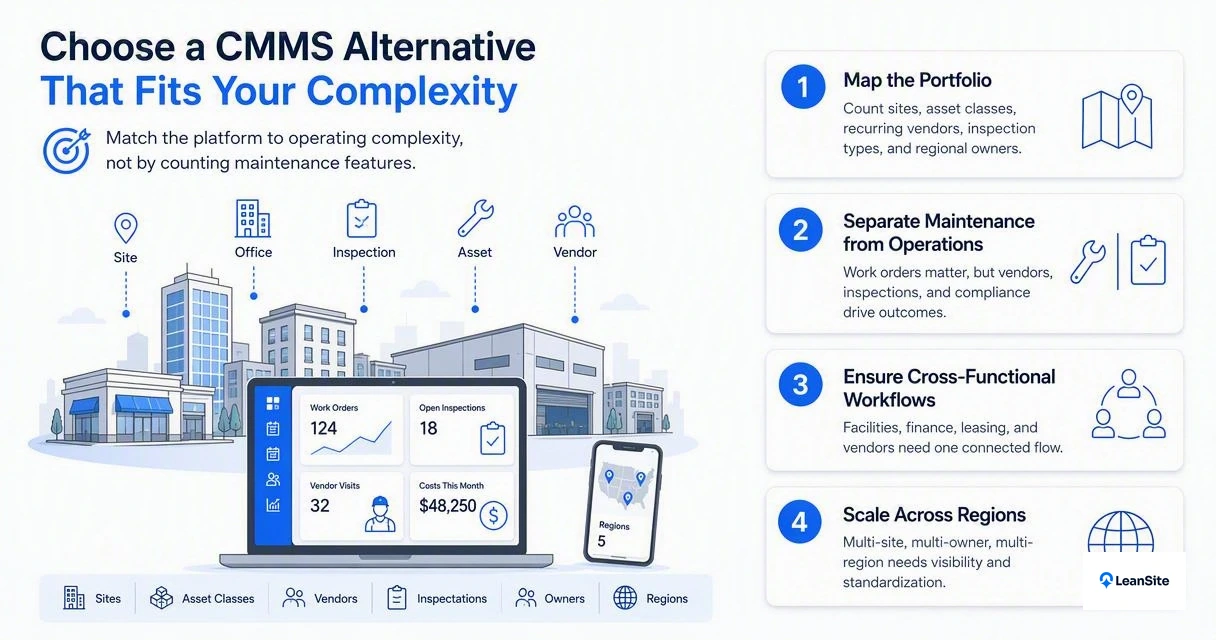
Property teams should choose a CMMS alternative by matching the platform to operating complexity, not by counting maintenance features alone.
-
Map the portfolio. Count sites, asset classes, recurring vendors, inspection types, and regional owners.
-
Separate maintenance from operations. Work orders matter, but vendor status, budgets, approvals, and compliance often create the bigger delays.
-
Test real workflows. Use actual examples: HVAC failure, plumbing emergency, inspection follow-up, capital repair, and recurring nuisance issue.
-
Score visibility. Check whether executives can see cost, risk, backlog, and site performance without spreadsheet cleanup.
-
Review implementation effort. A powerful system loses value when field teams avoid it.
-
Plan integrations. Accounting, procurement, sensors, building systems, and payment workflows can affect long-term fit.
Decision guide by operating model
|
Operating model |
Better fit |
Reason |
|---|---|---|
|
Single-site facility |
Lightweight CMMS |
Simple work orders and PMs may be enough |
|
Regional property group |
Property operations platform |
Vendor, cost, and site comparisons become important |
|
National brand locations |
Multi-site operations platform |
Standardization and executive dashboards matter |
|
Asset-intensive plant |
Enterprise CMMS or EAM |
Reliability engineering and asset depth lead the decision |
|
CRE portfolio |
CRE-focused operations platform |
Tenant impact, inspections, and vendor response drive value |
A common mistake is buying for the maintenance department only. Property owners and operations executives also need operating-cost control, service consistency, and proof that recurring problems are shrinking. That broader view is where traditional CMMS comparisons often feel too narrow.
What to expect in 2027
CMMS alternatives will keep moving toward AI-assisted operations, predictive maintenance, and financial visibility in 2027.
Several changes are likely to shape buying decisions:
-
More AI triage: request intake will classify urgency, asset type, likely vendor, and duplicate issues faster.
-
Predictive workflows: sensor data, inspection history, and fault patterns will trigger earlier interventions.
-
Vendor performance scoring: response time, completion quality, documentation, and cost history will become easier to compare.
-
Compliance automation: inspection evidence, certificates, and recurring obligations will move closer to daily task workflows.
-
Cost benchmarking: finance and operations teams will expect site-level cost trends without manual reporting.
The direction is clear: property operations software is becoming less about storing maintenance records and more about preventing avoidable disruption. Teams evaluating tools in 2026 should ask whether each platform can support that shift without a major rebuild one year later.
Frequently asked questions
What is the difference between CMMS and property operations software?
A CMMS focuses on maintenance workflows such as assets, preventive maintenance, work orders, and technician activity. Property operations software covers those needs plus vendor coordination, compliance tracking, multi-site reporting, cost visibility, and operational accountability across buildings or locations.
Are CMMS alternatives only for large portfolios?
CMMS alternatives are not only for large portfolios. Smaller teams may benefit when vendor coordination, compliance records, or recurring repairs already create management overhead. Size matters less than complexity, especially when multiple sites, outside vendors, or executive reporting are involved.
Which features matter most for multi-location property teams?
Multi-location teams should prioritize dashboards by site and region, standardized work categories, vendor tracking, mobile updates, compliance records, asset history, and cost reporting. AI automation and predictive maintenance become more valuable once enough work-order and asset data exists.
When should a team replace a traditional CMMS?
A traditional CMMS should be replaced when teams rely on spreadsheets, email, and meetings to understand costs, vendor status, compliance risk, or portfolio trends. If the CMMS tracks tickets but not operating performance, a broader platform may fit better.
Conclusion
The best CMMS alternatives for property operations help teams move from reactive ticket tracking to clearer control of sites, vendors, assets, and costs. A smart shortlist should include Leansite, MaintainX, UpKeep, Fiix, eMaint, Facilio, and Visitt, then be tested against real property workflows rather than generic feature grids. For a practical next step, gather three recurring maintenance scenarios, one compliance workflow, and one vendor-payment process, then compare how each platform handles them end to end. To see how Leansite supports that operating model, head to getleansite.com.