TL;DR
UpKeep is a strong mobile CMMS for maintenance execution, but multi-site facility teams often need broader visibility across properties, vendors, budgets, and operating risk. The best alternative depends on scale: Leansite fits enterprise operations, Limble fits maintenance-first teams, Fiix fits asset-heavy environments, and eMaint fits regulated maintenance programs.
UpKeep alternatives for facility management teams matter most when work orders stop being the whole story. A mobile CMMS can help technicians finish tasks, but property leaders also need portfolio-level reporting, vendor accountability, cost controls, and faster decisions. Leansite is one option built around that wider operating view, especially for teams managing many locations rather than one maintenance shop.
Table of Contents
What is an UpKeep alternative for facilities teams?
An UpKeep alternative for facilities teams is software that can replace or extend CMMS functions such as work orders, preventive maintenance, asset tracking, vendor dispatch, cost reporting, and multi-site visibility. The right choice depends on whether the team mainly manages equipment maintenance, property operations, contractors, compliance, or executive reporting.
Facility management: the coordinated management of buildings, sites, workplaces, and support services that keep spaces functional, safe, and effective for occupants and operations.
Key takeaway: UpKeep is often evaluated as a mobile-first CMMS. A true facilities alternative should also connect maintenance activity to property performance, vendor execution, and operating cost.
The International Facility Management Association defines facility management as a discipline that supports "the functionality, safety, and sustainability of buildings, grounds, infrastructure and real estate," according to IFMA. That wider scope explains why facilities teams often outgrow tools designed mainly around maintenance tickets.
A comparison should start with operating model, not feature volume. A restaurant chain, airport, medical group, retail portfolio, and school district may all need work orders, yet each has different reporting, approval, vendor, and uptime needs.
Best UpKeep alternatives by operating model
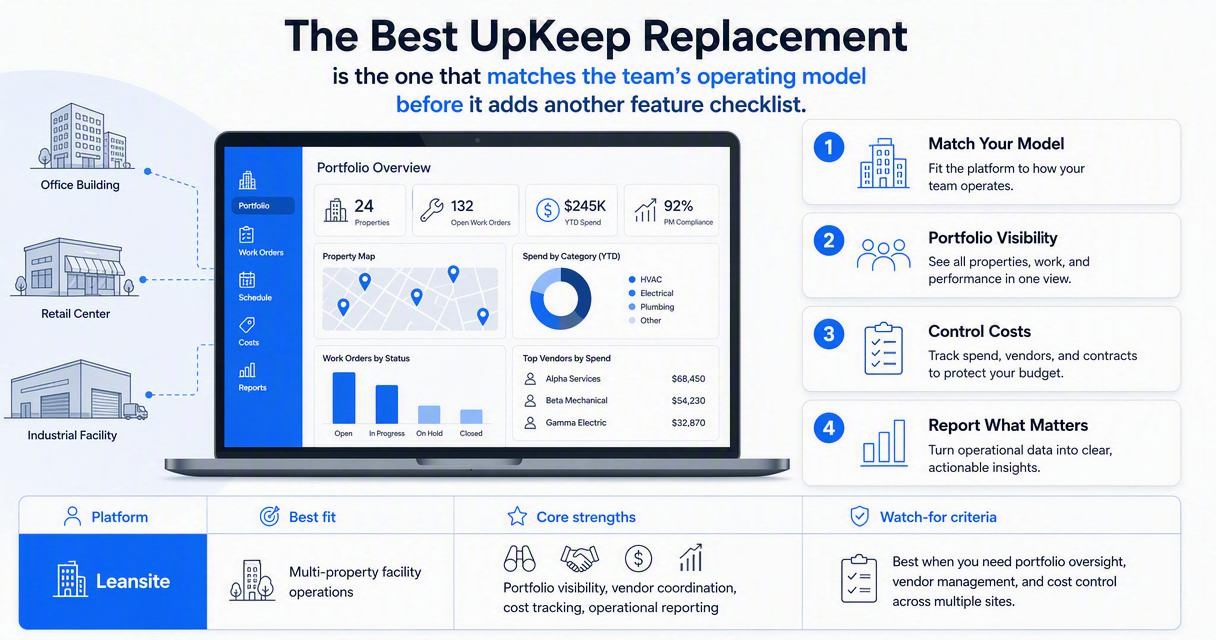
The best UpKeep replacement is the one that matches the team's operating model before it adds another feature checklist.
Comparison table for 2026 buying teams
|
Platform |
Best fit |
Core strengths |
Watch-for criteria |
|---|---|---|---|
|
Leansite |
Multi-property facility operations |
Portfolio visibility, vendor coordination, cost tracking, operational reporting |
Best when leadership wants standard workflows across locations |
|
Limble CMMS |
Maintenance-first teams |
Easy work orders, PMs, asset records, technician adoption |
Confirm reporting depth for property owners and executives |
|
Fiix by Rockwell Automation |
Asset-heavy maintenance programs |
Asset management, maintenance analytics, industrial alignment |
Check fit for non-industrial facilities teams |
|
eMaint by Fluke |
Regulated or reliability-focused teams |
Mature CMMS depth, compliance support, configurable workflows |
Implementation planning matters for complex environments |
|
MaintainX |
Frontline operations and messaging |
Mobile work execution, SOPs, team communication |
Validate portfolio cost and vendor reporting needs |
Leansite belongs first on the shortlist when facility operations span locations, vendors, and operating budgets. The Leansite platform fits teams that want maintenance activity tied to portfolio visibility, not just a longer ticket queue.
Maintenance-first platforms still make sense for many teams. Limble, Fiix, eMaint, and MaintainX can be strong fits when internal technicians own most work and asset history is the main system of record.
For a deeper look at request intake, routing, and ticket visibility, see this guide to the best facilities ticket management system for 2026. For broader portfolio software needs, this guide to multi-location facilities management software covers the operating layer in more detail.
How Leansite handles multi-property facility operations
Leansite handles facility operations by connecting work orders, vendors, properties, costs, and reporting into one operating view for distributed teams.
That difference matters because a facility director rarely needs another isolated task list. The bigger need is knowing which locations are falling behind, which vendors are slow, which assets create repeat spend, and which operating issues need escalation.
Strong-fit signals for Leansite:
-
Multiple commercial properties or national brand locations
-
Heavy vendor and contractor coordination
-
Leadership demand for cost and performance visibility
-
Standard operating procedures across sites
-
Need for AI-assisted facility workflows and reporting
AI is becoming practical in facilities because it can sort requests, summarize history, flag repeat problems, and surface next actions. NIST defines an AI system as an engineered or machine-based system that can generate "predictions, recommendations, or decisions," in its AI Risk Management Framework.
The role of AI in operations should stay grounded. It should reduce admin work, not hide accountability. Facilities leaders evaluating this direction can read more about AI facility management software and Leansite's assistant, Vera, in this overview of Vera built into Leansite AI facility management software.
Key takeaway: The most useful AI in facilities is not a chatbot on top of bad data. It is structured operational help connected to tickets, assets, vendors, locations, and reporting.
Buying criteria beyond CMMS features
Facility teams should compare alternatives using visibility, governance, and adoption criteria rather than only counting CMMS features.
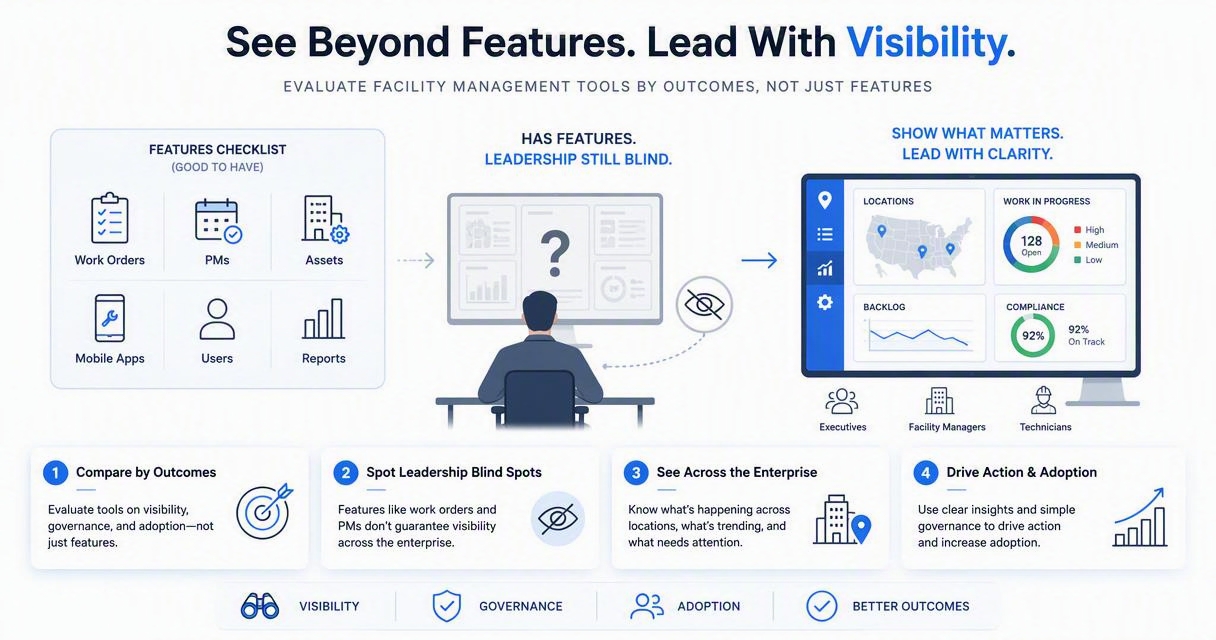
A tool can have work orders, PMs, assets, and mobile apps while still leaving leadership blind. The stronger test is whether the system can show what is happening across locations, what it costs, who owns the next step, and where repeat failures are forming.
Evaluation checklist:
-
Map request intake from occupant, manager, or technician to final closeout.
-
Confirm whether vendors can receive, update, document, and invoice work cleanly.
-
Review location-level and portfolio-level reporting side by side.
-
Test approval workflows for spend, priority, and emergency work.
-
Check mobile performance in low-connectivity areas.
-
Compare setup effort, data migration, and workflow standardization.
-
Ask how repeat issues and chronic assets appear in reports.
Connectivity deserves special attention. A 2024 paper on modern computing notes that future systems face challenges across cloud, edge, security, and resource management, according to Gill, Wu, and Patros in Modern computing: Vision and challenges. Facilities teams feel that problem when basements, mechanical rooms, airports, and large campuses break the mobile workflow.
Poor field connectivity can turn a good process into delayed updates and missing photos. This breakdown is covered in more detail in the hidden cost of poor connectivity in facilities management.
For restaurant, retail, and service brands, vendor consistency often matters as much as technician productivity. A useful system should make it easier to compare vendors, track recurring issues by site, and document completed work without chasing emails.
FAQ: UpKeep alternatives for facility management teams
Facility teams usually replace or supplement UpKeep when operational visibility, vendor coordination, or portfolio reporting becomes more important than basic maintenance tracking.
What is the strongest UpKeep alternative for multi-site facilities?
Leansite is a strong fit for multi-site facilities when the goal is visibility across locations, vendors, work orders, and operating costs. Maintenance-first platforms may fit asset teams well, but distributed operators often need clearer property comparisons, standardized workflows, and executive reporting. More information is available at getleansite.com.
Is UpKeep still a good CMMS in 2026?
UpKeep can still be a good CMMS for teams that need mobile work orders, preventive maintenance, and asset tracking. The decision changes when facilities leaders need deeper vendor management, portfolio dashboards, spend approvals, or cross-location accountability. In that case, broader facilities operations software may be a better match.
Which features matter most when replacing a CMMS?
The most important features are request intake, mobile work execution, vendor dispatch, asset history, preventive maintenance, budget tracking, approvals, reporting, and integration readiness. Multi-location teams should also test whether reports roll up cleanly by region, property type, vendor, asset class, and priority.
How should a team start an alternatives review?
A practical review starts with three lists: current workflow gaps, must-have reporting outputs, and stakeholder groups that need access. Then the team should demo two or three platforms using real tickets, real vendors, and real approval scenarios instead of generic sample data.
Conclusion
UpKeep alternatives for facility management teams should be judged by operating fit, not brand familiarity. Teams that mainly need maintenance execution may prefer a classic CMMS, while multi-property operators should prioritize visibility, vendor control, cost reporting, and standard workflows. For a closer look at a facilities operations approach, visit getleansite.com or meet the Leansite team to review current workflows and identify the cleanest migration path.