TL;DR
Retail maintenance teams need one system for store requests, vendor dispatch, inspections, SLA tracking, and cost control. The best fit in 2026 is software that supports multi-location visibility without stripping away local store context.
A broken HVAC unit, freezer alarm, or lighting issue can turn into lost sales fast when a retail team lacks clear maintenance ownership. Retail facilities maintenance software gives store teams, district leaders, vendors, and facilities directors one shared place to capture requests, assign work, monitor service levels, and control spend. Retail facilities maintenance software: a digital system for managing maintenance requests, work orders, vendors, assets, inspections, SLAs, and reporting across retail locations. Platforms such as Leansite are built for operators that need consistent execution across many sites while keeping store-level details visible.
Table of Contents
What is retail facilities maintenance software?
Retail facilities maintenance software is a platform that helps multi-store operators manage repairs, preventive maintenance, inspections, vendor work, and cost reporting from one system. In 2026, the strongest tools combine work order management, asset history, mobile access, dashboards, and automation for regional oversight.
General facility management software is broad. Retail maintenance software has to handle trading hours, branded store standards, high-volume service requests, vendor networks, and fast escalation when issues affect customers.
Common retail maintenance entities:
-
Work order: a tracked maintenance job with status, priority, location, photos, notes, and completion history.
-
SLA: a service-level agreement that defines response or completion expectations for specific trades or priorities.
-
OEM: an original equipment manufacturer, meaning the company that produces parts or equipment that may be sold by another company.
-
Preventive maintenance: scheduled service meant to reduce reactive failures and extend asset life.
Competitor pages in the 2026 search results often focus on broad facility management rankings, including Gartner Peer Insights listings for products such as FMX, Binocs, and Corrigo on its facility management software review page. Retail operators need a narrower lens: store uptime, brand compliance, dispatch speed, and regional cost control.
For background on multi-site operating models, see the complete guide to multi-location facilities management software.
Core workflows retail teams should expect
The best retail maintenance systems connect request intake, dispatch, inspection, SLA tracking, and reporting in one repeatable workflow.
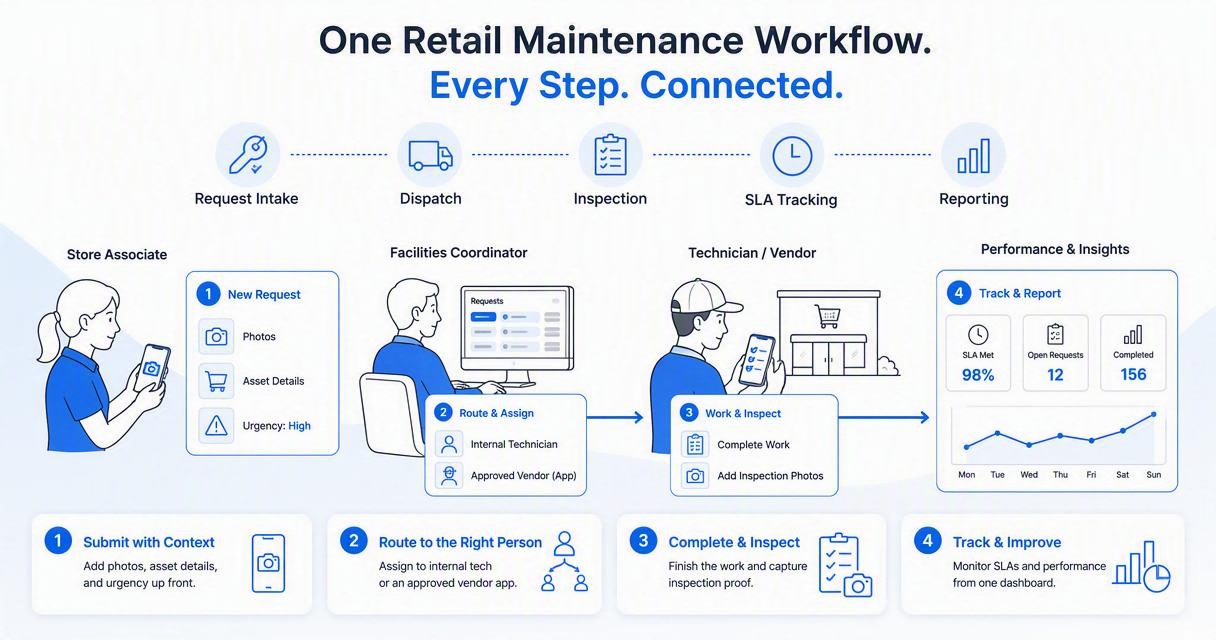
A store associate should be able to submit a request with photos, asset details, and urgency. A facilities coordinator should then route that request to an internal technician or approved vendor based on trade, region, warranty status, and priority.
Workflow map for daily operations
| Workflow | What good software does | Retail impact |
|---|---|---|
| Request intake | Captures issues from mobile, desktop, or store portals | Fewer missed calls and text threads |
| Trade dispatch | Routes HVAC, plumbing, electrical, janitorial, or fixture work | Faster assignment to the right vendor |
| Brand inspections | Uses checklists for lighting, signage, restrooms, safety, and front-of-house standards | More consistent store conditions |
| SLA tracking | Monitors response, arrival, completion, and overdue work | Clear accountability across regions |
| Cost controls | Tracks quotes, approvals, invoices, and recurring asset spend | Better visibility into operating costs |
| Reporting | Shows performance by district, vendor, trade, and asset | Stronger capital planning decisions |
Retail teams also need offline or low-connectivity support in back rooms, warehouses, and older shopping centers. The article on industries that need offline maintenance software explains why field access matters when work happens away from reliable Wi-Fi.
"All models are wrong, but some are useful.", George E. P. Box, Wikiquote
That idea fits maintenance reporting. Dashboards do not need to predict every breakdown perfectly, but they should help teams spot patterns, compare vendors, and act before small issues become expensive failures.
How Leansite handles retail execution
Leansite supports retail execution by tying store requests, work orders, vendor coordination, inspections, and reporting into a practical operating layer for multi-location teams.
The Leansite platform is a good fit when facilities leaders need fast intake from stores, clear task ownership, and visibility across districts or regions. It gives operators a way to standardize how maintenance work moves while still preserving the local context attached to each store.
Retail maintenance feature checklist
- Store-level request capture: issues can be logged with location, priority, notes, and attachments.
- Work order routing: tasks can move to internal teams or outside vendors without losing history.
- Inspection consistency: recurring checklists help protect brand standards across stores.
- SLA visibility: overdue or high-priority jobs become easier to spot before escalation.
- Portfolio reporting: leaders can review cost, vendor, asset, and location trends.
AI is becoming part of this workflow, especially for summarizing work histories, organizing requests, and helping teams find patterns. For a closer look at that shift, the guide to AI facility management software covers practical use cases without treating automation as a magic fix.
Research on generative AI by Yogesh K. Dwivedi, Nir Kshetri, Laurie Hughes, and coauthors in the International Journal of Information Management highlights both opportunities and risks for research, practice, and policy in 2023, which remains relevant as operations teams add AI features to maintenance software. The paper is available through ScienceDirect.
For teams comparing work order tools across several locations, the 2026 guide to multi-site maintenance software offers a deeper buying framework.
How should buyers compare platforms in 2026?
Retail buyers should compare platforms by operational fit, not only by feature count or review rankings.
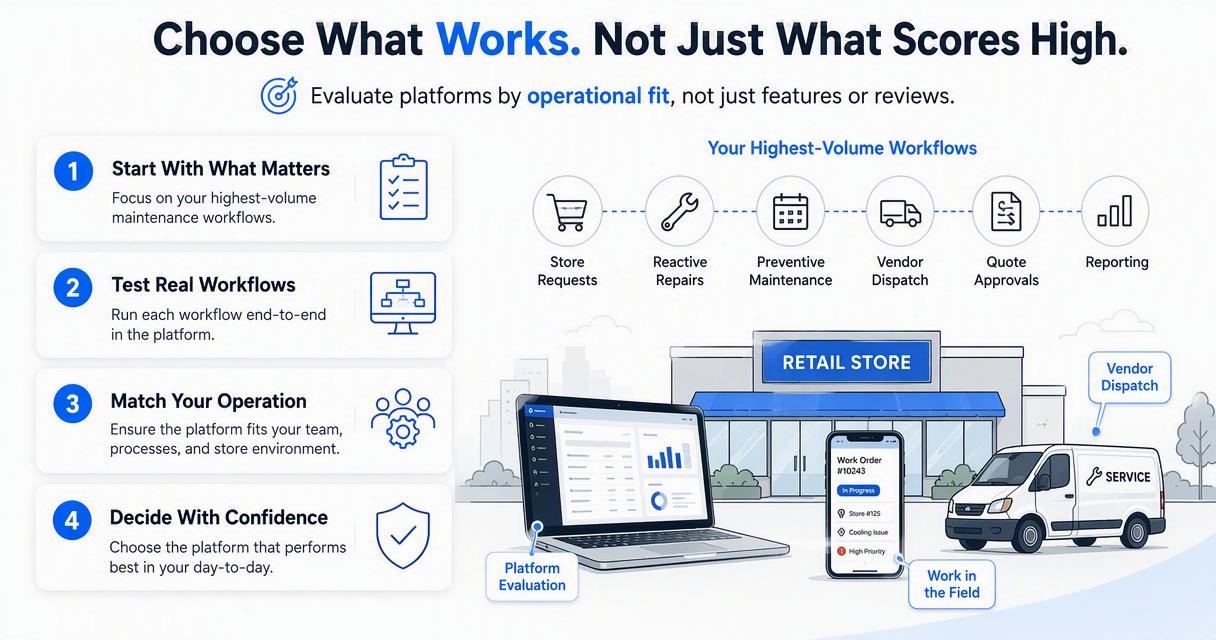
A strong evaluation starts with the highest-volume workflows: store requests, reactive repairs, preventive maintenance, vendor dispatch, quote approvals, and reporting. Each platform should be tested against actual store scenarios, not a generic demo script.
Buying scorecard for retail operators
| Buying criterion | Why it matters | What to ask during a demo |
|---|---|---|
| Multi-location hierarchy | Retail teams need store, district, region, and portfolio views | Can reports roll up without hiding store-level notes? |
| Vendor management | Outside trades often perform specialized work | Can vendors update jobs, attach invoices, and meet SLA rules? |
| Mobile usability | Store managers and technicians need quick updates | How many taps does a basic request take? |
| Preventive maintenance | Scheduled work reduces reactive disruption | Can PMs be built by asset, location, season, or trade? |
| Cost approval flow | Retail spend often needs controls before dispatch or invoice | Can quotes and approvals be tied to work orders? |
| Integrations | Finance, asset, and communication tools may already exist | Which systems connect without custom work? |
Avoid treating a broad "best facilities management software" list as the whole buying process. Search results in 2026 include long review articles and broad directories, but store operations depend on details that generic rankings may miss.
For teams focused on job flow, how to simplify facility work orders fast gives practical ways to cut delays between request, assignment, and completion.
Helpful software overview video
Property management software is not the same category as retail maintenance software, but comparison videos can help buyers see how vendors frame scheduling, communication, documentation, and reporting.
What changes are coming next?
Retail maintenance software is moving toward more predictive, sensor-informed, and AI-assisted operations while keeping human approval central for cost and vendor decisions.
Flexible sensors, connected assets, and IoT monitoring are becoming more relevant for refrigeration, HVAC, energy systems, and safety equipment. A 2023 ACS Nano technology roadmap by Yifei Luo and coauthors tracks the direction of flexible sensor research, including materials, devices, and systems that may shape future monitoring tools. The paper is available through DiVA.
2026 to 2027 retail maintenance priorities
-
Predictive maintenance: use asset history and sensor alerts to reduce avoidable downtime.
-
AI-assisted triage: classify requests faster and suggest next actions.
-
Vendor performance analytics: compare response time, completion quality, and cost by trade.
-
Brand-standard inspections: keep physical store conditions consistent across regions.
-
Capital planning: use repair history to decide when replacement beats another repair.
Predictive maintenance is especially useful for high-cost assets. The guide on maximizing facility uptime with predictive maintenance explains how planned work can reduce disruption when the right data is available.
Teams evaluating Leansite can also visit getleansite.com to see how the platform supports multi-location maintenance operations.
FAQ
What features matter most for retail maintenance teams?
The most important features are work order intake, vendor dispatch, SLA tracking, mobile updates, inspection checklists, cost approvals, and reporting by store, district, region, vendor, and trade. Retail teams should also look for asset history and preventive maintenance scheduling.
How is retail maintenance software different from a CMMS?
A CMMS focuses heavily on assets, preventive maintenance, and maintenance history. Retail maintenance platforms usually add stronger support for store requests, vendor coordination, brand inspections, multi-location reporting, and service-level tracking across many operating sites.
Can small retail chains use this type of software?
Small chains can use the same approach if maintenance work is spread across several locations or vendors. The value grows when managers need proof of completion, cost visibility, and fewer calls, texts, and spreadsheets.
Does AI replace facilities coordinators?
AI does not replace judgment in vendor selection, quote approval, safety decisions, or capital planning. In maintenance software, AI is best used work history, classify requests, surface patterns, and reduce manual administrative work.
Conclusion
Retail facilities maintenance software should make store work easier to capture, faster to dispatch, and simpler to measure across every location. The next practical step is to map the top five maintenance workflows, list the vendors and trades involved, and compare platforms against real retail scenarios. For a focused look at multi-store execution with Leansite, head to getleansite.com and review how request intake, work orders, inspections, and reporting fit current operations.