TL;DR
A strong commercial building checklist separates daily checks, monthly inspections, seasonal service, and annual compliance work. Facility teams should assign every item to an owner, asset, due date, proof requirement, and escalation path so preventive work becomes trackable instead of optional.
Reactive repairs get expensive fast, especially when small failures hide inside HVAC units, roof drains, panels, restrooms, and shared spaces. A facility maintenance checklist for commercial buildings gives facility managers, property owners, and vendor teams a repeatable way to protect uptime, prove work completion, and spot risk before tenants or customers report it. Leansite helps turn those checklist items into assigned, trackable work orders for multi-site teams that need fewer surprises and clearer accountability.
Table of Contents
What is commercial facility maintenance?
Commercial facility maintenance is the planned inspection, servicing, repair, and documentation of building systems that keep a property safe, usable, efficient, and compliant. In plain terms, it covers the routine work that prevents avoidable failures across HVAC, plumbing, electrical, exterior, safety, common areas, and records.
Maintenance: According to the technical definition summarized by Wikipedia, maintenance includes functional checks, servicing, repairing, or replacing equipment, machinery, building infrastructure, and supporting utilities.
Corrective maintenance: Wikipedia defines corrective maintenance as work performed to identify, isolate, and fix a fault so failed equipment or systems can return to operating condition.
"An ounce of prevention is worth a pound of cure.", Benjamin Franklin, Founders Online
That old line still fits modern facilities. Preventive tasks such as filter changes, drain clearing, breaker inspections, and exit-light tests usually cost less than after-hours emergency calls, tenant disruption, and asset replacement.
The checklist should not live as a static PDF. Better results come when each line item becomes a recurring task with a cadence, asset tag, technician, vendor, location, photo requirement, and closeout note. Teams still working from email and spreadsheets can compare modern workflows in why multi-site maintenance teams rely on email and spreadsheets.
Which checklist items should be done by cadence?
A commercial maintenance schedule should group work by daily, weekly, monthly, quarterly, seasonal, and annual cadence so teams know what must happen now and what can wait. Cadence-based planning also keeps inspections consistent across multi-location portfolios, campuses, retail sites, offices, warehouses, and mixed-use properties.
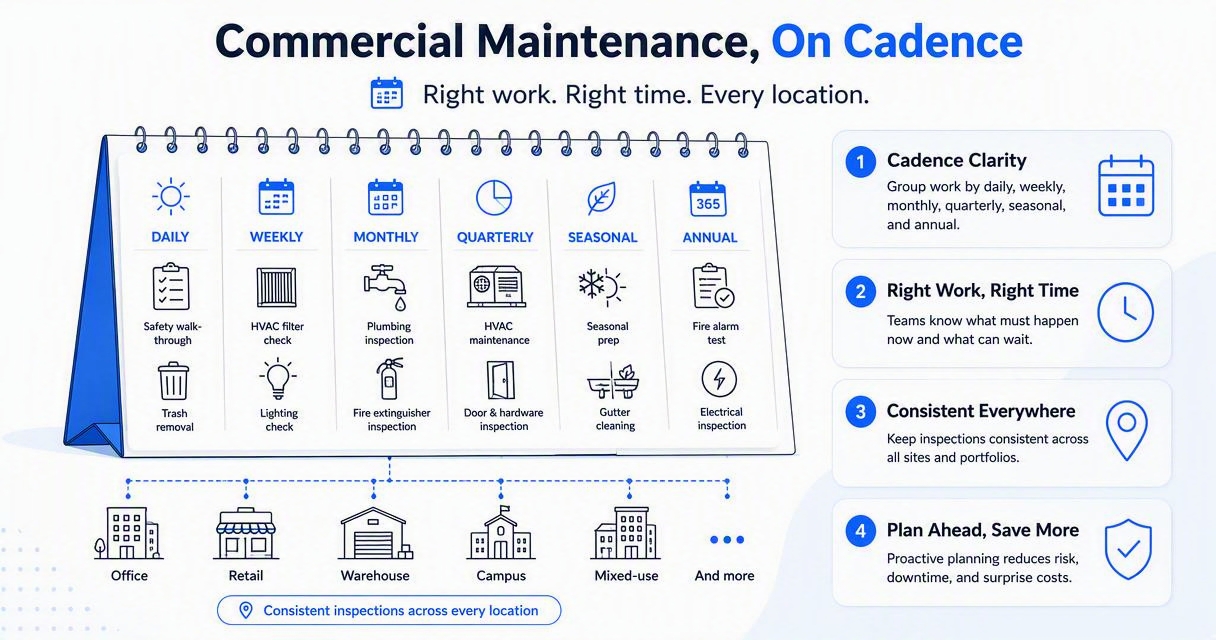
Cadence-based maintenance checklist
| Cadence | Core tasks | Proof to collect |
|---|---|---|
|
Daily |
Walk entrances, lobbies, restrooms, loading areas, and visible safety hazards |
Photo, issue notes, immediate work order if needed |
|
Weekly |
Check lighting, door hardware, trash areas, leaks, signage, and common-area condition |
Pass or fail status, repair notes |
|
Monthly |
Inspect HVAC filters, plumbing fixtures, electrical rooms, roof drains, pest activity, and parking areas |
Readings, photos, asset notes |
|
Quarterly |
Test emergency lighting, review vendor PMs, inspect panels, check belts, lubricate moving parts |
Test results, vendor invoice, closeout report |
|
Seasonal |
Prepare HVAC for heating or cooling season, inspect roofs after storms, service irrigation, check snow or heat plans |
Seasonal checklist, photos, contractor notes |
|
Annual |
Fire and life safety inspections, backflow testing where required, capital asset review, insurance documentation |
Certificates, compliance files, budget notes |
Daily checks should be short. A five-minute walkthrough can catch water on floors, blocked exits, damaged doors, overflowing waste, and broken lights before they become complaints.
Monthly and quarterly work deserves tighter documentation. Deferred maintenance tends to hide inside slow leaks, dirty coils, loose electrical connections, and worn belts, which is why facility leaders often study the hidden cost of deferred maintenance when building budgets.
Annual tasks should connect to compliance, insurance, capital planning, and lease obligations. Certificates, vendor reports, and inspection records should be easy to retrieve during audits, ownership reviews, or incident investigations.
What should each building system checklist include?
Each building system checklist should define the asset, inspection point, acceptable condition, required action, priority level, and documentation standard. The strongest checklist separates simple in-house observations from licensed vendor work so responsibility stays clear.
HVAC, plumbing, electrical, exterior, safety, and shared-space tasks
HVAC and ventilation
-
Replace or inspect filters based on usage, occupancy, and manufacturer guidance.
-
Check belts, coils, drain pans, vibration, thermostats, economizers, and unusual noise.
-
Confirm rooftop units are secure, labeled, accessible, and free of debris.
Plumbing and water systems
-
Inspect restrooms, janitor closets, kitchens, water heaters, valves, and visible piping.
-
Look for slow drains, running toilets, corrosion, low pressure, and moisture under fixtures.
-
Schedule backflow, grease trap, sump pump, and sewer work where applicable.
Electrical and lighting
-
Check panels for labeling, clearance, heat, moisture, and visible damage.
-
Replace failed lamps, inspect exterior lighting, and test emergency lights.
-
Escalate breaker trips, burning smells, exposed wiring, or overloaded circuits.
Exterior and envelope
-
Inspect roof drains, gutters, downspouts, flashing, sealants, sidewalks, curbs, and parking lots.
-
Check doors, docks, fences, gates, windows, and drainage after heavy weather.
-
Track roof issues with photos because small openings can become major interior damage.
Safety and common areas
-
Confirm exits are clear, signs are visible, floors are safe, and handrails are secure.
-
Inspect lobbies, corridors, elevators, stairwells, break rooms, and tenant-facing spaces.
-
Record fire extinguisher status, alarm panel issues, first-aid supplies, and trip hazards.
"In God we trust. All others must bring data.", W. Edwards Deming, The Deming Institute
That mindset fits maintenance records. A completed task without timestamped evidence, photos, readings, or vendor notes is hard to defend later.
Predictive programs go one step further by using asset history and condition signals to plan work before failure. Facility teams exploring that model can read the benefits of predictive maintenance.
How should teams turn checklist items into recurring tasks?
Teams should convert checklist lines into recurring tasks by assigning ownership, cadence, assets, priority, instructions, proof requirements, and escalation rules. That process turns a generic list into a live maintenance program that can be audited, repeated, and improved across every building.
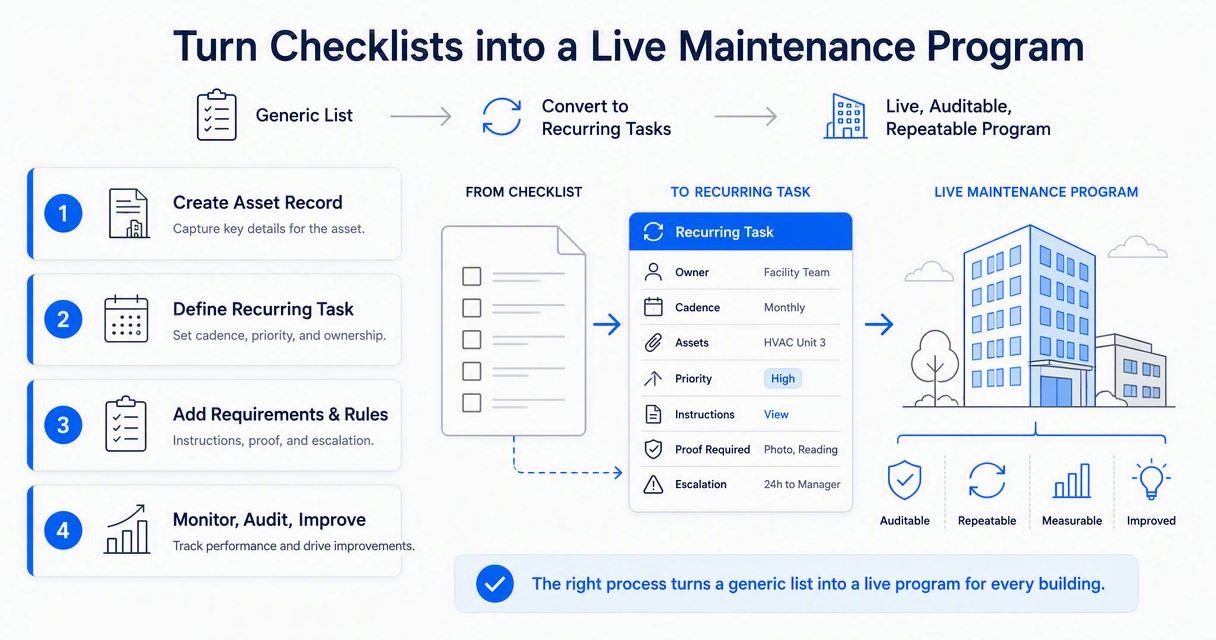
Workflow for recurring maintenance tasks
-
Create asset records: Name the equipment, location, model, serial number, warranty status, and vendor.
-
Set the cadence: Match daily, weekly, monthly, seasonal, or annual timing to risk and manufacturer guidance.
-
Assign responsibility: Route work to an in-house technician, mobile team, or approved vendor.
-
Attach instructions: Add checklist steps, lockout notes, access details, photos, and safety requirements.
-
Require proof: Use timestamps, readings, signatures, photos, and closeout comments.
-
Escalate exceptions: Trigger follow-up work orders when an inspection fails.
-
Review trends: Compare repeat issues, emergency calls, labor hours, and vendor response times.
The Leansite platform is built for this kind of operational loop: checklist, work order, proof, escalation, and reporting. More details are available at Leansite, and teams can also visit getleansite.com when ready to see how recurring work can be organized across locations.
A digital work-order flow also reduces the lag between issue discovery and action. For a practical workflow, see how to simplify facility work orders fast.
Connectivity should be part of the plan. Basements, roofs, mechanical rooms, parking decks, and remote sites often have weak signal, so offline access matters for inspections and closeout notes. Related risks are covered in the hidden cost of poor connectivity in facilities management.
FAQ: commercial building maintenance checklist
The most useful maintenance checklist is short enough for daily use, detailed enough for compliance, and structured enough to become recurring work. These answers cover common questions from facility managers, owners, vendors, and operations leaders.
How often should a commercial building be inspected?
A commercial building should be inspected daily for visible safety and cleanliness issues, monthly for core systems, seasonally for weather-sensitive assets, and annually for compliance and capital planning. Higher-risk sites such as restaurants, healthcare buildings, warehouses, and high-traffic retail locations may need tighter schedules based on use and local requirements.
Who owns the facility maintenance checklist?
Ownership usually sits with the facility manager, property manager, or operations director. Individual tasks may be assigned to technicians, janitorial teams, security staff, vendors, or specialty contractors. Clear ownership matters because shared responsibility without task assignment often leads to missed inspections and weak documentation.
What is the difference between preventive and corrective maintenance?
Preventive maintenance happens before failure, such as inspections, lubrication, cleaning, calibration, and scheduled replacement. Corrective maintenance happens after a fault is found or a system fails. A good checklist includes both: preventive tasks to reduce breakdowns and corrective workflows to document repairs when inspections uncover problems.
Should a checklist be paper or digital?
Paper works for simple walkthroughs, but digital checklists are better for recurring schedules, photos, timestamps, multi-site reporting, and vendor coordination. Many teams still use paper because it feels fast in the field, but digital systems make completion easier to prove later. Leansite supports that shift without making the checklist process feel heavy.
Conclusion
A facility maintenance checklist for commercial buildings works best when it becomes an operating system, not a forgotten file. Start with cadence-based tasks, organize them by building system, assign every item to a responsible party, and require proof at closeout. For teams ready to replace scattered notes with recurring work, vendor tracking, and cleaner records, Leansite is a practical next step. Head to getleansite.com and map the first 30 days of preventive tasks before the next emergency repair sets the schedule.