TL;DR
Facility efficiency improves when teams measure labor hours, response times, vendor spend, asset uptime, repeat work, and portfolio visibility together. The strongest 2026 playbook combines preventive maintenance, clean work-order data, vendor accountability, and software that shows performance across every site.
Facility efficiency is no longer just a utility-bill conversation; it now decides how fast repairs get done, how much vendor work costs, and how clearly leaders see risk across a portfolio. Facility efficiency: the ability of a building, campus, or multi-site portfolio to deliver safe, reliable operations with the lowest practical waste in labor, time, spend, energy, and asset downtime. Platforms such as Leansite help facilities teams connect work orders, vendors, assets, and approvals so efficiency becomes measurable instead of anecdotal.
Table of Contents
What is facility efficiency?
Facility efficiency is the measurable relationship between operating output and the resources required to produce it, including labor hours, response times, vendor spend, asset uptime, repeat work, and visibility across locations. A highly efficient facility resolves issues quickly, prevents avoidable failures, controls third-party costs, and gives leaders clear data for decisions.
A simple definition helps separate efficiency from cost cutting. Cutting cost can reduce service quality. Efficiency protects uptime while reducing waste.
Core operating terms:
-
Labor efficiency: completed work compared with technician hours, overtime, and travel time.
-
Response efficiency: time from request submission to acknowledgement, dispatch, and completion.
-
Vendor efficiency: outside spend measured against scope, speed, quality, and invoice accuracy.
-
Asset efficiency: uptime, lifecycle cost, and maintenance history for equipment such as HVAC, refrigeration, plumbing, lighting, elevators, and forklifts.
-
Portfolio visibility: the ability to compare sites, regions, vendors, and asset classes in one view.
"In God we trust; all others must bring data.", W. Edwards Deming, The W. Edwards Deming Institute
That quote fits facilities work because gut feel hides repeat problems. One noisy HVAC unit, one slow vendor, or one unclear approval path can look small at a single site but become expensive across 50 locations.
How should facility efficiency be measured?
Facility efficiency should be measured with a small scorecard that connects speed, cost, quality, uptime, and visibility instead of tracking isolated work-order counts. The best scorecards show whether maintenance is getting faster, more planned, less repetitive, and easier to manage across sites.
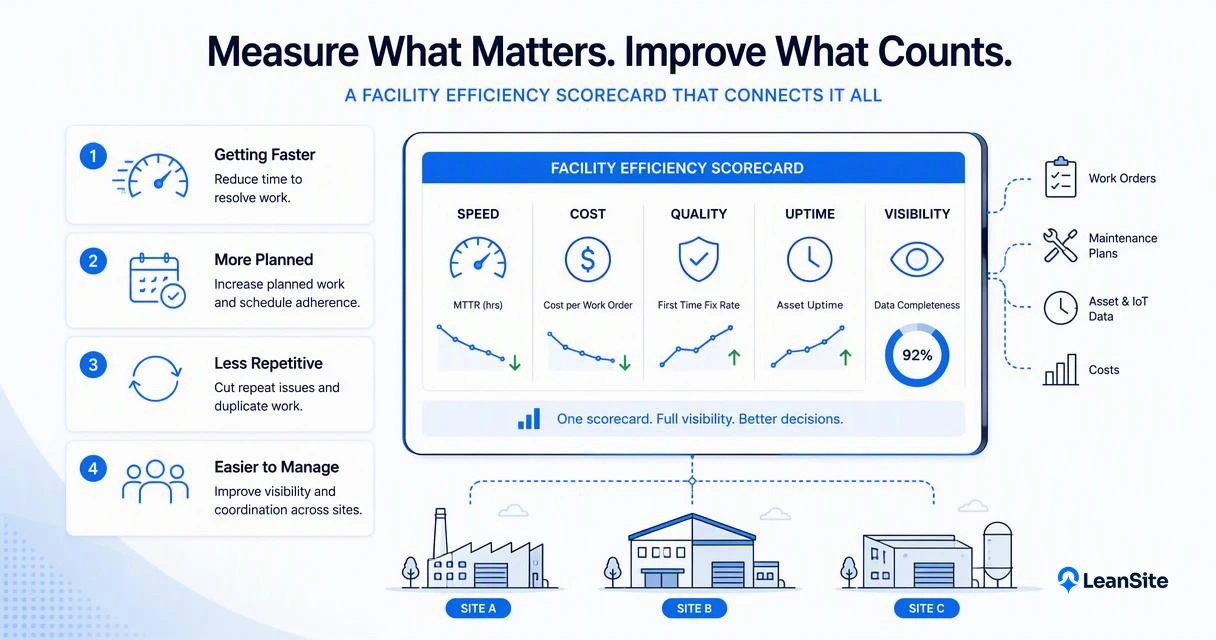
Core metrics scorecard for facility teams
|
Metric |
What it answers |
Strong signal |
Watchout |
|---|---|---|---|
|
Average response time |
How fast work starts |
Shorter time from request to dispatch |
Fast acknowledgement can still hide slow completion |
|
First contact resolution rate |
How often issues close without rework |
More requests fixed on first visit |
Complex jobs may need parts or approvals |
|
Maintenance plan compliance |
Whether planned work happens on schedule |
Higher completion of PM tasks |
Checking boxes is not the same as preventing failures |
|
Asset uptime |
How reliably equipment supports operations |
Fewer unplanned outages |
Uptime needs asset criticality context |
|
Repeat work rate |
Whether repairs actually hold |
Fewer callbacks for the same issue |
Poor issue coding can hide repeats |
|
Vendor spend per site |
Where outside costs concentrate |
Stable cost with consistent service levels |
Low spend may mean deferred work |
|
Labor hours per work order |
How much effort work consumes |
Lower hours without lower quality |
Route time and admin time matter |
|
Portfolio visibility |
Whether leaders can compare locations |
Standard dashboards across sites |
Inconsistent categories ruin comparisons |
Average response time, first contact resolution, and maintenance plan compliance appear in competitor coverage, including Famase's article on key indicators for facility management efficiency and Yardi Corom's discussion of regular maintenance, technology, energy initiatives, and space optimization. The missing piece is how those metrics work together.
For multi-location operators, the scorecard should roll up by region, brand, site type, asset class, vendor, and priority level. A deeper guide to that operating model is available in Leansite's article on multi-location facilities management software.
What improves operating performance fastest?
Operating performance improves fastest when teams standardize requests, shift repeat work into preventive maintenance, and make vendor activity visible from dispatch through invoice. The fastest gains usually come from fixing handoffs rather than buying new equipment first.
A practical 6-step improvement playbook
-
Standardize work-order categories. Use consistent issue types, priorities, locations, assets, and closeout notes.
-
Separate urgent from important. Safety, shutdown risk, and revenue-impacting issues need different workflows than cosmetic repairs.
-
Audit repeat work weekly. Repeat HVAC, plumbing, door, refrigeration, or electrical calls often point to poor root-cause resolution.
-
Move predictable tasks into PM plans. Filter changes, inspections, cleaning, calibration, and seasonal checks should not depend on memory.
-
Track vendor lifecycle data. Measure dispatch speed, first-time fix quality, not-to-exceed approvals, quote aging, and invoice variance.
-
Review by portfolio segment. Restaurants, campuses, warehouses, clinics, and retail sites have different uptime risks.
The Leansite platform fits this playbook by centralizing work orders, vendor dispatch, approvals, and performance history in one operating view. For teams comparing software options, the guide to top work-order platforms for multi-site facilities offers useful evaluation criteria.
Energy projects still matter, especially lighting, HVAC controls, appliances, and space use. Yet equipment upgrades work best after the basics are clean. Otherwise, teams may replace assets while leaving bad scheduling, vague scopes, and weak vendor accountability untouched.
Relevant visual example
Airport design shows the same principle at a larger scale: flow, visibility, and bottleneck reduction often matter as much as the building systems themselves.
Where do teams lose efficiency most often?
Teams lose efficiency most often in the gaps between request intake, dispatch, completion notes, approvals, and portfolio reporting. The work may still get done, but the organization loses time, cost control, and institutional memory along the way.
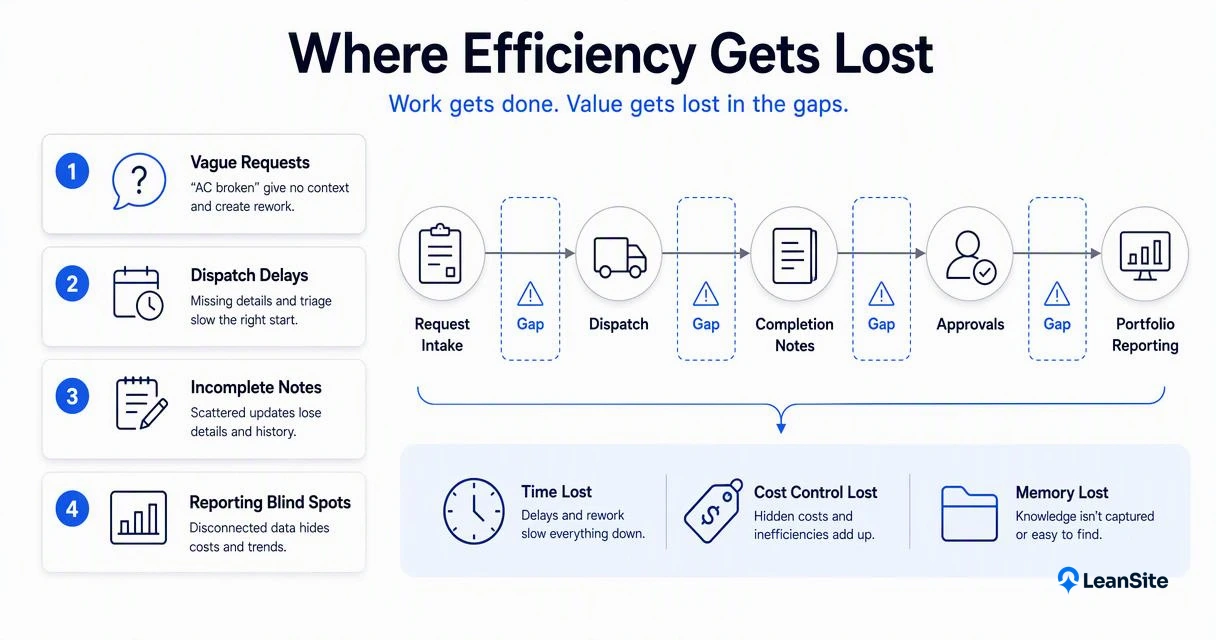
Common friction points include:
-
Vague work requests: "AC broken" gives less direction than asset, zone, temperature, symptoms, and urgency.
-
Untracked phone calls and texts: informal dispatch can speed one job while hiding workload and spend.
-
Missing asset history: teams cannot see whether repair or replacement makes more sense.
-
Slow quote approvals: jobs sit idle while vendors wait for permission.
-
Poor closeout data: no photos, root cause, parts used, or follow-up need.
-
Invoice mismatch: billed work does not clearly match the approved scope.
These problems become harder in chain restaurants, campus environments, and regional portfolios because volume hides patterns. Leansite's guide to restaurant chain facilities management in 2026 shows how location-based operations need both speed and cost visibility. Campus teams face similar transparency pressure, especially when stakeholders want clearer status updates, as covered in work-order transparency for campus facilities.
Manual tracking vs connected operations
|
Operating area |
Spreadsheet or inbox process |
Connected facilities process |
|---|---|---|
|
Intake |
Free-text requests vary by person |
Structured forms capture site, asset, priority, and photos |
|
Dispatch |
Calls, texts, and emails scatter updates |
Assignments, SLAs, and vendor notes stay in one record |
|
Approvals |
Quote decisions get buried |
Thresholds and approval history remain visible |
|
Reporting |
Monthly cleanup required |
Dashboards update from live work-order data |
|
Vendor payment |
Invoice review is manual |
Scope, completion, and cost history support faster review |
Better data maturity also takes time. The article on why year two is when facilities data proves its value explains why trends become more useful after teams build consistent history.
What should leaders expect in 2027?
Leaders should expect efficiency programs in 2027 to focus more on AI-assisted triage, predictive maintenance, vendor benchmarking, and portfolio-level decision support. The shift will not remove facilities expertise; it will make clean operational data more valuable.
AI will likely help sort requests, recommend vendors, summarize job history, flag duplicate issues, and identify assets with rising risk. That matches the broader software direction described in Leansite's guide to AI facility management software. Tools such as Vera, described in Leansite's AI assistant overview, point toward faster answers inside daily workflows.
Still, AI cannot fix unclear categories, missing closeout notes, or inconsistent vendor rules. The better 2026 move is to clean the operating model now: standard fields, required photos, asset tagging, PM calendars, approval thresholds, and vendor scorecards.
FAQ
What is a good first metric to track?
Average response time is often the best first metric because it shows how quickly the team acknowledges and starts work. It should be paired with completion time and repeat work rate, since fast dispatch without durable resolution can create a false sense of progress.
How often should efficiency metrics be reviewed?
Site-level metrics should be reviewed weekly, while portfolio trends usually need a monthly operating review. Weekly reviews catch stuck work and repeat issues. Monthly reviews help leaders compare vendors, regions, asset classes, budget pressure, and preventive maintenance compliance.
Does efficiency always mean fewer people?
Efficiency does not always mean a smaller team. In facilities, it often means fewer avoidable trips, clearer priorities, better vendor coordination, and more planned work. Labor savings may show up as less overtime, faster completion, or more time available for inspections and improvement projects.
How can a facility team start without new software?
A team can start by standardizing request categories, requiring closeout notes, tagging critical assets, and reviewing repeat work every week. Software becomes more valuable once those rules exist because the system can turn consistent activity into useful dashboards and decision support.
Conclusion
Facility efficiency improves when the operating model connects work intake, labor, vendors, assets, preventive maintenance, and portfolio reporting. The next practical step is a 30-day baseline: capture response time, repeat work, PM compliance, vendor spend, and asset downtime, then review the worst patterns by site and asset class. For teams ready to manage that process in one system, Leansite can support cleaner work orders, clearer vendor coordination, and faster reporting. Head to getleansite.com to see how a connected facilities workflow can turn daily maintenance activity into measurable operational control.