TL;DR
A strong facilities maintenance RFP should define scope, service levels, software requirements, implementation expectations, and scoring before vendors respond. The best 2026 procurement process favors measurable uptime, mobile work orders, asset data, vendor accountability, and clear cost visibility.
A facilities maintenance RFP template turns a messy vendor search into a measurable buying process. Facilities maintenance RFP: a request for proposal that asks vendors or software providers to explain how they will manage maintenance work, assets, service levels, reporting, pricing, and support across one site or many locations. For teams comparing platforms, Leansite is relevant because maintenance, dispatching, job tracking, vendor coordination, and portfolio visibility all belong in the same evaluation, not in separate spreadsheets.
Table of Contents
What should a facilities maintenance RFP include?
A facilities maintenance RFP should include company context, site details, scope of work, service-level requirements, software needs, implementation expectations, support standards, pricing format, security questions, and a weighted scoring matrix. This structure keeps proposals comparable and reduces vague promises during final selection.
The RFP should start with the operating reality. A restaurant chain, healthcare facility, retail portfolio, warehouse network, and office campus will not evaluate maintenance the same way. Multi-site teams should define location count, asset categories, trade coverage, internal staff roles, and outside vendor volume before asking for pricing.
A good RFP does not ask, "Can this vendor do maintenance?" It asks, "Can this vendor prove how maintenance will be planned, tracked, measured, and improved?"
Core RFP sections to copy into the document
-
Company overview: business type, operating hours, location count, and maintenance maturity.
-
Procurement timeline: RFP release date, question deadline, demo window, finalist interviews, award date, and expected launch.
-
Scope of work: preventive maintenance, reactive work, inspections, asset tracking, vendor dispatch, parts, invoices, and reporting.
-
Service levels: response times, completion targets, escalation rules, uptime goals, and proof requirements.
-
Technology requirements: mobile work orders, asset records, dashboards, integrations, permissions, and audit trails.
-
Commercial terms: pricing model, implementation fees, support costs, renewal terms, and cancellation language.
The International Organization for Standardization describes facility management as work that connects people, place, and process within the built environment. That definition, reflected in ISO 41001 facility management standards, supports a broad RFP scope that covers operations, not just repairs.
Helpful procurement overview video
This overview is useful for procurement teams that need a quick refresher on RFP structure before tailoring the document for facilities operations.
How should the scope of work be written?
The scope of work should describe the exact maintenance outcomes expected, the assets covered, the trades included, the locations in scope, and the responsibilities split between internal teams, vendors, and software providers. Specific scope language prevents vendors from pricing different assumptions.
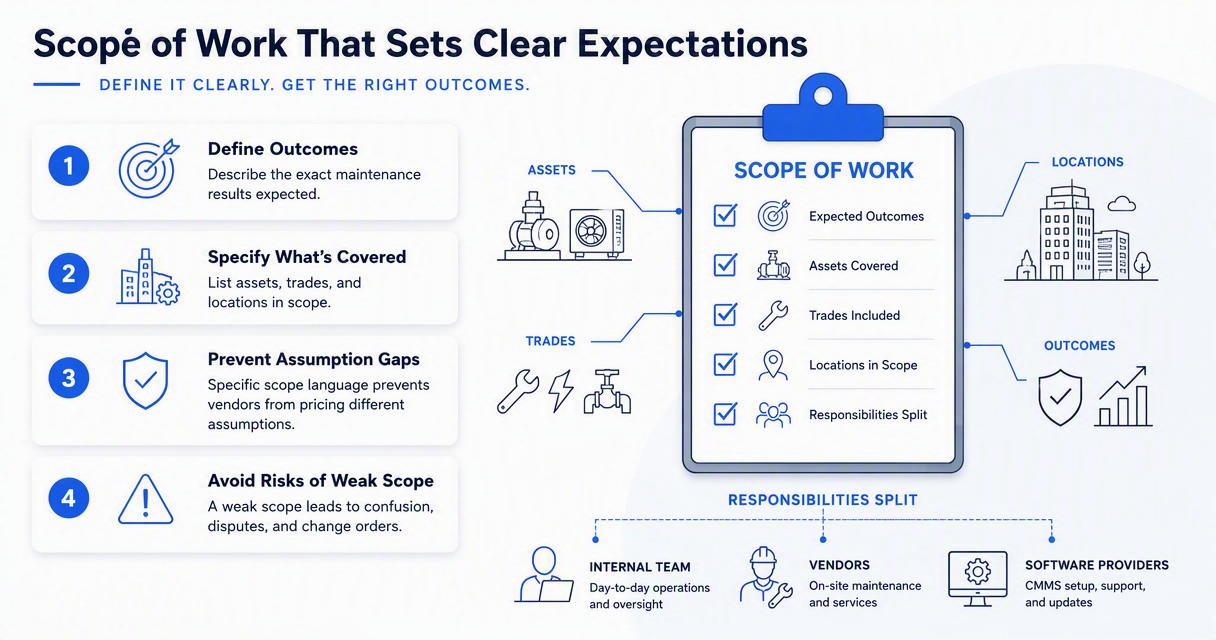
A weak scope says "manage maintenance requests." A strong scope separates emergency response, recurring preventive tasks, inspections, capital work support, vendor assignment, documentation, and closeout evidence.
For broader background on portfolio-level operations, the guide to multi-location facilities management software explains why location consistency matters when asset conditions, vendors, and budgets vary by market.
Scope categories and required vendor responses
|
Scope area |
RFP requirement |
Vendor response should prove |
|---|---|---|
|
Reactive maintenance |
Intake, triage, dispatch, completion, photos, and notes |
How requests move from issue to closeout |
|
Preventive maintenance |
Calendar tasks, asset schedules, recurring checklists |
How missed PMs are flagged and corrected |
|
Asset management |
Equipment records, warranty dates, service history |
How asset data stays accurate over time |
|
Vendor coordination |
Trade coverage, assignment rules, compliance, invoices |
How outside vendors are tracked and measured |
|
Reporting |
Dashboards, exports, cost trends, SLA performance |
How leaders see risk before budgets slip |
Large operators should ask vendors to provide sample workflows, not just feature lists. A workflow answer shows who receives the request, what happens after hours, who approves spend, how evidence is captured, and how exceptions get escalated.
Scope language for multi-site teams
A multi-site maintenance RFP should require location hierarchies, regional permissions, trade-specific routing, and portfolio reporting. These details matter because national operations teams often need local execution with central visibility.
Useful language can be short: "The provider must support location-level work orders, regional vendor assignment, portfolio dashboards, and role-based access for facilities, operations, finance, and executive users."
Teams managing restaurants or retail locations can adapt the same approach with industry-specific assets such as HVAC, refrigeration, lighting, plumbing, kitchen equipment, signage, and life-safety systems. Related operational examples appear in the 2026 guide to facilities management for restaurant chains.
Which software requirements belong in the RFP?
Software requirements should cover work order intake, mobile execution, preventive maintenance, asset history, vendor management, approvals, reporting, integrations, data ownership, and implementation support. A modern facilities platform should help teams reduce manual follow-up, not create another place to copy data.
For 2026, the RFP should also ask how artificial intelligence is used, where human approval remains required, and how recommendations are audited. The buying team can review current use cases in AI facility management software before adding AI requirements to the document.
The Leansite platform fits this part of the evaluation when procurement teams want one system for maintenance requests, vendor dispatch, job status, approvals, and multi-location visibility. The RFP should ask every provider to demonstrate those workflows with real examples, not polished slideware.
Feature checklist for maintenance platforms
-
Request intake: web, mobile, QR code, email, or location-level submission.
-
Work order routing: automatic assignment by trade, priority, location, and approval rule.
-
Mobile execution: technician notes, photos, timestamps, status updates, and checklists.
-
Preventive maintenance: recurring schedules, asset-based tasks, missed-work alerts, and completion proof.
-
Vendor controls: insurance, rates, dispatch history, SLA tracking, and invoice matching.
-
Dashboards: open work, overdue tasks, spend, asset trends, and vendor performance.
-
Integrations: finance, identity, messaging, ERP, accounting, and existing CMMS data.
-
Data rights: export access, retention policy, implementation migration, and offboarding plan.
Preventive maintenance deserves extra weight because it protects uptime and reduces avoidable reactive work. The article on predictive maintenance benefits is a useful follow-up when teams want to move beyond calendar-based tasks.
How should vendors be scored?
Vendors should be scored with a weighted matrix that balances operational fit, software capability, implementation plan, support quality, reporting depth, security, and total cost. Weighting prevents the lowest bid from winning when it cannot meet uptime, visibility, or adoption goals.
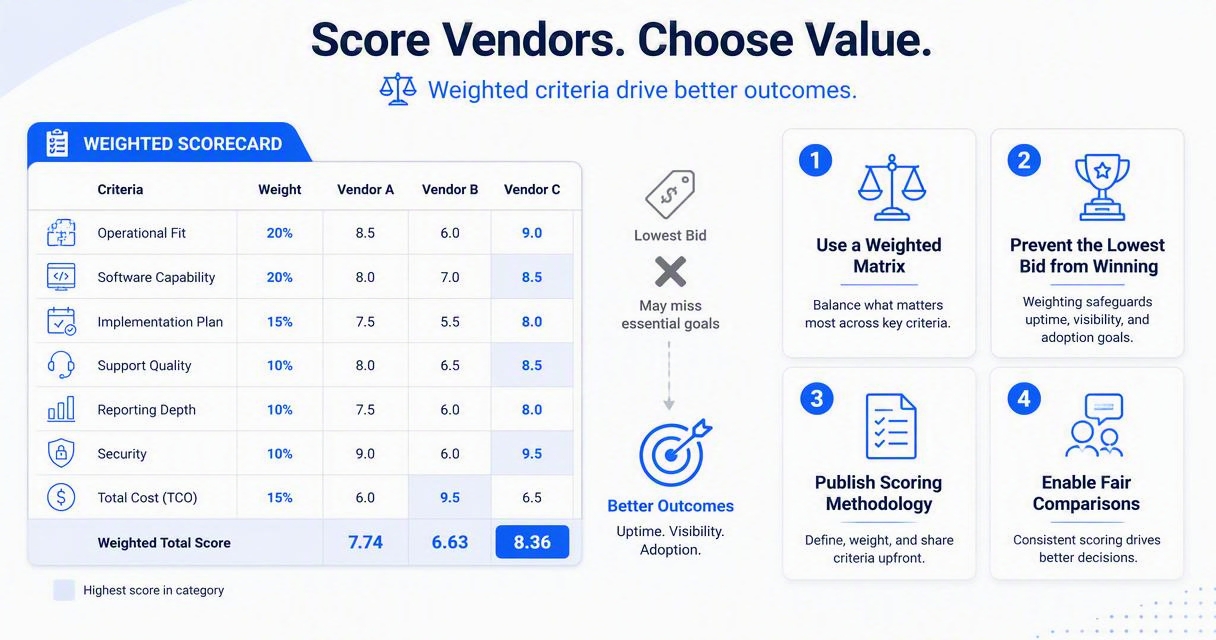
Procurement teams should publish the scoring model inside the RFP. That move tells vendors what matters and reduces confusion after demos. It also helps executives compare finalists using the same standard.
Recommended RFP scoring matrix
|
Category |
Weight |
What to evaluate |
|---|---|---|
|
Operational fit |
20% |
Site types, trade coverage, workflow match, asset complexity |
|
Platform capability |
20% |
Work orders, PMs, mobile tools, vendor controls, dashboards |
|
Implementation plan |
15% |
Timeline, data migration, training, launch support |
|
Reporting and analytics |
15% |
SLA trends, spend visibility, asset history, executive dashboards |
|
Support and account management |
10% |
Response model, escalation path, success reviews |
|
Security and data governance |
10% |
Permissions, audit logs, data exports, integration controls |
|
Total cost |
10% |
Subscription, services, add-ons, renewal terms |
A comparison article such as Leansite vs. Accruent Maintenance Connection can help buyers think through category tradeoffs before building a final scorecard.
"If you can't describe what you are doing as a process, you don't know what you're doing.", W. Edwards Deming, The W. Edwards Deming Institute
That quote applies directly to maintenance procurement. A vendor that cannot describe implementation, escalation, reporting, and continuous improvement as a process may be hard to manage after contract signature.
What implementation questions should the RFP ask?
The RFP should ask vendors to explain launch timeline, data migration, user training, change management, integration work, support coverage, and success milestones. Implementation quality often decides whether a maintenance platform becomes the system of record or another underused tool.
A practical RFP asks for named roles. Vendors should identify the project manager, implementation consultant, technical contact, support path, and executive sponsor. Buyers should also ask how adoption will be measured after 30, 60, and 90 days.
With Leansite, implementation discussions should focus on how locations, users, vendors, assets, workflows, and approval rules get configured for daily maintenance work. Teams comparing multi-site tools can also review best multi-site maintenance software in 2026 for additional selection context.
Implementation questions to include
-
What data fields are required before launch?
-
How are assets, locations, vendors, users, and permissions imported?
-
Which integrations are standard, and which require paid services?
-
What training is included for requesters, technicians, managers, vendors, and executives?
-
How are legacy work orders and asset histories handled?
-
What does the vendor consider a successful go-live?
-
Which reports will be available on day one?
-
How often will performance be reviewed after launch?
RFPs should also request a sample implementation plan. A credible plan includes dates, responsibilities, dependencies, and risks. A vague plan with "training and configuration included" is not enough for complex facilities operations.
FAQ
Facilities teams often ask the same procurement questions before issuing an RFP. These answers can be copied into planning notes before the document is finalized.
How long should a facilities maintenance RFP be?
A practical RFP is usually long enough to define scope, requirements, pricing, implementation, and scoring without overwhelming vendors. Many teams can cover the essentials in 10 to 20 pages, plus attachments for asset lists, locations, sample work orders, and contract terms.
Should an RFP cover both services and software?
An RFP should cover both when maintenance execution depends on technology. Even service-heavy contracts need work order tracking, SLA reporting, asset history, invoice review, and escalation visibility. Separating service questions from software questions often hides gaps until after launch.
How many vendors should receive the RFP?
Most teams benefit from a focused shortlist instead of a broad blast. Three to six qualified vendors usually gives procurement enough comparison without creating review fatigue. The shortlist should include providers that already match location count, asset complexity, reporting needs, and support expectations.
What is the biggest mistake in a maintenance RFP?
The biggest mistake is asking for generic capabilities instead of measurable workflows. A better document asks vendors to show how a request is created, approved, dispatched, completed, verified, reported, and billed. That format exposes operational fit much faster than yes-or-no feature responses.
Conclusion
A facilities maintenance RFP template should make every vendor prove scope fit, workflow clarity, SLA discipline, software strength, reporting value, and implementation readiness. The next step is to copy the sections above into a working document, add site and asset details, assign scoring weights, and require a live demo using real maintenance scenarios. For teams ready to compare modern maintenance operations workflows, Leansite information is available at getleansite.com.