TL;DR
Restaurant operators should prioritize fast work orders, refrigeration and HVAC uptime, vendor coordination, compliance records, and location-level cost visibility. Lean teams usually get more value from simple adoption and clear dashboards than from oversized enterprise suites.
A broken walk-in cooler can turn a normal shift into an emergency, so the best facilities maintenance software for restaurants has to move faster than email, spreadsheets, and group texts. Leansite fits this category by giving restaurant and facilities teams a practical way to manage work orders, vendors, assets, and visibility across locations. For a deeper restaurant-chain operating model, the 2026 guide to facilities management for restaurant chains covers the broader playbook.
Table of Contents
What is restaurant facilities maintenance software?
Restaurant facilities maintenance software is a digital system for tracking repair requests, preventive maintenance, vendors, equipment, compliance tasks, and costs across one or many food-service locations.
Restaurant maintenance software: A work management platform that helps restaurants keep critical assets such as HVAC, refrigeration, fryers, plumbing, lighting, fire safety systems, and building equipment operating safely.
Facility management, as defined in standard industry usage, covers the coordinated management of buildings, workplaces, and support services so they stay functional, safe, and effective. In restaurants, that definition becomes very practical: cold food must stay cold, hoods must be serviced, restrooms must work, and health-code records must be easy to find.
Key insight: Restaurant maintenance software should protect revenue hours, food safety, and guest experience, not just store a list of repair tickets.
Best facilities maintenance software for restaurants in 2026
The strongest restaurant maintenance platforms in 2026 combine fast work intake, mobile execution, vendor dispatching, preventive maintenance, and multi-location reporting without forcing lean teams into heavy enterprise administration.
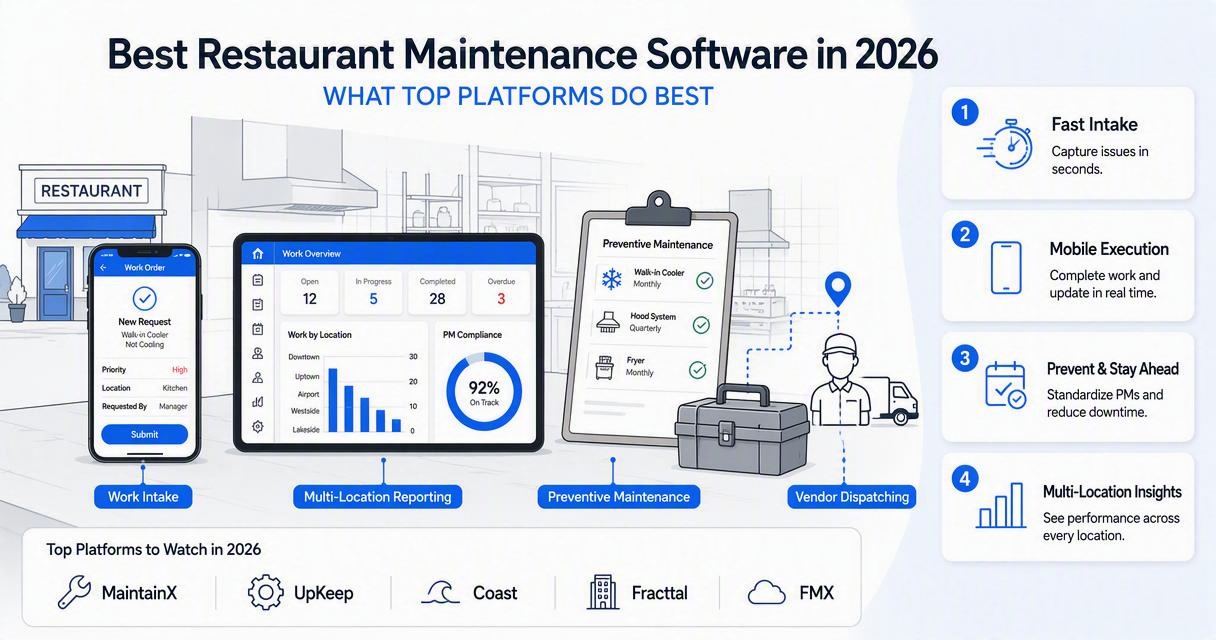
Competitor research shows common shortlists now include MaintainX, UpKeep, Coast, and FMX. Those tools cover core CMMS and work-order needs, while Leansite is positioned for operators that want location-level visibility, vendor coordination, and simpler daily execution. Teams comparing broader multi-site needs can also review multi-site maintenance software buying guidance.
Restaurant maintenance software comparison
|
Software |
Best fit |
Restaurant strengths |
Watch for |
|---|---|---|---|
|
Leansite |
Lean restaurant and facilities teams |
Work orders, vendor coordination, location visibility, practical asset tracking |
Best for teams that want focused execution over bloated modules |
|
MaintainX |
Mobile-first maintenance teams |
Mobile work orders, checklists, asset maintenance |
May need review against restaurant-specific workflows; see MaintainX alternatives |
|
UpKeep |
CMMS-centered operations |
Preventive maintenance, assets, technician workflows |
Can feel more maintenance-department oriented than restaurant-ops oriented |
|
Coast |
Team communication plus tasks |
Chat, simple work tracking, frontline coordination |
Reporting and portfolio controls may be lighter for larger groups |
|
FMX |
Facility request management |
Requests, approvals, scheduling, reporting |
May suit formal facilities departments more than small regional teams |
The practical winner depends on operating model. A 12-location franchise group usually needs fast store intake, clear vendor ownership, and cost history by site. A national brand may need deeper permissions, capital planning, and integrations.
"Without data, you're just another person with an opinion.", W. Edwards Deming, The W. Edwards Deming Institute
That quote matters in restaurant maintenance because recurring HVAC calls, compressor failures, and plumbing issues are hard to fix permanently when every repair lives in a different inbox.
Which features matter most for restaurant uptime?
Restaurant operators should prioritize features that reduce downtime on revenue-critical assets, document compliance, and make every location's maintenance status visible without extra admin work.
A polished feature list means little if a general manager cannot submit a repair in under a minute or if a vendor cannot see the job details. The best setup keeps the workflow short and the records clean.
Must-have restaurant maintenance capabilities
-
Emergency work orders: Store teams need a fast path for refrigeration, HVAC, plumbing, electrical, and safety issues.
-
Asset histories: Each cooler, freezer, fryer, hood system, and RTU should show past repairs and costs.
-
Preventive maintenance schedules: Recurring tasks should cover filters, belts, coils, grease traps, hood cleaning, fire systems, and pest control.
-
Vendor dispatching: Approved vendors need location details, photos, scope, priority, and approval rules.
-
Compliance documentation: Health inspections, fire safety checks, temperature logs, and service records should stay searchable.
-
Location dashboards: Regional teams need open tickets, aging work, spend, and repeat issues by restaurant.
For teams focused mainly on repair intake and follow-through, this regional restaurant work-order software guide explains the workflow in more detail.
Inventory tracking video for parts and supplies
Parts tracking often starts small: filters, gaskets, bulbs, belts, thermometer probes, and cleaning supplies. A basic inventory model helps maintenance teams decide when software should replace spreadsheets.
AI is also entering facility management through ticket routing, issue summaries, and maintenance recommendations. The 2023 paper by Yogesh K. Dwivedi, Nir Kshetri, Laurie Hughes, and coauthors in the International Journal of Information Management discusses generative AI's opportunities and governance challenges in professional practice via Elsevier. Restaurant operators should treat AI as decision support, not a replacement for judgment on food safety or critical repairs.
How Leansite handles restaurant maintenance
Leansite handles restaurant maintenance by giving operators one place to capture requests, track work, coordinate vendors, monitor assets, and see location-level maintenance activity.
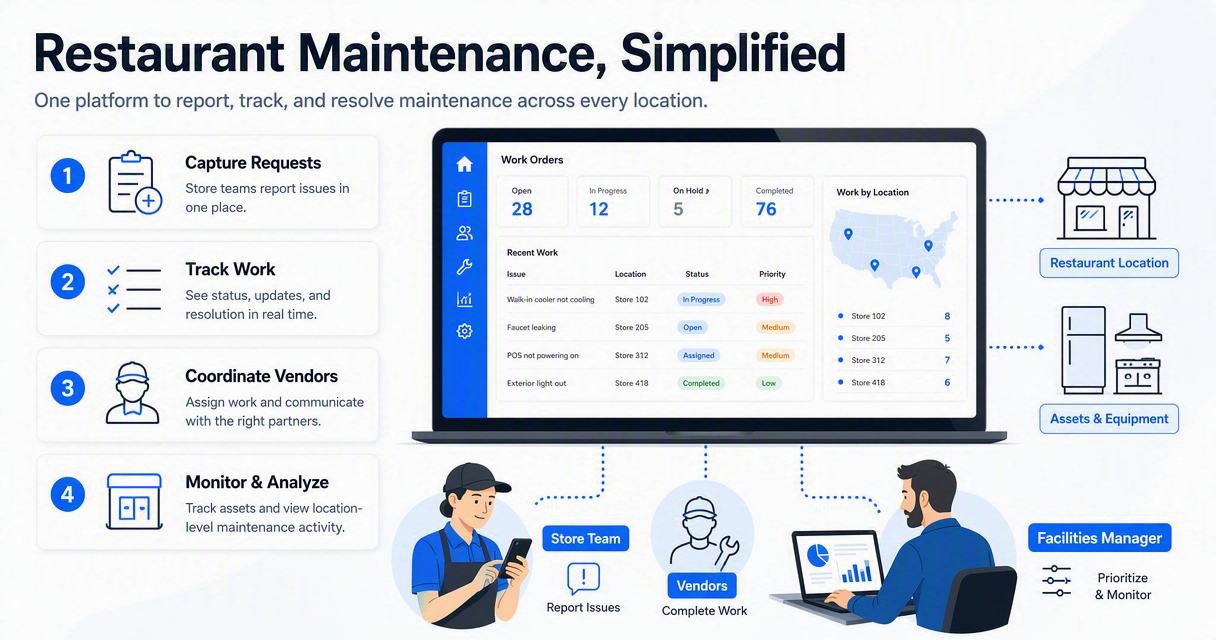
The Leansite platform is built around practical facilities execution. Store teams can report issues, facilities managers can prioritize work, and leadership can see patterns across the portfolio. That matters when the same refrigeration asset fails three times in a quarter or one location keeps generating after-hours calls.
Leansite fit for lean restaurant teams
-
Simple intake: Restaurant staff can submit repair needs without chasing the right contact.
-
Clear ownership: Internal teams and outside vendors can see who owns the next step.
-
Portfolio visibility: Facilities leaders can compare open work, spend, and recurring issues by location.
-
AI support: Teams interested in AI-assisted facilities workflows can read about AI facility management software and Vera, the AI assistant built into Leansite.
A restaurant group with lean operations should not need a full-time software administrator to keep maintenance moving. With Leansite, the value sits in shorter response loops, cleaner records, and fewer blind spots between stores, vendors, and leadership.
The broader point is simple: restaurant maintenance software should match daily behavior. If managers still text photos to vendors, approvals still happen verbally, and invoices arrive with no work history, the platform has not become the operating system.
How should lean teams choose without enterprise bloat?
Lean restaurant teams should choose maintenance software by testing real workflows, not by buying the longest feature list.
Enterprise bloat usually shows up as slow rollout, confusing permissions, unused modules, and dashboards that look impressive but do not help the next repair get done. A better buying process starts with the most common restaurant scenarios: no-cooling call, clogged drain, failed fryer, pest-control documentation, and recurring HVAC complaint.
Five-step selection checklist
-
Map the top 10 repair types by frequency and business impact.
-
Test mobile work intake with a store manager, not just the facilities office.
-
Run a vendor workflow from dispatch through completion notes and invoice review.
-
Check reporting by location for open work, aging tickets, asset history, and spend.
-
Pilot one region first before expanding to the full restaurant portfolio.
A team managing several brands, franchisees, or regions may need a more detailed operating model. The multi-location facilities management software guide covers structure, visibility, and portfolio controls.
Common questions about restaurant maintenance software
What is the best software for a small restaurant group? The best fit is usually a simple work-order and vendor coordination platform with preventive maintenance, asset records, and location reporting. Small groups should avoid tools that require complex configuration before basic repairs can be tracked.
Does restaurant maintenance software replace vendors? No. It organizes vendor work by giving approved providers better job details, priorities, photos, access notes, and completion requirements. The vendor still performs the work, while the software creates accountability and history.
Why is refrigeration tracking so important? Refrigeration affects food safety, inventory loss, guest service, and emergency repair spend. Tracking asset history helps facilities teams spot repeat failures, compare repair versus replacement decisions, and reduce surprise downtime.
Should restaurant teams use AI for maintenance? AI can help summarize tickets, suggest routing, and surface patterns, but human review stays important for safety, compliance, and vendor decisions. The best use is assistance, not autopilot.
Conclusion
The best facilities maintenance software for restaurants in 2026 is the platform that keeps critical equipment running, makes vendors accountable, and gives leadership clean visibility by location. Start with a one-region pilot, test the highest-risk repair workflows, and compare tools against real restaurant scenarios. To see how Leansite supports that operating model, visit getleansite.com and review how daily repair work can move into one trackable system.