TL;DR
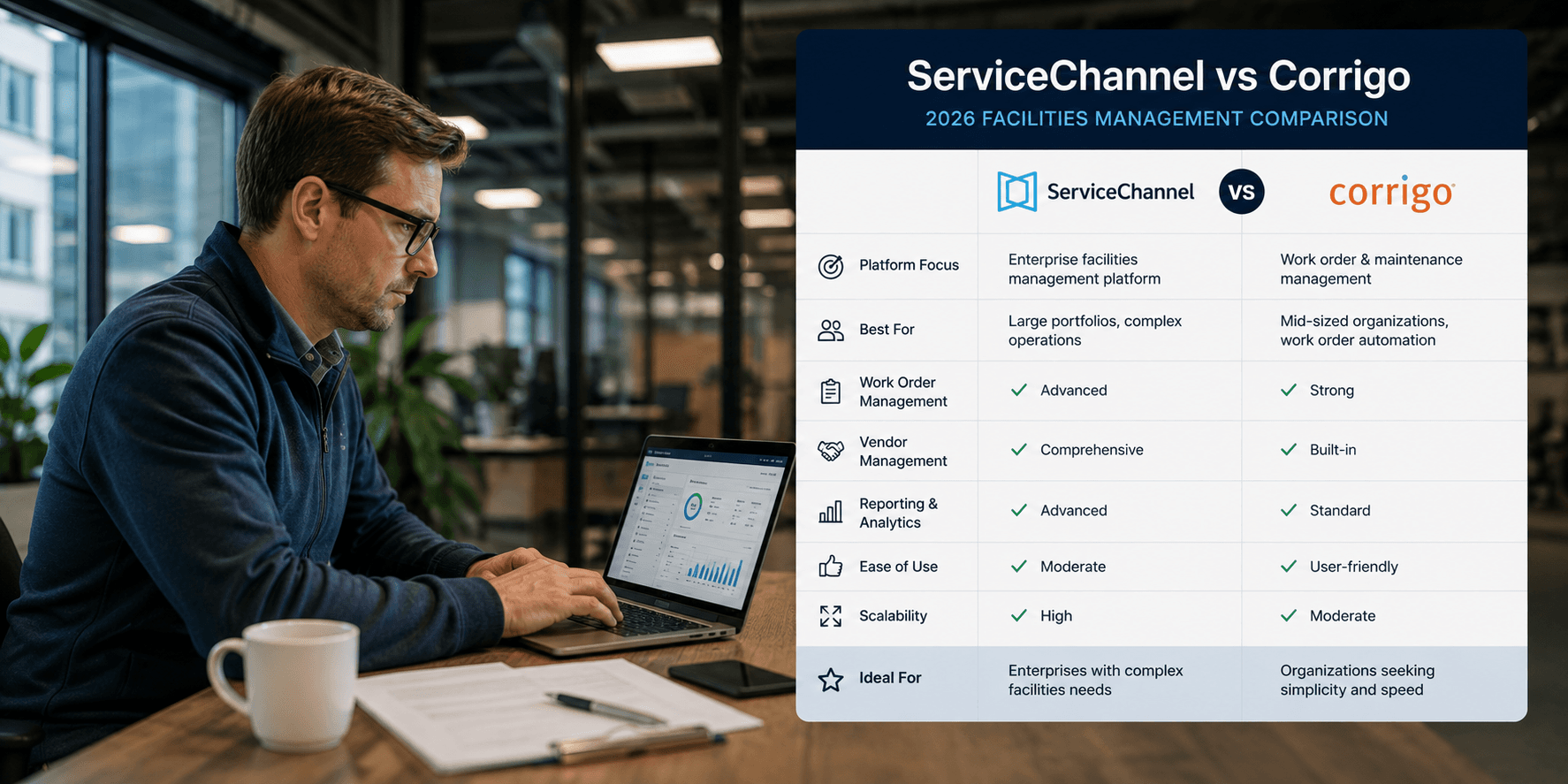
ServiceChannel is usually the stronger fit for large multi-site brands that need mature contractor sourcing and spend controls. Corrigo often fits teams that want JLL-connected facilities workflows, solid support scores, and structured maintenance operations. Teams that want a lighter, faster alternative should also evaluate Leansite before committing to either enterprise platform.
ServiceChannel vs Corrigo is really a choice between two enterprise facilities management styles: a contractor-heavy network model and a structured CMMS-style operations model. Both platforms help facilities teams manage work orders, vendors, assets, invoices, and reporting, but the better pick depends on portfolio complexity, vendor strategy, and rollout capacity. For teams that want a simpler path before buying an enterprise suite, Leansite is also worth a close look.
Table of Contents
What is the practical difference between ServiceChannel and Corrigo?
ServiceChannel is best known for multi-site contractor sourcing, work order management, compliance, and facilities spend control, while Corrigo focuses on CMMS-style maintenance execution, vendor coordination, and service operations. In short, ServiceChannel leans toward external service provider management, while Corrigo leans toward structured facilities operations across assets, technicians, and vendors.
Facilities management software: A system used to manage maintenance work orders, assets, vendors, preventive maintenance, compliance, invoices, and operating visibility across buildings or locations.
ServiceChannel describes itself as facilities management software for maintenance, contractor sourcing, and service automation on the ServiceChannel website. Corrigo is commonly evaluated as a facilities and work order platform, and G2's 2026 comparison notes that Corrigo stands out for a higher G2 rating and stronger support scores in its category-level comparison of Corrigo and ServiceChannel.
Fast decision table
| Choose this platform | Best fit | Main strength | Watch item |
|---|---|---|---|
| ServiceChannel | National retailers, restaurants, banks, and distributed brands | Contractor network, trade coverage, compliance, invoice workflows | Enterprise setup can require process discipline |
| Corrigo | Facilities teams that want structured CMMS workflows and JLL-connected service operations | Work order structure, asset maintenance, support reputation | Marketplace depth may not match ServiceChannel in some trades |
| Leansite | Teams that want modern facility task tracking without heavy enterprise overhead | Fast visibility, practical workflows, easier adoption | Best evaluated against specific portfolio needs |
ServiceChannel is often the safer enterprise bet when outside vendor governance is the main pain. Corrigo is often easier to justify when internal maintenance structure and support experience matter more.
How do work orders, vendors, and reporting compare?
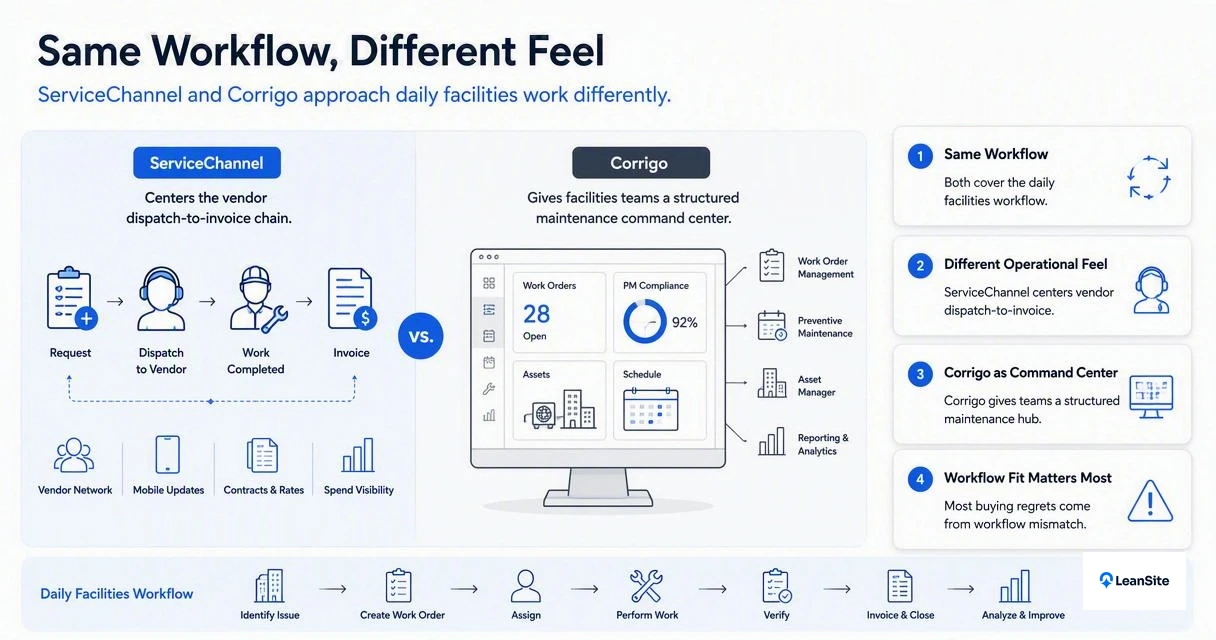
ServiceChannel and Corrigo both cover the daily facilities workflow, but the operational feel is different: ServiceChannel centers the vendor dispatch-to-invoice chain, while Corrigo gives facilities teams a structured maintenance command center. The distinction matters because most buying regrets come from workflow mismatch, not missing features.
Feature-by-feature comparison
| Capability | ServiceChannel | Corrigo | Practical meaning |
|---|---|---|---|
| Work orders | Strong for request intake, dispatch, status tracking, and approvals | Strong for work order structure, maintenance tracking, and service execution | Both can manage reactive work, but workflows feel different |
| Vendor network | Known for contractor sourcing and provider management | Supports vendor coordination and service providers | ServiceChannel has the stronger marketplace identity |
| Preventive maintenance | Supports recurring maintenance programs | Fits planned maintenance and CMMS-style routines | Corrigo may feel more natural for asset-driven PMs |
| Invoicing | Strong approval and spend-control workflows | Supports service and cost tracking | ServiceChannel is often favored when invoice governance is central |
| Reporting | Enterprise dashboards for spend, SLAs, and vendor performance | Operational reporting for maintenance and service activity | Reporting value depends on clean data and consistent use |
For work orders, ServiceChannel typically fits high-volume external dispatch environments. A retailer with 600 locations, dozens of trades, and strict not-to-exceed limits may value its contractor governance more than asset-level depth.
Corrigo can be a better match when internal teams need a clear system for tickets, asset history, recurring jobs, and technician coordination. Facility managers who live inside the queue all day may care more about workflow clarity than marketplace scale.
The 6sense category page reports Corrigo at 10.81% market share and ServiceChannel at 5.51% market share in its facilities management dataset, based on the 6sense Corrigo vs ServiceChannel comparison. That does not prove product quality, but it does show both tools are visible, established choices in the category.
For related product research, the detailed Leansite vs Corrigo comparison helps teams compare Corrigo against a lighter modern operating layer.
Which platform is easier to implement and run?
Corrigo is often easier to frame around maintenance operations, while ServiceChannel can take more planning when the rollout includes vendor onboarding, trade rules, invoice controls, and multi-site approvals. Neither platform should be treated as a plug-and-play task app for a complex enterprise property portfolio.
Implementation checklist
-
Map the operating model: Define which work stays internal, which work goes to vendors, and which approvals apply by trade or spend level.
-
Clean the location list: Standardize store, site, asset, and region names before import.
-
Segment vendors: Separate preferred, backup, emergency, warranty, and project vendors.
-
Set SLA rules: Create response and resolution targets by priority, location type, and asset class.
-
Pilot one region: Test dispatch, notes, photos, invoices, and reporting before national rollout.
-
Train by role: Requesters, facility managers, technicians, vendors, and finance teams need different views.
ServiceChannel implementation effort usually rises with vendor count and invoice complexity. If a company needs trade-specific rules, insurance validation, compliance documents, and automatic routing across hundreds of locations, the setup phase deserves serious project management.
Corrigo implementation effort usually rises with asset structure and maintenance process complexity. Teams should spend time defining equipment records, PM schedules, technician workflows, and escalation paths before go-live.
A common misconception is that software alone fixes poor facilities data. Messy vendor records, vague issue categories, and inconsistent closeout notes will weaken either platform.
The Leansite platform is positioned for teams that want clearer maintenance visibility and faster coordination without jumping straight into a heavy enterprise deployment. A deeper comparison with ServiceChannel is available in the Leansite vs ServiceChannel guide.
Who should choose ServiceChannel, Corrigo, or Leansite?
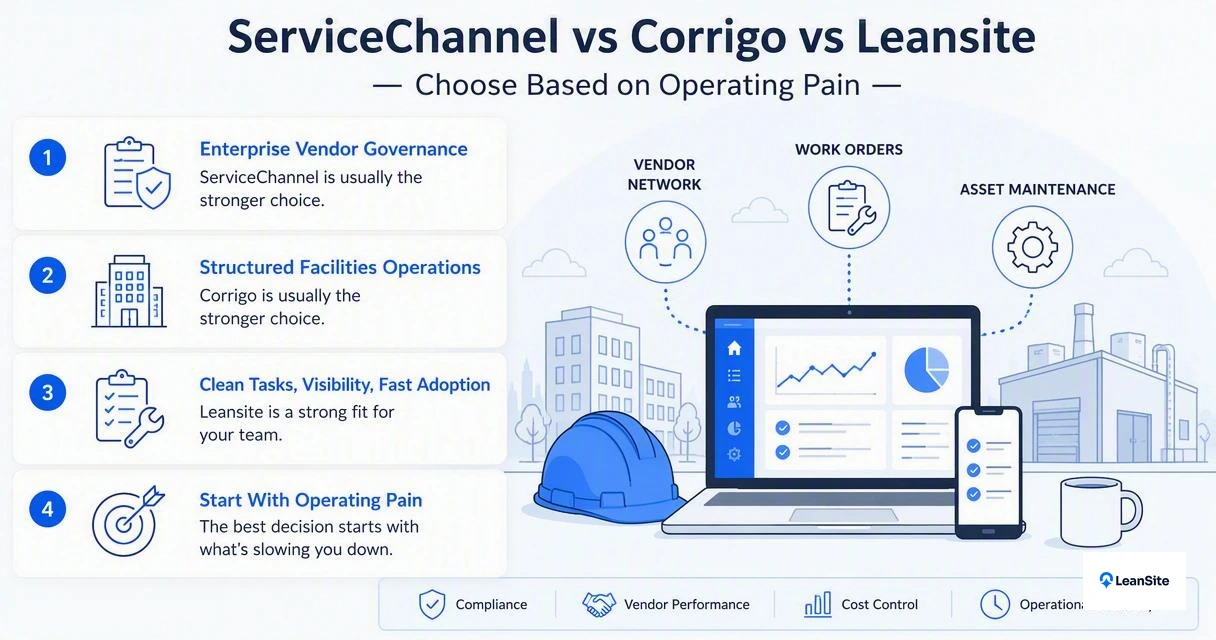
ServiceChannel is usually the stronger choice for enterprise vendor governance, Corrigo is usually the stronger choice for structured facilities operations, and Leansite is a strong fit for teams that want clean task tracking, maintenance visibility, and faster adoption. The best decision starts with operating pain, not brand recognition.
Buyer fit matrix
| Buyer situation | Best-fit option | Why it fits |
|---|---|---|
|
Large retail or restaurant chain with many outside contractors |
ServiceChannel |
Contractor sourcing, compliance, invoice approvals, and multi-site vendor controls are core needs |
|
Facilities department with asset-heavy maintenance routines |
Corrigo |
CMMS-style structure supports tickets, planned work, and service history |
|
Property owner seeking simpler visibility into maintenance activity |
Leansite |
Clear workflows help owners see tasks, costs, and status without extra complexity |
|
Operations team replacing spreadsheets and email |
Leansite |
Faster adoption can matter more than enterprise feature depth |
|
Organization with strict finance controls around vendor invoices |
ServiceChannel |
Invoice governance and NTE workflows are a major strength |
|
Team already aligned with JLL service operations |
Corrigo |
Existing operational alignment can reduce process friction |
ServiceChannel should be shortlisted when vendor management is the center of the facilities function. It makes the most sense when the organization needs contractor discovery, compliance documents, standardized rates, dispatch rules, and invoice control in one system.
Corrigo should be shortlisted when maintenance process discipline is the priority. It suits teams that want a more structured way to manage tickets, preventive maintenance, service records, and operational accountability.
Leansite deserves consideration when the buying team wants practical control without adding unnecessary workflow weight. Facility managers, owners, and multi-location operators can visit getleansite.com to see how a focused facilities workflow compares with larger enterprise systems.
What should facilities teams expect in 2027?
Facilities software in 2027 will likely put more pressure on vendor performance data, AI-assisted scheduling, cost prediction, and mobile proof of work. The winning platform will not simply create tickets; it will help teams decide who should do the work, when it should happen, and whether the price makes sense.
2027 buying criteria to add now
-
AI-assisted triage: Systems should classify requests by trade, urgency, and likely cost.
-
Vendor scorecards: Facilities teams will expect clearer views of response time, callback rate, invoice accuracy, and location-level performance.
-
Mobile closeout proof: Photos, notes, timestamps, and technician updates will become standard evidence.
-
Portfolio benchmarking: Owners will want cost-per-location and cost-per-asset trends, not just ticket counts.
-
Integration readiness: Finance, accounting, procurement, and property systems will need cleaner data flows.
ServiceChannel has a natural advantage if contractor data, dispatch scale, and vendor compliance become the main battleground. Corrigo has a natural advantage if asset maintenance, service process discipline, and technician workflows become the priority.
Leansite fits the same future from a different angle: clearer day-to-day execution before teams become buried in administrative setup. For operators still stuck in email, group chats, and spreadsheets, that practical shift can create value faster than a broad enterprise rollout.
FAQ
Is ServiceChannel better than Corrigo?
ServiceChannel is better when external contractor sourcing, vendor compliance, invoice approvals, and multi-site dispatch rules are the main requirements. Corrigo can be better when a facilities team needs structured work orders, asset maintenance routines, and service operations. The stronger platform depends on workflow, portfolio size, and vendor strategy.
Is Corrigo a CMMS?
Corrigo is commonly evaluated as a facilities management and CMMS-style platform because it supports work orders, maintenance activity, service coordination, and asset-related workflows. Buyers should still confirm required CMMS functions during demos, including preventive maintenance depth, asset hierarchy, technician workflows, reporting, and integrations.
Do ServiceChannel and Corrigo publish pricing?
Public pricing is not usually the most useful comparison point for enterprise facilities platforms because final cost depends on locations, users, modules, vendors, integrations, and implementation scope. Buyers should compare total cost of ownership, including setup time, vendor onboarding, training, support, and administrative workload.
What is the best alternative to both platforms?
Leansite is a practical alternative for teams that want clearer maintenance tracking, task visibility, and facility coordination without taking on a heavier enterprise system first. A team comparing enterprise tools should define must-have workflows, then review demos, support expectations, and rollout effort side by side.
Conclusion
ServiceChannel vs Corrigo comes down to operating model. Pick ServiceChannel when vendor governance, contractor sourcing, and invoice controls drive the business case. Pick Corrigo when structured maintenance execution and CMMS-style workflows matter more. Add Leansite to the shortlist when speed, visibility, and adoption are the bigger priorities. The next step is simple: document the top five workflows, score each platform against them, then request demos using the same work order, vendor, and reporting scenarios. For a lighter facilities workflow review, head to getleansite.com.