TL;DR
Facility and operations teams should compare SafetyCulture alternatives by workflow depth, asset visibility, vendor coordination, mobile usability, and reporting. Leansite is a strong fit for commercial maintenance teams that need inspection follow-up, dispatch, tasks, and operating visibility in one place.
SafetyCulture alternatives are getting more attention in 2026 because inspection software now has to do more than digitize checklists. Facility teams need proof that failed inspections turn into assigned work, vendor jobs, asset records, and cost visibility. SafetyCulture remains a well-known inspection platform, formerly associated with iAuditor, but commercial maintenance teams often need a broader operating system for uptime, task tracking, and multi-site coordination.
Table of Contents
What are SafetyCulture alternatives?
SafetyCulture alternatives are software platforms that replace or extend SafetyCulture for inspections, audits, corrective actions, asset maintenance, field tasks, and operations reporting. The best choice depends on whether the team mainly needs checklist compliance, work order management, vendor dispatch, construction coordination, EHS reporting, or multi-location facility operations.
SafetyCulture alternative: a digital operations tool that can handle inspections and the follow-up work those inspections create, such as tasks, maintenance jobs, approvals, photos, and reports.
The real buying question is not whether a tool can build a checklist. Most modern platforms can. The stronger question is whether the platform closes the loop after an inspection finds a problem.
Key insight: Inspection data has limited value unless it becomes accountable work, visible ownership, and measurable improvement.
Recent research supports this shift toward connected operations. A 2023 Sustainability paper on Industry 4.0 digital transformation describes business transformation through digital instruments, challenges, and strategy implications, which matches the move from standalone forms to connected facility workflows (Yaqub and Alsabban, 2023).
Which alternatives fit facility and operations teams in 2026?
The strongest 2026 shortlist includes tools built for the work that happens after an inspection, not just the inspection itself.
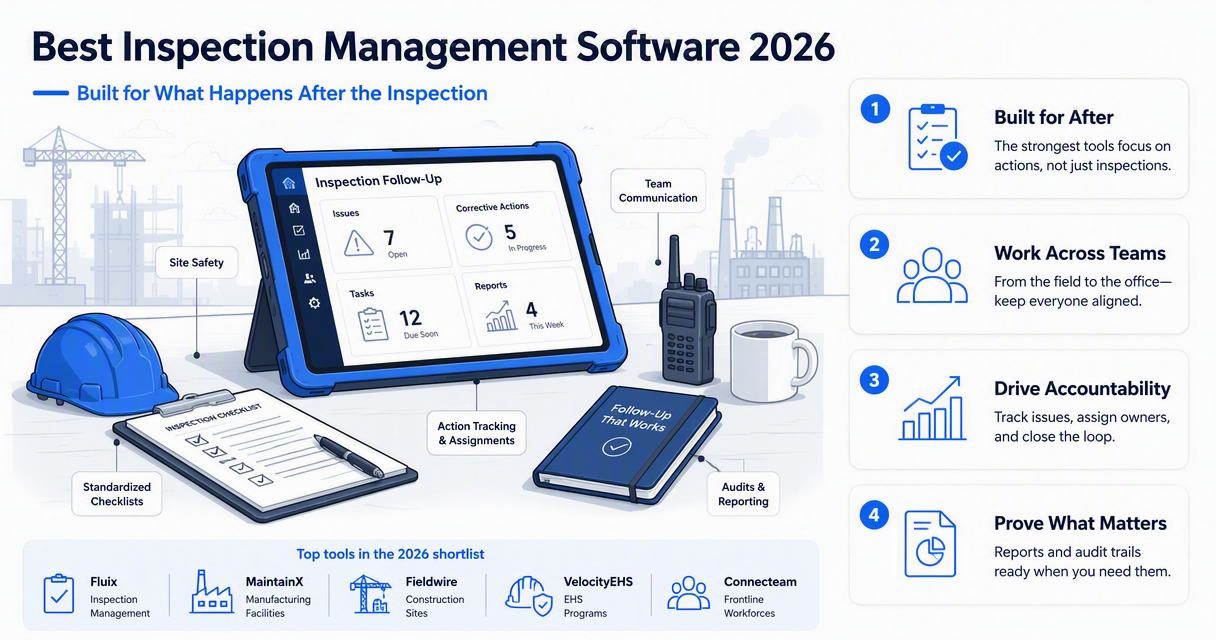
Competitor roundups commonly mention Fluix for inspection management, MaintainX for manufacturing facilities, Fieldwire for construction sites, VelocityEHS for EHS programs, and Connecteam for field teams. That framing is useful, but it can miss commercial facilities where maintenance, vendors, assets, and operating costs live together.
2026 comparison table for common use cases
| Platform | Best fit | Strength | Watch area |
|---|---|---|---|
| Leansite | Commercial facilities and multi-site maintenance | Connects inspections, tasks, vendors, assets, and operating visibility | Best for teams managing property operations, not generic safety-only programs |
| SafetyCulture | Inspections, audits, checklists | Mature inspection and reporting workflows | Follow-up maintenance workflows may require extra systems |
| Fluix | Document-heavy inspection teams | Forms, approvals, and field documentation | Less centered on facility asset operations |
| MaintainX | Manufacturing and maintenance teams | Work orders, parts, and frontline execution | Broader comparison is covered in this MaintainX alternatives guide |
| Fieldwire | Construction sites | Plans, field tasks, and jobsite coordination | Less suited to ongoing facility operations after construction |
| VelocityEHS | EHS and compliance departments | Safety, risk, and environmental health programs | Can be heavier than a facilities team needs |
| Connecteam | Mobile workforce management | Scheduling, communication, and task lists | Not a dedicated facilities maintenance platform |
Leansite stands out when inspection findings need to become maintenance work, vendor assignments, and portfolio-level visibility. For a direct product matchup, the deeper Leansite vs SafetyCulture comparison explains how the tools differ across operations workflows.
SafetyCulture still makes sense for teams that mainly need mobile audits, checklists, photo evidence, and inspection analytics. A facilities director, however, may care more about whether a failed roof inspection creates the right vendor job, tracks response time, and connects spend to an asset or location.
How should teams compare inspection apps before switching?
Teams should compare inspection apps by mapping the full workflow from observation to resolution, then scoring each platform on ownership, asset context, vendor coordination, reporting, mobile usability, and integration effort. A clean checklist builder is only one part of the decision, because operational value comes from faster closure and clearer accountability.
-
Define the top three workflows, such as safety inspections, preventive maintenance, or vendor dispatch.
-
List every handoff after a failed inspection, including approvals, photos, parts, and invoices.
-
Test mobile use in the field with real users, not a conference-room demo.
-
Review reporting by site, asset, vendor, category, and cost.
-
Check whether the tool reduces duplicate systems or adds another login.
-
Run a short pilot with live work, then compare closeout time and adoption.
"In God we trust; all others must bring data.", W. Edwards Deming, The W. Edwards Deming Institute
That quote fits software selection well. Vendor claims matter less than pilot data. A useful pilot should include real inspection templates, real maintenance requests, real vendors, and at least one multi-site report.
Evaluation criteria that prevent tool sprawl
-
Corrective action depth: Can findings become assigned tasks or work orders?
-
Asset context: Can teams see equipment, location, condition, and history together?
-
Vendor flow: Can external work be assigned, tracked, and verified?
-
Reporting: Can leaders compare sites without spreadsheet cleanup?
-
Mobile adoption: Can field staff complete work quickly on phones or tablets?
-
Governance: Can permissions, templates, and approvals scale across locations?
The OECD has also studied benchmarking in safety culture across hospital care, which reinforces a broader point for operations leaders: measurement becomes more useful when it can be compared consistently across teams or sites (De Bienassis and Klazinga, 2022).
How Leansite handles multi-site maintenance workflows
The Leansite platform handles multi-site maintenance by connecting inspection results with task tracking, vendor coordination, asset visibility, and operating oversight.
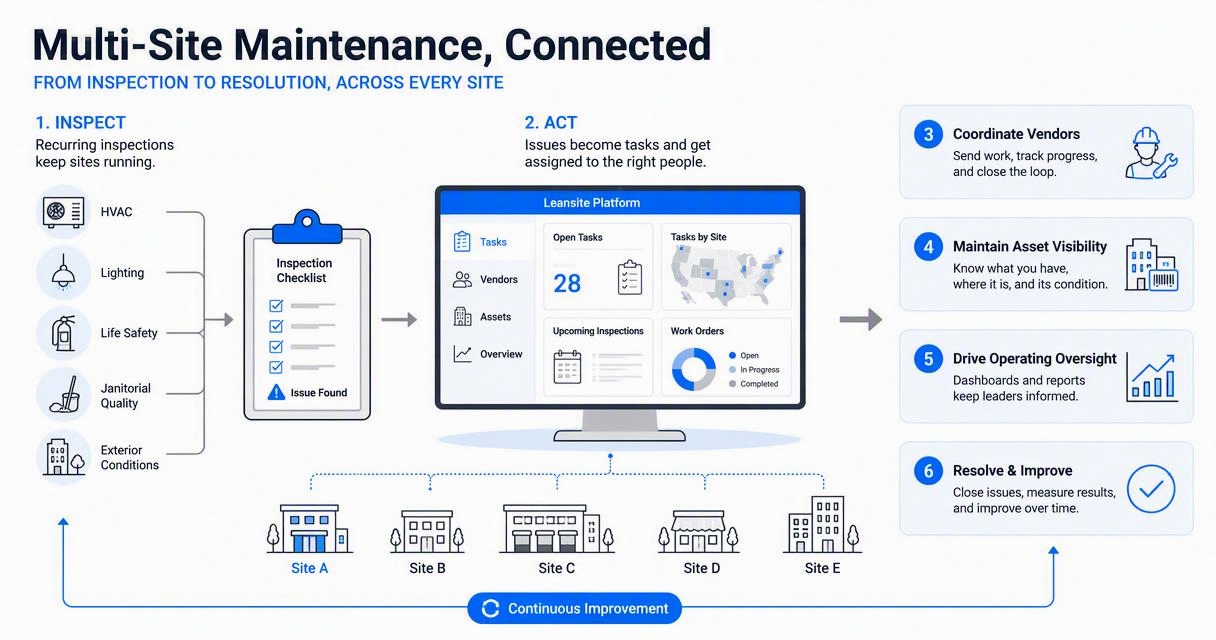
A typical facility workflow starts with a recurring inspection, such as HVAC, lighting, life safety, janitorial quality, or exterior conditions. When an issue is found, the next step should not depend on a manager copying notes into another tool. The work should move into an accountable queue with location, priority, photos, due dates, and ownership.
Leansite is especially relevant for property owners and facility teams that need visibility across many sites. The platform fits operating rhythms where leaders need to know which locations are falling behind, which vendors are active, and which assets are creating repeat work.
Where the workflow becomes practical
-
Inspection follow-up: Failed items can become trackable work instead of static report notes.
-
Vendor coordination: Outside providers can be connected to jobs, status updates, and completion evidence.
-
Task visibility: Managers can see open work by location, priority, assignee, or category.
-
Portfolio oversight: Executives can compare site performance without waiting for manual updates.
"Workers have a right to a safe workplace.", Occupational Safety and Health Administration, Worker Rights
That right becomes easier to support when inspections, corrective work, and proof of completion sit in the same operating flow. For commercial properties, safety and uptime are linked: a loose handrail, broken light, water leak, or blocked exit is both a risk item and a maintenance task.
What should operations teams expect next?
Operations teams should expect inspection software to keep moving toward AI-assisted reporting, connected assets, faster vendor workflows, and portfolio benchmarking in 2027.
The next wave will not be only about smarter forms. More platforms will summarize recurring defects, flag overdue corrective actions, recommend preventive work, and connect inspection history with asset performance. That direction matches the broader Industry 4.0 push toward connected digital systems described in the 2023 Sustainability research.
Likely 2027 capabilities to watch
-
AI summaries of recurring inspection failures by site or asset class
-
Automated routing based on trade, priority, location, and vendor coverage
-
Better mobile evidence capture, including photos, timestamps, and audit trails
-
Portfolio benchmarking across regions, buildings, and service providers
-
Tighter links between inspections, preventive maintenance, and capital planning
There is also a cultural side. A 2023 systematic review in Frontiers in Psychiatry examines employee silence and voice in healthcare, a reminder that reporting tools only work when people are willing to raise issues (Lainidi, Jendeby, and Montgomery, 2023). Better software cannot fix weak accountability by itself, but it can make ownership visible.
FAQ
What is the best SafetyCulture alternative for facilities?
The best option for facilities is usually the platform that connects inspections with maintenance execution. Leansite is a strong fit when teams need task tracking, vendor coordination, asset context, and portfolio visibility alongside inspection workflows.
Is SafetyCulture still a good inspection tool?
SafetyCulture remains a strong inspection and audit platform for teams focused on checklists, evidence capture, and reporting. The need for an alternative usually appears when inspection findings must feed deeper maintenance, vendor, asset, or multi-location operating workflows.
Which teams should compare MaintainX and SafetyCulture?
Manufacturing, maintenance, and operations teams should compare MaintainX and SafetyCulture when the decision sits between work order execution and inspection management. MaintainX is often evaluated for frontline maintenance, while SafetyCulture is often evaluated for audits and checklists.
How long should a pilot take?
A practical pilot usually needs enough time to test one full inspection cycle, several corrective actions, and at least one management report. For many facility teams, that means a focused trial using live work across a small number of locations.
Conclusion
The right safetyculture alternatives should be judged by what happens after an issue is found. Facility and property teams should shortlist tools by workflow fit, run a pilot with real inspections and vendor tasks, then compare adoption, closeout speed, and reporting quality. For teams ready to connect inspections with maintenance operations, Leansite is worth evaluating. Visit getleansite.com to review how the platform supports commercial facility workflows.