TL;DR
Limble is usually the simpler CMMS for fast technician adoption, mobile work orders, and preventive maintenance rollouts. Fiix is often the stronger fit for asset-heavy organizations that want deeper enterprise controls, analytics, and Rockwell Automation alignment. Facility teams that also manage vendors, sites, and operating visibility may need a broader platform rather than a maintenance-only CMMS.
A CMMS decision can shape years of maintenance habits, labor reporting, and asset reliability. Limble vs Fiix is a practical choice between fast, technician-friendly maintenance execution and a more enterprise-oriented maintenance system tied to Rockwell Automation. CMMS: a computerized maintenance management system is software that stores maintenance data, work orders, preventive maintenance schedules, assets, labor, inventory, and related reporting, similar to the definition summarized by Wikipedia. For facility teams that also need vendor coordination, site visibility, and operating workflows beyond maintenance, Leansite belongs in the same evaluation set.
Table of Contents
What is the practical difference between Limble and Fiix?
Limble is best understood as a mobile-first CMMS built for fast adoption, while Fiix is a maintenance management platform with stronger enterprise and industrial automation positioning. Both manage work orders, assets, preventive maintenance, and reporting, but the buying logic differs: Limble favors speed and usability; Fiix favors depth, scale, and integration with Rockwell Automation.
Limble's public positioning emphasizes easy-to-learn CMMS software and faster deployment for maintenance teams, as shown on the Limble CMMS website. Fiix is now branded as Fiix by Rockwell Automation, which matters for manufacturers and asset-intensive operations already connected to Rockwell systems, according to Rockwell Automation.
Limble vs Fiix comparison at a glance
| Category | Limble | Fiix |
|---|---|---|
| Best fit | Facilities and maintenance teams prioritizing quick adoption | Industrial, enterprise, and asset-heavy teams |
| Usability | Simple, mobile-forward workflows | More configurable, more training likely |
| Work orders | Strong for technician execution and task completion | Strong for structured maintenance programs |
| Preventive maintenance | Easy PM scheduling and checklists | Advanced PM planning for complex assets |
| Asset management | Clear asset records and histories | Deeper enterprise asset structure |
| Analytics | Practical dashboards for maintenance KPIs | Broader reporting and enterprise analytics potential |
| Integrations | Common business and maintenance integrations | Rockwell Automation alignment is a major differentiator |
Key takeaway: The better choice depends less on feature count and more on the operating model. A team that needs quick field adoption may prefer Limble, while a multi-plant or industrial team may prefer Fiix.
How do implementation, usability, and mobile work compare?
Limble usually has the edge for teams that want technicians using the system quickly, while Fiix tends to reward teams that can invest more time in configuration, data structure, and process design. Implementation success depends on asset data quality, PM templates, mobile adoption, and manager follow-through more than software alone.
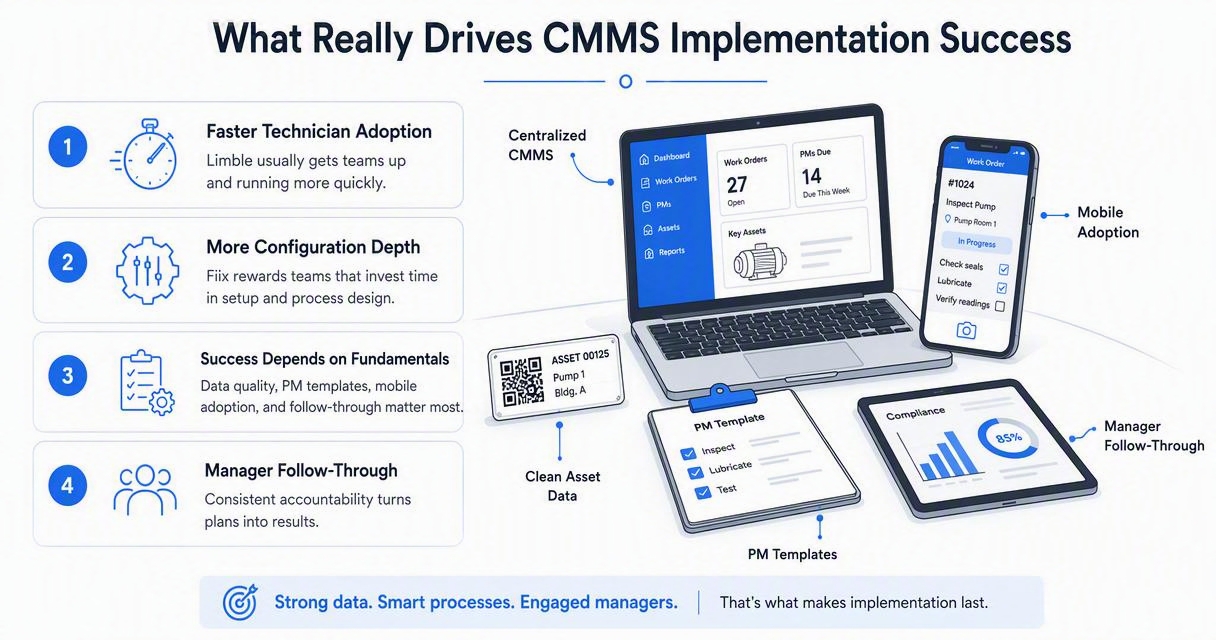
A practical rollout should be judged by how fast technicians can complete real work without side spreadsheets, paper notes, or duplicate entry. Limble's appeal is its low-friction interface. Fiix can support more complex setups, but complexity only pays off when the organization has the internal process discipline to manage it.
Implementation checklist for either CMMS
-
Clean the asset list before import, including names, locations, criticality, and parent-child relationships.
-
Build the first 20 preventive maintenance templates around the highest-risk equipment.
-
Train technicians on mobile work order completion before training managers on dashboards.
-
Set required fields lightly at first, then tighten data rules after adoption improves.
-
Review backlog, PM compliance, and repeat failures every week for the first 90 days.
"Asset management is the coordinated activity of an organization to realize value from assets.", International Organization for Standardization, ISO 55000
That ISO definition is a useful filter. A CMMS should not become a digital filing cabinet. It should help turn maintenance activity into asset value, lower downtime risk, and clearer operating decisions.
Related CMMS usability video
Which platform is stronger by feature area?
Limble is stronger for simple work execution and frontline usability, while Fiix is stronger where enterprise asset structure, integrations, and industrial maintenance maturity matter most. Most facility teams should score each platform by workflow fit, not by a long checklist where rarely used features look equal to daily tasks.
Feature-by-feature decision table
| Feature area | Limble advantage | Fiix advantage | Buying signal |
|---|---|---|---|
| Work orders | Fast creation, assignment, and mobile completion | More configurable routing and structure | Choose based on technician adoption versus process depth |
| Preventive maintenance | Easy recurring schedules and checklists | Strong for complex maintenance programs | Match PM complexity to internal maintenance maturity |
| Asset records | Simple histories and QR code-friendly access | Deeper hierarchy and enterprise asset context | Asset-heavy sites may need Fiix depth |
| Inventory | Practical parts tracking | More scalable maintenance inventory controls | Multi-site storerooms may lean Fiix |
| Analytics | Clear maintenance dashboards | Stronger enterprise reporting direction | Executive reporting needs may decide the fit |
| Integrations | Good for common facility workflows | Stronger industrial automation tie-in | Rockwell environments should review Fiix first |
Fiix deserves a close look when maintenance is connected to manufacturing reliability, automation, and enterprise asset management. Limble deserves a close look when the main obstacle is technician participation and faster movement from paper, spreadsheets, or email into a live system.
Analytics deserve special attention because bad maintenance data creates confident but weak decisions. Dashboards should separate urgent backlog, aging corrective work, PM compliance, asset downtime, repeat failures, labor hours, and vendor response time.
"All models are wrong, but some are useful.", George E. P. Box, All models are wrong
That quote applies directly to CMMS dashboards. A report does not need perfect precision to be useful, but it does need consistent data entry and a clear decision attached to each metric.
When is a facility operations platform the better fit?
A facility operations platform can be a better fit when maintenance is only one part of a larger operating workflow that includes vendors, locations, service requests, approvals, cost visibility, and portfolio-level accountability. Traditional CMMS tools are maintenance-first; broader operations platforms connect maintenance activity to business execution.
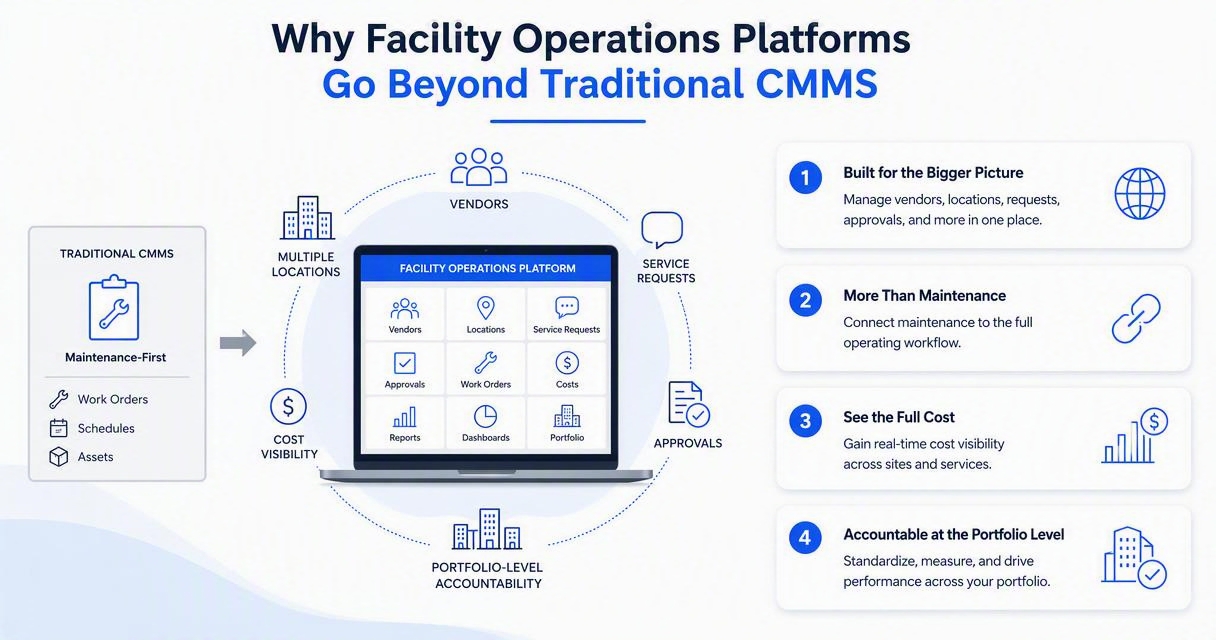
Leansite is best considered when facility teams need a cleaner way to manage site work, vendor coordination, and operational visibility across multiple properties. For a deeper side-by-side view against one maintenance-first option, the Leansite and Fiix CMMS comparison gives more context on where a broader facility workflow can matter.
Signals that maintenance software is not enough
-
Work orders often involve outside vendors, invoices, approvals, and follow-up calls.
-
Regional managers need visibility across many locations, not just one equipment room.
-
Property owners want operating cost trends, not only task completion counts.
-
Maintenance teams need dispatching, job tracking, and payment status in the same process.
-
Executives want portfolio-level performance without waiting for manual reports.
In those cases, the software decision should start with the full operating workflow. A CMMS may still be part of the stack, but the system of record for facility operations may need to cover more than assets and PMs.
FAQ: Limble, Fiix, and CMMS selection
Common CMMS questions usually come down to adoption, depth, and operating scope. The answers below give facility leaders a quick way to narrow the decision before scheduling demos or building a formal scorecard.
Is Limble easier to use than Fiix?
Limble is generally viewed as the easier system for frontline adoption because its product positioning centers on simple, mobile-first maintenance execution. Fiix can still be usable, but it often fits teams that are prepared for more configuration, more structured asset data, and a more enterprise-style rollout.
Is Fiix better for enterprise maintenance teams?
Fiix is often a stronger fit for enterprise and industrial maintenance teams, especially where Rockwell Automation alignment matters. Organizations with complex assets, multiple plants, advanced reporting needs, or industrial reliability programs may find Fiix better matched to long-term maintenance maturity.
Can either tool manage vendors?
Both systems can support vendor-related maintenance work through work orders, assignments, notes, and documentation. Facility operations teams with heavy vendor dispatching, service verification, approvals, and cost tracking may need broader workflow coverage than a traditional maintenance-first CMMS provides.
What should a demo include?
A strong demo should use real examples: one emergency repair, one recurring PM, one asset history, one technician mobile workflow, one vendor job, and one executive report. The best demo test is whether daily users can understand the workflow without a long explanation.
Conclusion
Limble vs Fiix should be decided by operating reality, not brand familiarity. Limble fits teams that need fast adoption and clean maintenance execution. Fiix fits organizations that need deeper enterprise maintenance structure, especially in industrial environments connected to Rockwell Automation.
A smart next step is to run a 30-day pilot with five real assets, ten recurring PMs, three technicians, and one manager dashboard. If the evaluation also includes vendors, multi-site visibility, and operating cost control, Leansite should be reviewed alongside the CMMS shortlist. For a broader facility operations path, visit getleansite.com and compare the workflow against the maintenance-only options before committing.