TL;DR
Leansite is the better fit for operators that need faster rollout, simpler task tracking, and clearer multi-site visibility. Corrigo remains a strong enterprise CMMS for large organizations that need deep vendor management, spend analytics, and JLL-backed facilities workflows.
The leansite-vs-corrigo decision usually comes down to speed versus enterprise depth. Leansite is built for maintenance teams that need quick adoption across locations, while Corrigo, a JLL Technologies product, is positioned as cloud-based enterprise facility management software for work orders, assets, vendors, automation, and business intelligence, according to JLL Technologies.
CMMS: A computerized maintenance management system is software used to organize work orders, assets, preventive maintenance, labor, vendors, and facility records.
Company: A company is a legal entity formed by people with a shared objective, such as profit or public benefit, as summarized by Wikipedia.
Table of Contents
What is the leansite-vs-corrigo decision in 2026?
The leansite-vs-corrigo decision is a comparison between a faster, operations-friendly maintenance platform and a larger enterprise CMMS tied to JLL's facilities technology portfolio. The practical question is whether a team needs rapid field adoption and simpler portfolio control, or deeper enterprise vendor, spend, and workflow infrastructure.
Corrigo's public positioning focuses on automating FM workflows, managing maintenance work orders, optimizing vendor coordination, and using AI-enabled workflows with business intelligence. That makes it relevant for large facilities teams, outsourced FM groups, and procurement-heavy organizations.
Leansite fits operators that want less rollout drag and more day-to-day clarity for maintenance, vendors, and multi-location execution. Teams comparing software can also review the detailed Leansite and Corrigo comparison for a closer product-level view.
Decision snapshot for facility leaders
-
Pick the faster adoption path when field teams, store managers, or site supervisors must start using the system quickly.
-
Pick the heavier enterprise path when procurement controls, vendor networks, and formal spend analytics outweigh rollout simplicity.
-
Require live workflow proof before contract signature, not just feature lists.
"Without data, you're just another person with an opinion." , W. Edwards Deming, The W. Edwards Deming Institute
Maintenance software should prove value with work completion, response time, asset history, and vendor performance data. A polished demo matters less than whether technicians, property teams, and vendors actually keep records current.
How do Leansite and Corrigo compare feature by feature?
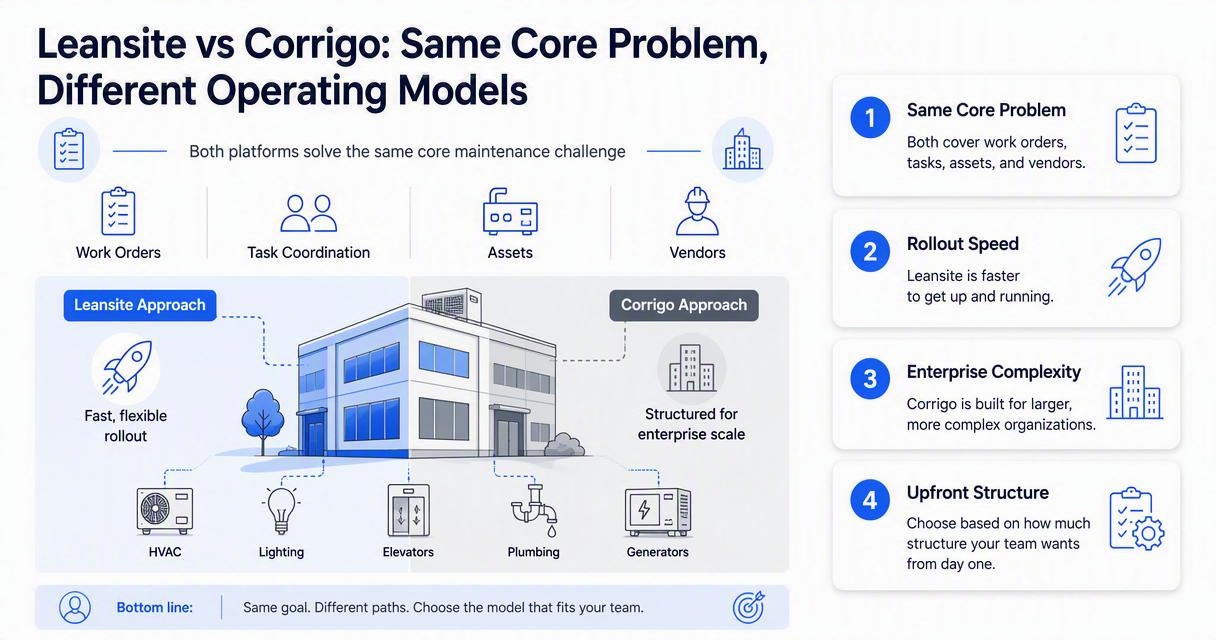
Leansite and Corrigo cover the same core maintenance problem, but they approach it from different operating models. Both address work orders, task coordination, assets, and vendors; the main differences appear in rollout speed, enterprise complexity, and how much structure a facilities team wants upfront.
Side-by-side CMMS comparison table
|
Category |
Leansite |
Corrigo |
|---|---|---|
|
Best fit |
Mid-sized and multi-location operators that want quick adoption |
Enterprise facilities teams with formal FM processes |
|
Core use case |
Work orders, task tracking, vendor coordination, visibility |
Work orders, assets, vendors, spend analytics, BI |
|
Deployment style |
Fast-track setup aimed at days or weeks |
Enterprise implementation often planned over longer phases |
|
Field usability |
Designed for practical maintenance execution |
Stronger for structured enterprise workflows |
|
Vendor management |
Built for dispatching, job tracking, and faster coordination |
Known strength in vendor management and spend control |
|
Reporting |
Operational visibility for managers and owners |
Business intelligence for enterprise FM programs |
|
Buying concern |
Fit, adoption, and speed |
Configuration, process alignment, and scale |
The platform overview is most relevant for buyers checking whether a lighter rollout can still support portfolio visibility. Corrigo's strongest case appears when a company already has complex vendor governance, procurement rules, and a mature facilities operating model.
Key takeaway: Feature parity is not the same as operational fit. A smaller team can lose time inside a powerful system if the setup model is too heavy for daily maintenance habits.
Where does Corrigo fit best, and where can it feel heavy?
Corrigo fits best in enterprise environments that need structured facilities management, vendor oversight, spend analytics, and centralized reporting. Its JLL connection gives it credibility with large portfolios, outsourced maintenance models, and organizations that already think in terms of formal FM programs.
Corrigo can feel heavy when the main goal is quick task capture, simple work order follow-through, and easy participation from non-technical location staff. Longer implementation planning, deeper configuration, and enterprise workflows can slow teams that mainly need faster dispatching and completion visibility.
The concern is not capability. The concern is operating weight. A system built for large-scale governance may be more than a regional restaurant group, retail operator, or property team needs during the first phase of maintenance modernization.
Common Corrigo fit signals
Corrigo deserves a serious look when the buying committee has these needs:
- Centralized vendor compliance across many trades and regions.
- Formal work order routing, approvals, and service categories.
- Spend analytics tied to facilities budgets and procurement review.
- Business intelligence for executives and outsourced FM partners.
- A longer implementation window with dedicated administrative owners.
Teams also comparing larger IWMS-style products may find the Planon IWMS comparison useful, since that decision often involves similar questions about enterprise scope and rollout complexity.
Is Leansite a better Corrigo alternative for mid-sized operators?
Leansite is often the better Corrigo alternative for mid-sized operators when speed, usability, and site-level follow-through matter more than enterprise system depth. Restaurant groups, retail chains, commercial properties, and regional operators usually need work to move faster, not another complicated administrative layer.
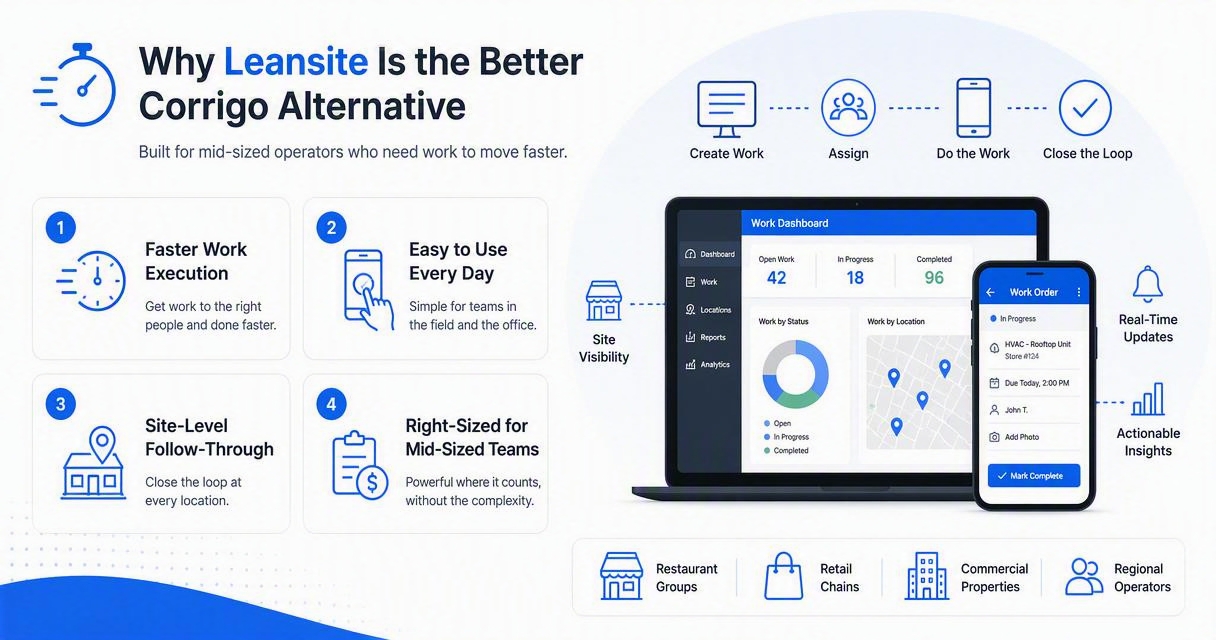
The same maintenance issue shows up in both products: repairs must be reported, assigned, completed, documented, and reviewed. The difference is how much process surrounds that loop. With Leansite, the value case is practical execution across people who may not live inside facilities software all day.
Same problem, different approaches
-
Work order intake: Location teams need a clear way to report issues without messy texts, calls, or spreadsheets.
-
Dispatching: Managers need to assign internal staff or outside vendors fast.
-
Visibility: Owners and directors need to see what is open, aging, recurring, or expensive.
-
Accountability: Vendors need documented job status, photos, notes, and payment-ready records.
The mobile app workflow matters because field adoption often decides whether a CMMS succeeds. If technicians and site staff avoid the tool, reports become stale and managers return to manual follow-up.
AI is also becoming more relevant in facilities operations. For teams exploring assistant-style workflows, the article on Vera, the AI assistant built into Leansite offers more context on where maintenance software is heading.
"There is nothing so useless as doing efficiently that which should not be done at all." , Peter F. Drucker, Drucker Institute
That quote applies directly to CMMS selection. Automating a slow approval chain or overbuilt ticket flow can preserve the wrong process. A clean maintenance platform should shorten the path from issue to resolution.
Frequently asked questions about Leansite and Corrigo
A FAQ is a curated list of questions and answers covering important, unknown, or commonly misunderstood parts of a topic, as defined by Wikipedia. These questions focus on buying fit, not generic feature claims.
Which platform is better for restaurants and retail?
Leansite is usually the stronger fit for restaurants and retail groups that need fast reporting, dispatching, and multi-site visibility without a long enterprise rollout. Corrigo may fit national operators with more formal vendor programs, deeper procurement controls, and dedicated facilities administrators.
Which platform is better for enterprise vendor management?
Corrigo is better aligned with enterprise vendor management when the organization needs structured provider networks, spend analytics, and mature facilities processes. Its JLL Technologies positioning centers on cloud-based CMMS workflows, vendor coordination, automation, and business intelligence for facilities management at scale.
What should buyers test before choosing either CMMS?
Buyers should test real work order intake, vendor assignment, mobile updates, photo documentation, recurring issue tracking, reporting, and invoice handoff. A pilot should include technicians, vendors, location managers, and finance stakeholders because each group affects whether maintenance data stays accurate.
What other CMMS comparisons help with shortlisting?
Related comparisons can clarify whether the need is lightweight work execution, enterprise CMMS depth, or property-focused operations. Useful next reads include the FMX comparison and the Accruent Maintenance Connection comparison, especially for teams building a broader shortlist.
Conclusion
The best choice depends on operating reality. Corrigo suits enterprise FM teams that need mature vendor governance, spend analytics, and formal workflows. Leansite is the warmer recommendation for operators that need faster adoption, clearer daily execution, and less friction across sites, vendors, and maintenance teams.
A practical next step is to map the last 30 days of maintenance requests, then run the top five workflows through both systems: urgent repair, preventive task, vendor dispatch, recurring issue, and owner-level reporting. If speed and usability are the deciding factors, head to getleansite.com and request a focused walkthrough using real facility scenarios.