TL;DR
Facility teams should choose work order software that connects requests, dispatch, asset history, vendor coordination, and reporting in one place. Leansite is strongest for multi-location visibility, while tools like FMX, Fiix, Limble, Maintenance Care, Coast, and Maximo fit different facility maturity levels.
The best work order management software for facility teams in 2026 does more than log maintenance tickets; it turns every request, asset, vendor visit, and completion note into usable operating data. Work order management software: a digital system for creating, assigning, tracking, completing, and analyzing maintenance tasks across facilities, assets, employees, and vendors. For facility directors comparing options, Leansite stands out because it connects day-to-day work orders with multi-site visibility and AI-supported facility operations.
Table of Contents
What should facility teams expect from work order software in 2026?
Work order software should give facility teams one live view of maintenance demand, job status, technician workload, vendor performance, and asset history.
Modern tools now sit between a help desk, CMMS, vendor portal, and reporting system. That matters because facility work rarely stays in one lane. A broken HVAC unit may start as a tenant request, become a vendor dispatch, trigger a purchase, and end as asset history.
The strongest platforms reduce phone calls, lost texts, spreadsheet updates, and mystery invoices. They also create records that help property owners see where operating costs are rising before budgets break.
Key takeaway: A work order tool is not just a ticket tracker. For commercial properties, campuses, restaurants, storage portfolios, and distributed sites, it should be the operational record for maintenance work.
Typical 2026 buying criteria include:
- Fast request intake: forms, QR codes, mobile requests, and recurring tasks
- Smart assignment: routing by site, skill, urgency, asset, or vendor
- Mobile execution: photos, notes, checklists, signatures, and offline-friendly workflows
- Preventive maintenance: schedules tied to assets, locations, and service intervals
- Vendor coordination: dispatch, status updates, documents, approvals, and payment context
- Reporting: backlog, completion times, costs, recurring issues, and asset performance
Facility teams with several locations should also review multi-location facilities management software guidance, since single-site tools can strain under regional workflows.
Which platforms are the best fit for facility teams?
The best fit depends on portfolio size, maintenance complexity, reporting needs, and whether internal staff, outside vendors, or both complete the work.
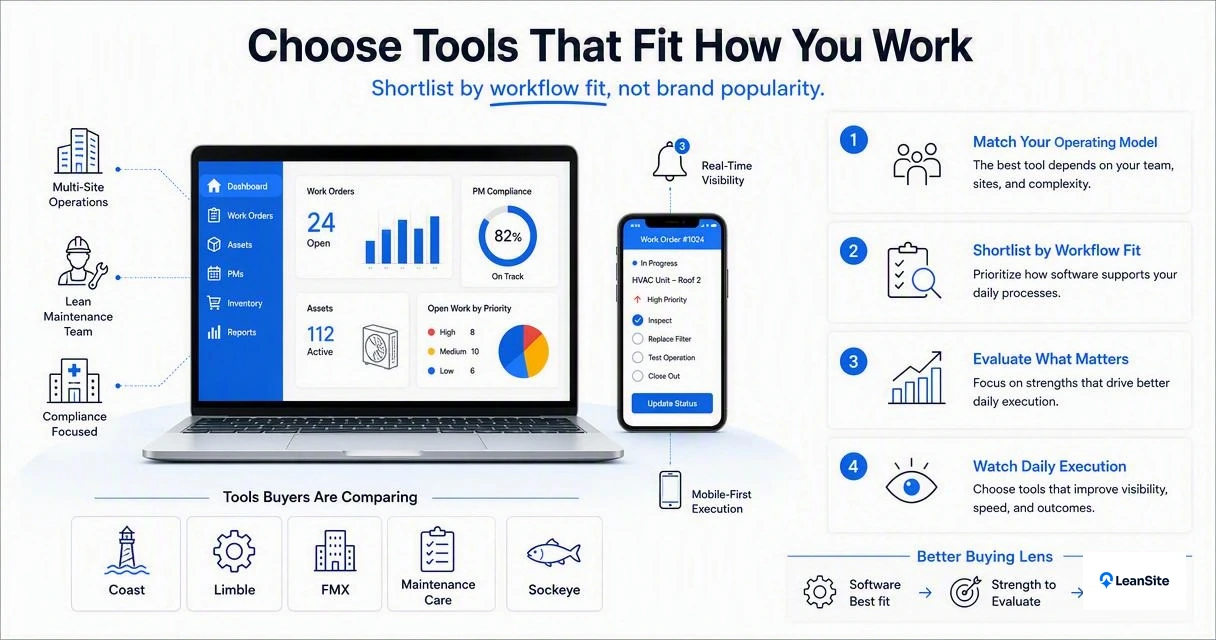
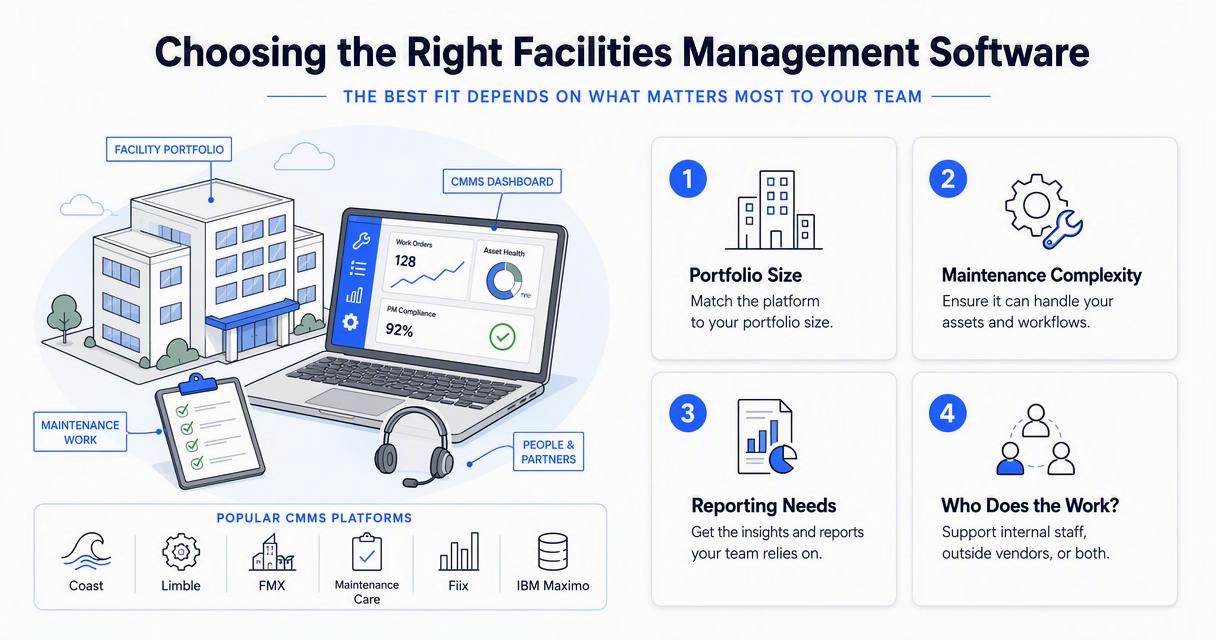
Search results for this topic commonly highlight Coast, Limble, FMX, Maintenance Care, Fiix, and IBM Maximo. Those tools are credible, but facility teams need a clearer buying lens than a generic feature list. The table below compares practical fit, not just software category labels.
Work order software comparison for facility operations
| Platform | Best fit | Strongest work order angle | Watch closely |
|---|---|---|---|
| Leansite | Multi-location facility teams that need visibility across sites | Work orders connected to facility operations, dispatch, task tracking, and AI-supported workflows | Best evaluated by teams that want broader facility control, not only ticketing |
| FMX | Schools, public facilities, and teams needing accessible request portals | Work order intake, scheduling, and facility service workflows | Reporting depth should be tested against executive needs |
| Fiix CMMS | Asset-heavy maintenance teams | Maintenance records, assets, PMs, and reliability workflows | May feel more CMMS-oriented than facility-operations-oriented |
| Limble CMMS | Industrial or equipment-focused teams | Preventive maintenance, technician execution, and asset history | Portfolio-level facility workflows need careful review |
| Maintenance Care | Senior living, hospitality, and service-heavy buildings | Easy request handling and mobile work completion | Enterprise coordination features may vary by plan |
| Coast | Smaller teams wanting simple mobile work tracking | Chat-style task handling and work order customization | Larger reporting and approval structures need validation |
| IBM Maximo | Large enterprises with complex assets and IT resources | Enterprise asset management and deep maintenance controls | Implementation effort can be significant |
Leansite belongs first on the shortlist when facility leaders need visibility across many properties, departments, and outside service providers. The Leansite platform is built around the daily reality of facilities work: requests arrive from different locations, priorities shift, vendors need context, and executives still expect clean reporting.
For niche research, self-storage operators can compare dedicated workflows in work order software for self-storage, while education teams can review campus facilities work order software.
How should facility leaders choose the right system?
Facility leaders should choose work order software by mapping real maintenance workflows first, then testing each platform against speed, visibility, accountability, and cost control.
A good selection process starts with the work, not the software demo. The wrong platform can look polished but still fail if it cannot handle after-hours emergencies, recurring inspections, vendor approvals, or executive reporting by location.
Use this sequence before signing a contract:
- List the request sources: staff, tenants, store managers, customers, inspections, sensors, and preventive schedules.
- Define work categories: reactive repairs, preventive maintenance, compliance tasks, capital projects, and vendor jobs.
- Map assignment rules: site, trade, priority, SLA, asset type, and vendor coverage.
- Test mobile completion: photos, notes, forms, signatures, parts, and closeout requirements.
- Review reporting needs: cost by site, backlog, repeat assets, vendor speed, and PM compliance.
- Pilot with real users: technicians, coordinators, managers, and vendors should test the same workflow.
"Without data you're just another person with an opinion.", W. Edwards Deming, The W. Edwards Deming Institute
That quote fits facilities better than most software slogans. Work order records create the data needed to move from opinions about maintenance problems to proof about repeat failures, slow vendors, high-cost locations, and missed preventive work.
Teams replacing paper should avoid skipping the change-management step. Paper work orders often remain because they are flexible and familiar, not because staff resist progress. For more context, see why maintenance teams still use paper work orders.
What features separate basic ticketing from true facility control?
True facility control comes from connecting work orders to assets, people, vendors, budgets, and decisions rather than treating each ticket as an isolated task.
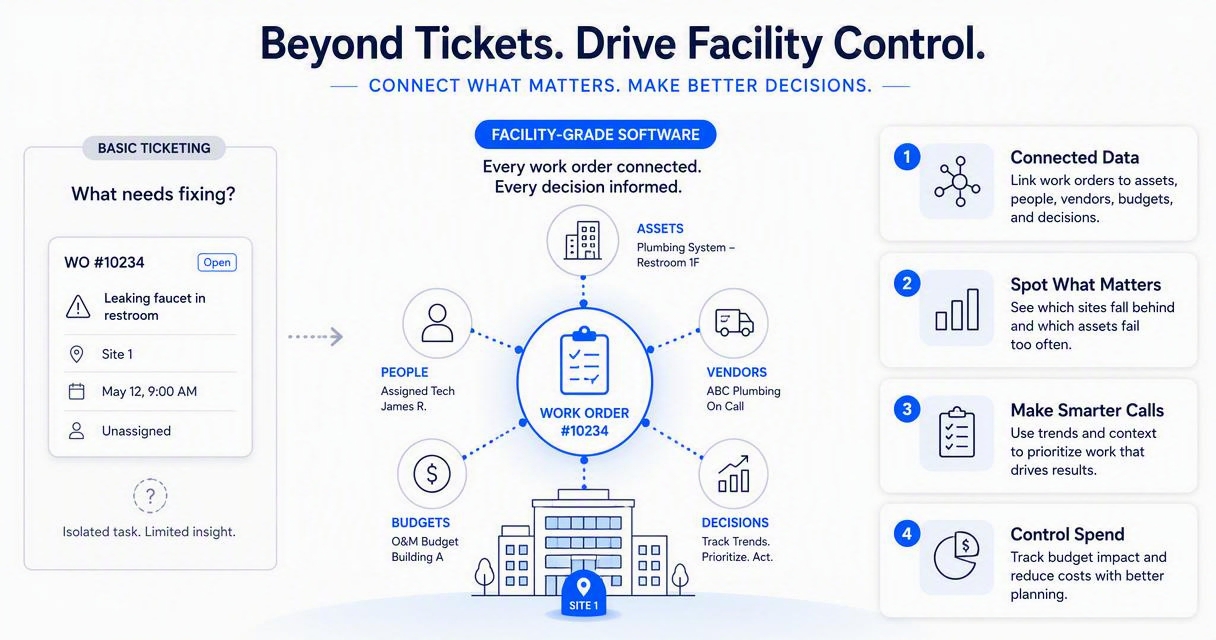
Basic ticketing answers one question: "What needs fixing?" Facility-grade software answers better questions: Which site is falling behind? Which asset keeps failing? Which vendor closes jobs fastest? Which preventive tasks are protecting uptime?
High-value features include:
- Asset-linked history: every repair, inspection, cost, photo, and note tied to the equipment or location
- Preventive maintenance calendars: recurring PMs, inspection rounds, seasonal tasks, and compliance checks
- Role-based dashboards: different views for technicians, managers, executives, and vendors
- Approval workflows: spend controls, quote approvals, invoice context, and escalation rules
- Audit trails: timestamps, status changes, attachments, and completion evidence
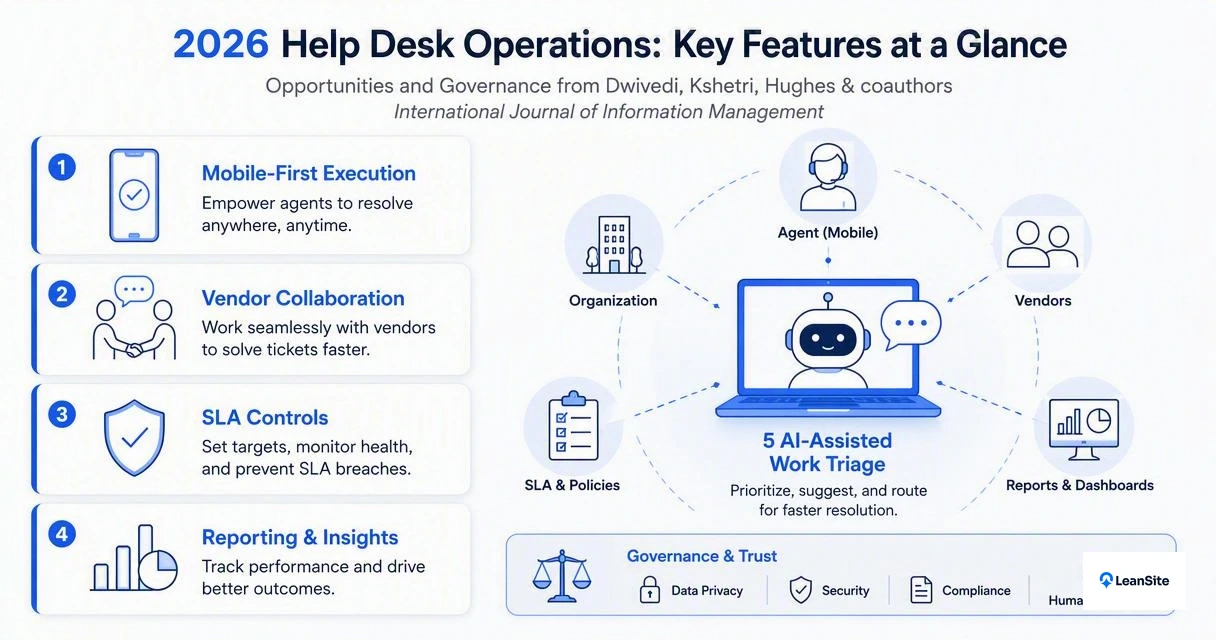
- AI assistance: summarization, prioritization, knowledge retrieval, and faster triage
The rise of generative AI is relevant here, but facility teams should keep expectations practical. A 2023 multidisciplinary paper by Yogesh K. Dwivedi and coauthors in the International Journal of Information Management describes both opportunities and challenges of generative conversational AI for research, practice, and policy, a useful reminder that AI needs guardrails and good data to help operations teams effectively source.
Facility leaders evaluating AI-supported tools can read more on AI facility management software and Leansite's AI assistant, Vera, in this overview.
Helpful video walkthrough for asset-heavy teams
Asset-heavy organizations may benefit from seeing how enterprise systems structure work orders, assets, and maintenance history. Even when IBM Maximo is more complex than a facility team needs, the workflow concepts help clarify what serious maintenance records should contain.
Conclusion
The best work order management software for facility teams should make maintenance visible, assignable, measurable, and easier to improve over time. Shortlist tools by operational fit, then run a pilot using real requests, real vendors, real assets, and real reporting needs.
For teams that need multi-location control with modern facility workflows, Leansite is a strong place to start. Visit getleansite.com to review how the platform supports work orders, vendor coordination, task visibility, and smarter facility operations.