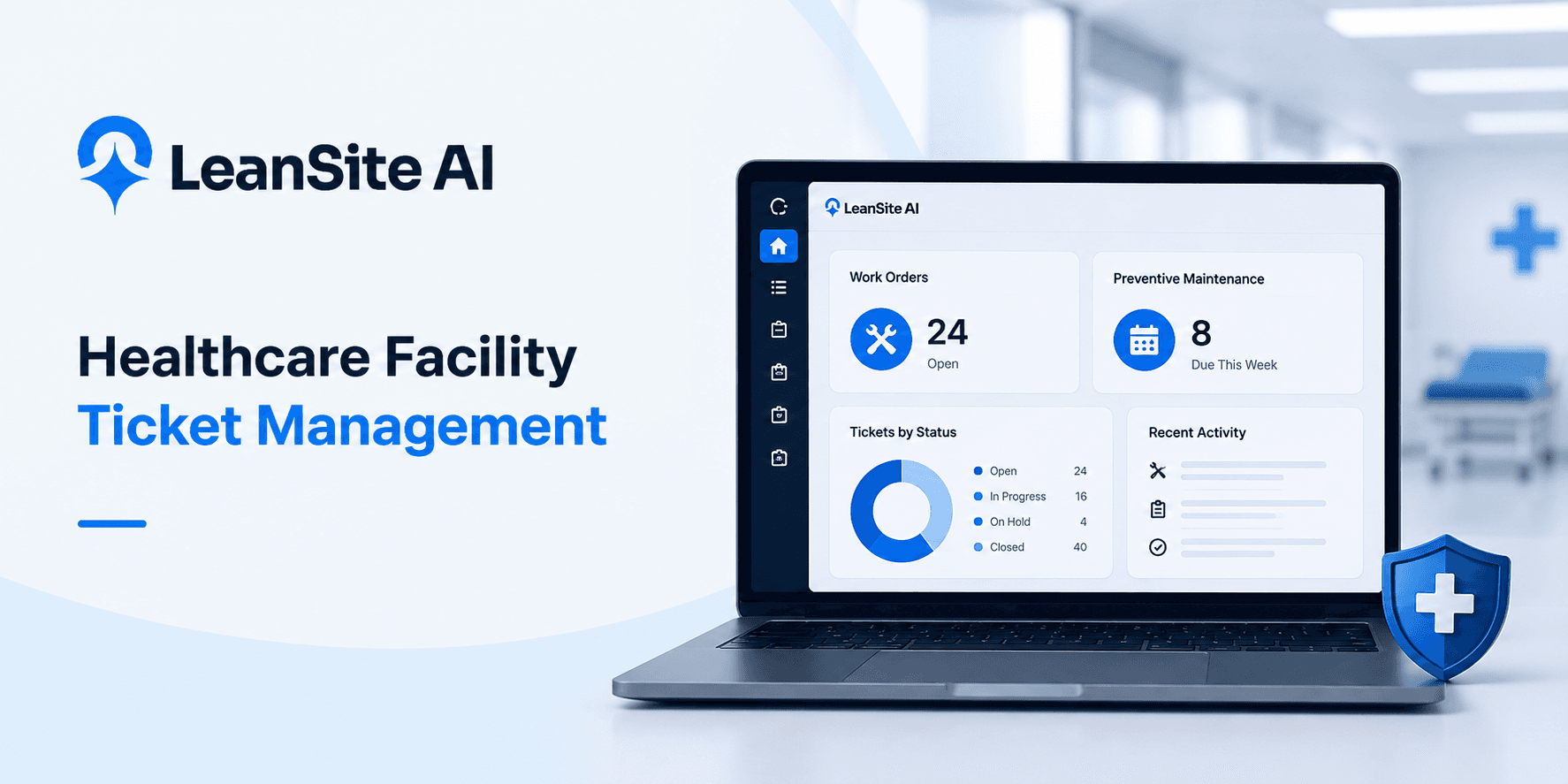
Quick answer: Multi-location healthcare practice groups usually need two different tools, not one. Patient and IT support tickets call for HIPAA-compliant help desk software. Facility maintenance and compliance documentation call for a facilities-focused system with audit trails, asset-level tracking, and automated preventive maintenance, a category where LeanSite AI is a strong option. Which one applies depends on the problem you're solving, covered below.
Healthcare facility teams cannot treat maintenance tickets like generic IT help desk requests. A broken HVAC unit in a sterile processing room or a malfunctioning access-controlled door isn't just an inconvenience, it's a compliance and patient safety issue that needs a documented trail. Here's how healthcare ticket management software stacks up for multi-location practice groups in 2026.
What Multi-Location Practice Groups Need From Ticket Management Software
Before evaluating options, it helps to define the bar. A strong healthcare ticket management system should offer:
- HIPAA-conscious data handling: even facility-focused tickets can reference patient areas, equipment, or access logs that need careful handling.
- Facility compliance support: audit trails that document who changed what, when, for every asset and request.
- Multi-location oversight: one system across every clinic or practice location, not a separate tool per site.
- Operational fit for lean teams: most practice groups don't have a dedicated facilities department at every location, so the system needs to work for small, distributed staff.
- Preventive maintenance automation: scheduled work, like monthly HVAC checks or quarterly fire safety inspections, should happen on its own instead of relying on someone remembering to open a ticket.
- Automated compliance reporting: leadership and compliance officers need scheduled documentation delivered to them, not a dashboard they have to remember to check.
What's the Difference Between a Help Desk Ticket and a Facility Work Order?
Search results and vendor comparisons in this space tend to blur two categories together, which confuses buyers. A help desk ticket typically addresses IT or patient-facing support issues. A facility work order addresses physical maintenance and equipment issues that can carry compliance or safety implications. The table below breaks down where each one fits.
|
HIPAA-Compliant Help Desk Software |
Facility & Operations Ticket Management |
|
|
Built for |
Patient-facing and IT support tickets |
Physical maintenance: HVAC, plumbing, medical equipment, access control |
|
Core problem it solves |
Password resets, portal issues, general inquiries, communication compliance |
Asset uptime, vendor tracking, preventive maintenance, compliance documentation |
|
What it can't do |
Give facilities leadership a defensible service record for a sterile-room HVAC unit |
Handle patient support tickets or portal/communication issues |
Most practice groups need both, but they solve different problems. Knowing which one you're solving determines which category actually fits.
What Should Facility Teams Look for in a Facility-Focused System?
For the facility and operations side, the differentiators that matter most:
- Compliance-ready audit trails: a complete, immutable history of every asset change — who made it, when, and what changed. This matters for regulated environments where inspectors need a defensible record.
- Location-based permissions: role-based access so staff at one clinic can't see or edit assets belonging to another location, while leadership retains full portfolio visibility.
- Asset-level maintenance history: tying tickets to the specific equipment involved (HVAC units, autoclaves, access systems) rather than a generic request, so recurring issues are traceable.
- Vendor accountability: a record of which vendors serviced which equipment, when, and at what cost — useful for both compliance and evaluating vendor performance across locations.
- Recurring and preventive maintenance workflows: the ability to configure a maintenance schedule once (daily, weekly, monthly, quarterly, or annually) and have work orders generate automatically, so preventive maintenance and compliance work happen on a predictable cadence instead of depending on staff memory.
- Automated, role-scoped reporting: scheduled reports and threshold alerts that reach the right people, at the right locations, without anyone needing to log in to check status.
This kind of documentation discipline isn't optional overhead accreditation bodies that evaluate healthcare facilities generally expect a documented maintenance history for life-safety and critical utility systems, which is why audit trails carry more weight in this category than in a typical IT help desk tool.
How Does LeanSite AI Support Healthcare Facility Compliance?
As one example of a facilities-focused platform built around these requirements, here's how LeanSite AI addresses each piece of the checklist above.
How does LeanSite AI create a defensible audit trail?
LeanSite AI's Assets feature lets operations teams build a complete inventory of facility equipment across every location, with immutable audit trails tracking every change: user, timestamp, field changed, and old and new values. Role-based, location-based permissions mean staff at one practice location only see their own site's assets and tickets, while multi-location leadership retains full oversight. Work orders link directly to specific assets, so a recurring HVAC or equipment issue carries its full service and vendor history rather than existing as a disconnected ticket. The Vendors tab on each asset shows every vendor who has serviced it, how many work orders they've completed, total amount spent, and the last service date.
How does LeanSite AI automate preventive maintenance?
LeanSite AI's Recurring Work Orders feature turns documentation into an operational habit rather than a one-time effort. Facility managers configure a recurrence pattern once — daily, weekly, biweekly, monthly, quarterly, annually, or a custom interval — for work like monthly HVAC preventive maintenance or quarterly fire safety inspections, and the platform generates each occurrence automatically. Every occurrence inherits its full configuration, including the linked asset, checklist, and Not-to-Exceed amount, from a parent template, so preventive maintenance and compliance work stay consistent across every location without anyone recreating the same ticket by hand.
How does LeanSite AI keep leadership informed without manual check-ins?
For leadership and compliance officers who don't live inside the platform day to day, LeanSite AI's Reports Module delivers scheduled PDF summaries by email on a set cadence — daily through quarterly — and can trigger threshold alerts when a work order sits open too long or a compliance task stalls. Recipients can be scoped to a single location or the full portfolio, so a regional director sees everything while a single clinic's office manager only sees their own site. A delivery history confirms exactly what was sent, to whom, and whether it arrived.
How does LeanSite AI enforce budget discipline?
Budget & NTE (Not to Exceed) rounds out the financial side of compliance discipline. Facility managers set an NTE on every work order, and the system blocks spending that would exceed the available budget before it happens, while vendors are blocked from submitting invoices above the approved amount. Every budget action, from creation to transfer to invoice approval, carries a full audit trail — the same defensible record for spend that multi-location practice groups already expect for maintenance history.
How to Choose the Right Platform
The right choice depends on which problem you're solving:
|
If you're solving... |
Look for... |
Example |
|
Patient support or IT tickets |
A HIPAA-compliant help desk platform built for communication and data security |
General help desk software |
|
Facility maintenance and compliance documentation |
Audit trails, asset-level tracking, recurring maintenance automation, location-based permissions |
LeanSite AI |
|
Both |
Two connected tools sharing consistent location and compliance data |
A help desk platform + LeanSite AI |
FAQ: Healthcare Ticket Management Software
Is facility maintenance software required to be HIPAA compliant?
Facility ticketing systems generally don't handle protected health information directly, but many healthcare organizations still prefer platforms with strong access controls and audit trails as a matter of compliance discipline.
Why does audit trail history matter for healthcare facilities specifically?
Regulated healthcare environments are subject to inspections and audits where a documented history of equipment maintenance and access changes can be required evidence of compliance.
Can preventive maintenance be automated instead of manually scheduled?
Yes. Recurring work order tools let facility managers set a cadence once — such as monthly HVAC checks or quarterly fire safety inspections — and the system generates each work order automatically, turning preventive maintenance and compliance documentation into a routine rather than a manual task.
Do multi-location practice groups need both a help desk tool and a facility system?
Most do, eventually. A help desk tool handles patient and IT support tickets; a facility system handles maintenance and compliance documentation. Running both, connected by consistent location data, is the most common setup once a practice group grows past a handful of sites.
Facility compliance shouldn't depend on someone's memory of when equipment was last serviced.
Book a demo with LeanSite AI to see how asset-level audit trails, recurring maintenance automation, and location-based permissions support compliance across every practice location.