TL;DR
Corrigo CMMS is best suited to enterprise facilities teams that need cloud work orders, vendor coordination, asset tracking, and preventive maintenance across many sites. Smaller teams should compare setup effort, pricing visibility, and day-to-day usability against lighter CMMS options before committing.
Corrigo CMMS sits in the enterprise facilities management category, where uptime, vendor control, and work order speed matter more than flashy dashboards. The platform, now associated with JLL Technologies, is built for commercial properties, retail networks, healthcare facilities, and service-heavy operations that need structured maintenance at scale. Teams comparing enterprise CMMS options often evaluate Corrigo beside platforms such as Leansite, eMaint, Fiix, and Planon.
Table of Contents
What is Corrigo CMMS?
Corrigo CMMS is a cloud-based computerized maintenance management system for creating work orders, managing assets, coordinating vendors, and tracking preventive maintenance across facilities portfolios.
CMMS: A computerized maintenance management system is software that stores maintenance data, schedules work, tracks assets, and helps operations teams manage repairs, inspections, labor, and vendors.
Corrigo's public positioning focuses on enterprise facility management, work order automation, asset management, preventive maintenance, quote approvals, invoicing workflows, and business intelligence. Its Google Play listing for Corrigo Enterprise also highlights mobile access for work orders and field execution, which matters for technicians and vendor networks.
Planon, another enterprise facilities software provider, is described by Wikipedia as a supplier of building management software, including IWMS, CMMS, and CAFM systems. That context matters because Corrigo is not just competing with simple ticketing apps; it sits closer to the broader facilities software category.
Key insight: Corrigo is usually a better fit for structured, multi-site maintenance programs than for small teams that only need basic task tracking.
Short CMMS explainer video
This explainer is useful for teams that need a quick baseline before comparing Corrigo, Leansite, eMaint, Fiix, or other facilities platforms. For a broader evaluation framework, the 2026 CMMS buyer's guide covers selection criteria, rollout planning, and feature tradeoffs.
Who is Corrigo built for?
Corrigo is built for facilities organizations that manage recurring maintenance, reactive repairs, vendors, and assets across many locations.
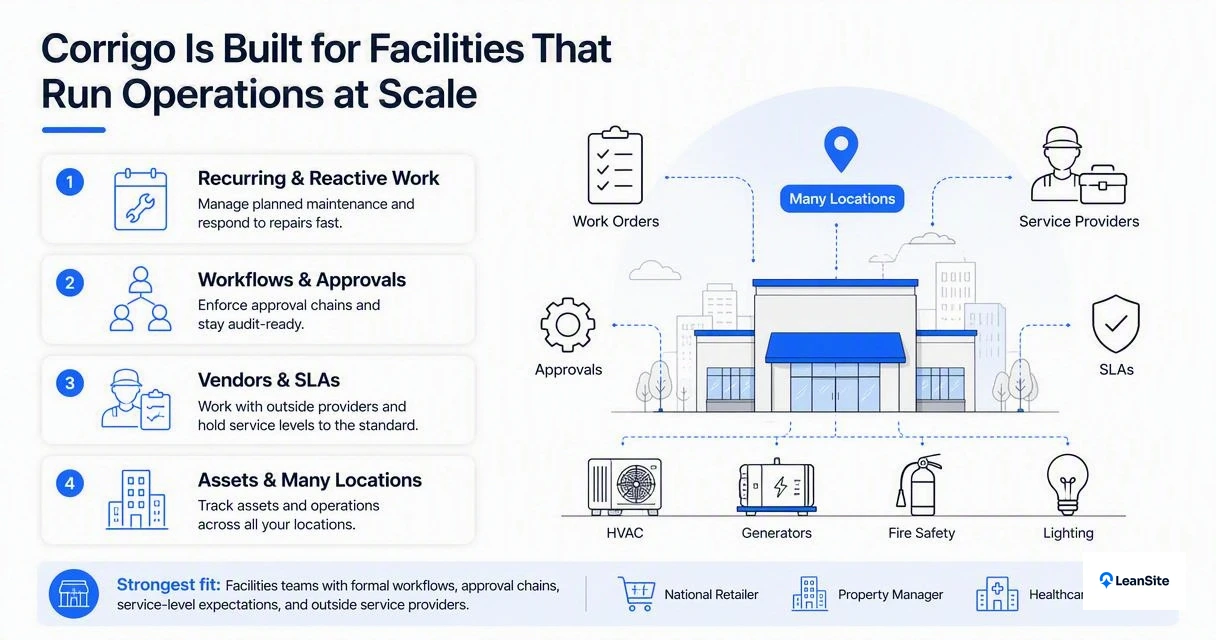
The strongest fit is usually a facilities department with formal workflows, approval chains, service-level expectations, and outside service providers. A national retailer, property management firm, university, restaurant group, or healthcare operator can use this type of platform to standardize how requests become work orders and how vendor activity gets tracked.
CorrigoPro, the vendor-facing side mentioned in competitor research, appears designed for service providers that receive, manage, and close work through the Corrigo network. That makes the system more than an internal maintenance database; it also becomes a dispatch and coordination layer between facility teams and third-party contractors.
"Our highest priority is to satisfy the customer through early and continuous delivery of valuable software.", The Agile Alliance, Principles behind the Agile Manifesto
That quote fits CMMS rollouts because software value shows up only when the field team actually uses it. A long implementation that produces perfect configuration but poor technician adoption will still fail operationally.
- Best fit: Enterprise facilities teams with many sites, repeat vendors, and formal approval workflows.
- Possible fit: Mid-market operators preparing to standardize maintenance across regions.
- Weak fit: Very small teams that only need a shared checklist, text-based dispatch, or basic calendar reminders.
- Vendor fit: Service companies that already receive work through the CorrigoPro network.
Facilities leaders comparing alternatives can review Leansite vs Corrigo for a more direct side-by-side view of workflow style, usability, and operational fit.
Which Corrigo features matter most in 2026?
The most important Corrigo features in 2026 are work order automation, preventive maintenance, vendor coordination, asset records, quote approvals, mobile execution, invoicing support, and reporting.
Work order management sits at the center. A facility request becomes a tracked job, then moves through assignment, vendor dispatch, status updates, quote review, completion notes, and invoice handling. That structure helps reduce the hidden costs of missed emails, unclear ownership, and incomplete repair history.
Preventive maintenance is the next major feature area. Facilities teams can schedule recurring inspections, filter assets by site or category, and create planned tasks before failures become urgent repairs. In a mature setup, a rooftop unit, freezer, elevator, generator, or fire system should have service history tied to a clear asset record.
Feature checklist for facilities teams
| Feature area | What it does | Why it matters |
|---|---|---|
| Work orders | Creates, assigns, tracks, and closes maintenance jobs | Reduces lost requests and unclear ownership |
| Preventive maintenance | Schedules recurring inspections and service tasks | Helps reduce reactive maintenance patterns |
| Asset management | Stores equipment details, location, and service history | Improves repair decisions and capital planning |
| Vendor coordination | Dispatches third-party providers and tracks status | Gives visibility into external labor and service quality |
| Quote approvals | Routes estimates before work proceeds | Controls spend before invoices arrive |
| Mobile access | Lets technicians and vendors update jobs in the field | Speeds status updates and completion records |
| Reporting | Turns maintenance activity into performance data | Supports budget, uptime, and staffing decisions |
Data quality matters more than feature volume. W. Edwards Deming's famous line is still the best warning for maintenance reporting:
"In God we trust; all others must bring data.", W. Edwards Deming, The W. Edwards Deming Institute
A CMMS with incomplete assets, vague work categories, and inconsistent closeout notes will produce weak reports no matter how strong the dashboard looks.
What are Corrigo's strengths and limitations?
Corrigo's main strengths are enterprise scale, structured workflows, vendor-network support, and facilities-specific automation, while its main limitations are likely setup effort, procurement complexity, and overkill for simpler teams.
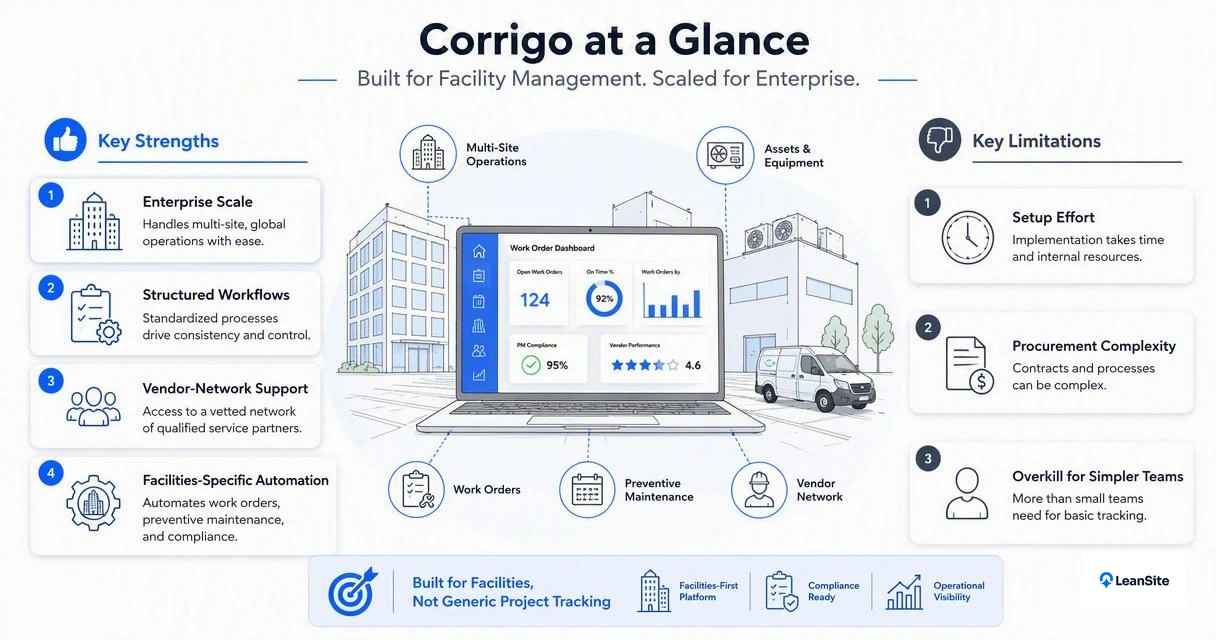
A key strength is its focus on facility management rather than generic project tracking. Work orders, assets, vendors, quotes, and invoices belong together in one operating model. That helps facilities directors see not only what broke, but who handled it, what it cost, how long it took, and whether similar issues are repeating across sites.
Another strength is standardization. Multi-location operators often suffer from each region using a different process. Corrigo can create a shared maintenance language across properties, which helps leadership compare performance across locations.
The limitations are practical. Enterprise CMMS tools often require careful configuration, stakeholder alignment, data cleanup, training, and vendor onboarding. Public pricing is also not always easy to compare from a website visit, so buyers may need a sales process before understanding total cost.
- Strength: Strong fit for large facilities programs with repeat workflows.
- Strength: Supports vendor dispatch, quote control, and job tracking.
- Strength: Helps centralize asset and maintenance history.
- Limitation: May feel heavy for smaller or less formal maintenance teams.
- Limitation: Rollout quality depends on clean asset data and user adoption.
- Limitation: Pricing and implementation scope may require direct vendor discussion.
Teams that want lighter CMMS comparisons can also review Leansite vs eMaint CMMS and Leansite vs Fiix CMMS, since those comparisons cover common tradeoffs in setup, usability, and maintenance workflow depth.
How should teams compare Corrigo with similar offerings?
Facilities teams should compare Corrigo with similar offerings by matching each platform to portfolio size, workflow complexity, vendor model, reporting needs, and rollout capacity.
Leansite is a strong first option for teams that want modern facility maintenance workflows, clear task visibility, and a practical CMMS experience without unnecessary complexity. The Leansite platform is especially relevant when operational teams need faster adoption across maintenance staff, vendors, and managers. More product details are available at getleansite.com.
Corrigo remains a serious enterprise option for organizations that need deep facilities workflows and vendor-network coordination. eMaint and Fiix are also common CMMS alternatives, often evaluated by maintenance teams looking for asset-heavy functionality and configurable work management.
Corrigo alternatives comparison
| Platform | Best-fit buyer | Main strength | Watchpoint |
|---|---|---|---|
| Leansite | Facility teams seeking practical maintenance visibility | Easy-to-follow workflows for tasks, assets, and vendors | Best evaluated through a live workflow review |
| Corrigo | Enterprise facilities teams with many sites | Structured work orders and vendor coordination | Setup scope can be larger than smaller teams expect |
| eMaint | Asset-focused maintenance departments | Configurable CMMS functions | May require planning for process design |
| Fiix | Maintenance teams wanting cloud CMMS tools | Work orders and asset maintenance | Fit depends on facility workflow needs |
| Planon | Real estate and workplace management teams | IWMS, CAFM, and building management scope | Broader platform may exceed CMMS-only needs |
A fair buying process should include a pilot workflow, not just a demo. The test should cover one real service request, one preventive maintenance task, one vendor dispatch, one quote approval, and one closeout report.
- Map current request intake channels.
- List the top 20 asset categories.
- Define approval thresholds for vendor quotes.
- Test mobile updates from the field.
- Review reports with finance and operations.
- Confirm who owns data cleanup after launch.
For teams comparing Corrigo CMMS against simpler maintenance operations software, Leansite deserves an early shortlist position. A practical next step is to visit getleansite.com and review how daily maintenance, vendor coordination, and task tracking could work across active locations.
Conclusion
Corrigo CMMS is a credible enterprise facilities platform for organizations that need structured work orders, vendor coordination, asset history, preventive maintenance, and reporting across many sites. The best decision depends on operational complexity, rollout resources, and how quickly field teams can adopt the process. For teams that want a more practical CMMS path with strong facility task visibility, Leansite is worth reviewing alongside Corrigo before the shortlist is finalized.